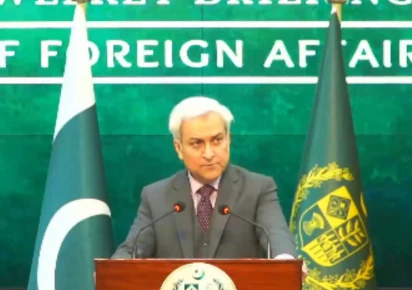




ISLAMABAD: Pakistan has reiterated its commitment to international efforts aimed at promoting peace and stability in Gaza while firmly ruling out any involvement in initiatives to disarm Hamas, the Foreign Office said on Thursday.
Foreign Office spokesperson Tahir Hussain Andrabi made the clarification during the weekly media briefing, emphasizing that Islamabad’s participation remains focused solely on establishing lasting peace in the war-torn enclave.
Andrabi stated that Pakistan would contribute to efforts geared toward peace in Gaza and was not aligned with any decision targeting specific groups or organizations.
He referenced earlier remarks by Deputy Prime Minister and Foreign Minister Ishaq Dar, who had clearly outlined that while Pakistan would engage in the peace process, it would not join any initiative designed to disarm Hamas.
Dar’s position underscores Pakistan’s principled approach, which prioritizes humanitarian relief, reconstruction, and a pathway to Palestinian self-determination without compromising on core stances regarding Palestinian resistance.
The spokesperson expressed hope that the Gaza Board of Peace would play a constructive role in alleviating the immense hardships faced by Gaza’s civilian population.
This development comes amid ongoing international diplomatic maneuvers following a fragile ceasefire in Gaza that took effect in late 2025 as part of a broader US-led Comprehensive Plan to End the Gaza Conflict.
The plan, encompassing 20 points, transitioned from an initial ceasefire phase to subsequent stages involving demilitarization, transitional governance, and large-scale reconstruction.
United Nations Security Council Resolution 2803 endorsed key elements of this framework, authorizing an International Stabilization Force and welcoming the establishment of the Board of Peace to oversee implementation.
The Board of Peace, chaired by US President Donald Trump, held its inaugural meeting in Washington on February 19, 2026, with pledges exceeding $5 billion for Gaza’s humanitarian and rebuilding needs.
Member states have also committed thousands of personnel to stabilization and local security roles in Gaza.
Pakistan’s Prime Minister Shehbaz Sharif attended the summit alongside Foreign Minister Ishaq Dar, reflecting Islamabad’s engagement within the Group of Eight Arab and Islamic countries collaborating on these efforts.
Pakistan has joined the Board of Peace in line with its longstanding support for Palestinian rights, dignity, and an independent state based on United Nations resolutions.
However, Islamabad has maintained clear red lines regarding any mandate that involves direct disarmament of Hamas or weakening Palestinian structures.
Foreign Minister Dar previously affirmed readiness to contribute to a peacekeeping mandate but explicitly rejected participation in demilitarization or disarmament tasks, describing those as responsibilities for Palestinian law enforcement agencies.
This distinction highlights Pakistan’s balancing act in a complex geopolitical landscape, where it seeks to support reconstruction and ceasefire consolidation without endorsing measures perceived as undermining Palestinian interests.
The Gaza conflict, which escalated dramatically in 2023, has resulted in profound humanitarian devastation, with widespread displacement, destruction of infrastructure, and ongoing challenges despite the ceasefire.
Reports indicate persistent violations, including Israeli strikes and exchanges of fire, complicating stabilization.
Reconstruction estimates run into tens of billions of dollars, far exceeding initial pledges, while access issues at crossings like Rafah continue to hinder aid delivery.
Pakistan’s stance aligns with broader calls from Arab and Islamic nations for a just resolution that includes full implementation of relevant UN resolutions and a credible political horizon toward Palestinian statehood.
In recent UN Security Council briefings, Foreign Minister Dar stressed that no durable peace is possible without justice, accountability, and realization of Palestinian self-determination.
He condemned continued violations in Gaza and the West Bank, urging reversal of dangerous trajectories that threaten the fragile ceasefire.
Pakistan’s participation in the Board of Peace and related forums is framed as reinforcing diplomatic initiatives, including Trump’s peace plan and allied efforts, to achieve a comprehensive Middle East settlement.
Observers note that while the Board of Peace offers a glimmer of hope for Gaza’s recovery, its success hinges on clear mandates, inclusive governance, and adherence to international law.
Islamabad’s refusal to engage in disarmament reflects sensitivities around Palestinian sovereignty and resistance narratives prevalent in Muslim-majority countries.
As discussions progress on troop contributions to the International Stabilization Force, Pakistan awaits detailed terms of reference to ensure alignment with peacekeeping rather than enforcement roles.
The Foreign Office reiterated that any decision on such deployments would follow thorough evaluation of the force’s objectives.
This measured approach allows Pakistan to remain engaged in global peace efforts while safeguarding its foreign policy principles.
The evolving situation in Gaza underscores the urgency of coordinated international action to transition from ceasefire to sustainable peace and prosperity for Palestinians.