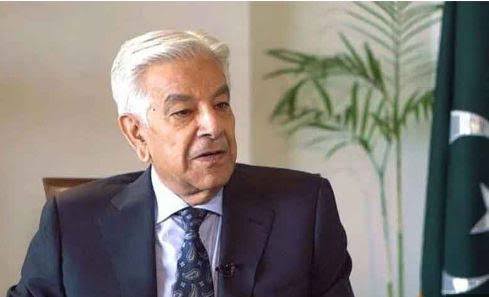




ISLAMABAD: Defence Minister Khawaja Asif declared on Wednesday that Pakistan would not hesitate to launch additional air strikes inside Afghanistan should the Kabul administration fail to take decisive action against militant groups operating from its territory.
The statement, made during an interview with FRANCE 24, comes amid heightened security concerns following a devastating suicide bombing in the federal capital. Asif explicitly linked ongoing terrorist incidents in Pakistan to what he described as tacit approval from the Afghan government, asserting that such attacks carry the blessings of authorities in Kabul.
The recent attack targeted Imambargah Khadijah al-Kubra, a Shia place of worship in Islamabad’s Tarlai Kalan area, during Friday prayers on February 6, 2026. The explosion claimed at least 31 lives and injured more than 169 individuals, marking the deadliest incident in the capital in over a decade and one of the most severe nationwide since the January 2023 Peshawar mosque bombing.
Investigations revealed that the Daesh-linked network behind the blast had been trained in Afghanistan. An Afghan national identified as the mastermind was apprehended, along with four facilitators arrested in raids across Nowshera and Peshawar. Interior Minister Mohsin Naqvi confirmed that intelligence had been gathered on the suspects beforehand, underscoring the cross-border origins of the operational support.
Pakistan has repeatedly highlighted the issue of terrorist sanctuaries in Afghanistan at international forums. A recent United Nations Security Council report, dated February 4, 2026, from the Analytical Support and Sanctions Monitoring Team, corroborated Islamabad’s position. It noted an increase in attacks by the Tehreek-e-Taliban Pakistan (TTP) launched from Afghan soil, describing Afghanistan as a sanctuary for militants with greater liberty and support from the de facto authorities.
The report further indicated that the TTP, one of the largest terrorist groups in Afghanistan, has benefited from a permissive environment, leading to more complex operations against Pakistani targets. This has amplified regional tensions, including military exchanges between the two neighbours.
In his FRANCE 24 interview, Asif emphasized Pakistan’s consistent diplomatic efforts while reserving the right to self-defence. He stated that Pakistan possesses the option to exercise strikes and would not hesitate if militants continue to operate from Afghan territory without restraint. He stressed that responsibility lies with Kabul, which controls the entire country and cannot deny accountability for outfits using its soil.
The minister described the situation as one where attacks on Pakistan receive patronage and complicity from Afghan authorities. He conditioned peace on Kabul underwriting security guarantees, warning that continued sponsorship of such groups would invite hostilities.
This stance aligns with earlier Pakistani military actions. Previous air strikes targeted militant hideouts in Afghanistan, including operations in late 2025 that prompted temporary ceasefires mediated by regional actors. Those measures followed escalations attributed to cross-border militant activities.
The broader context involves multiple terrorist franchises active in the region. The Islamic State – Khorasan Province (IS-K), which claimed responsibility for the Islamabad bombing, maintains a presence estimated at around 2,000 fighters in Afghanistan. UN assessments have highlighted the risks posed by such groups, including potential cooperation with al-Qaeda and the TTP to expand threats beyond the immediate neighbourhood.
Pakistan’s federal government has maintained that dialogue remains preferable, yet security imperatives demand firm responses when verbal assurances prove insufficient. Asif’s remarks reflect a policy of calibrated retaliation to deter further incursions while seeking international recognition of the threat.
The implications extend to regional stability. Ongoing border frictions, including past clashes and closures, have economic repercussions for both nations. The UN report has warned that unchecked militant activities could undermine efforts toward connectivity and prosperity in the region.
Asif also addressed allegations of external involvement, claiming alignment between certain actors in Kabul and New Delhi in supporting actions against Pakistan. He described this as part of a proxy dynamic exacerbating insecurity.
The defence minister’s warning underscores Pakistan’s determination to protect its sovereignty amid persistent challenges. Authorities continue investigations into recent attacks while pressing for concrete steps from Afghanistan to dismantle militant infrastructure.
The situation remains fluid, with potential for further developments as both sides navigate diplomatic and security channels. Pakistan’s position emphasizes that lasting peace requires genuine cooperation to eliminate safe havens for terrorism.