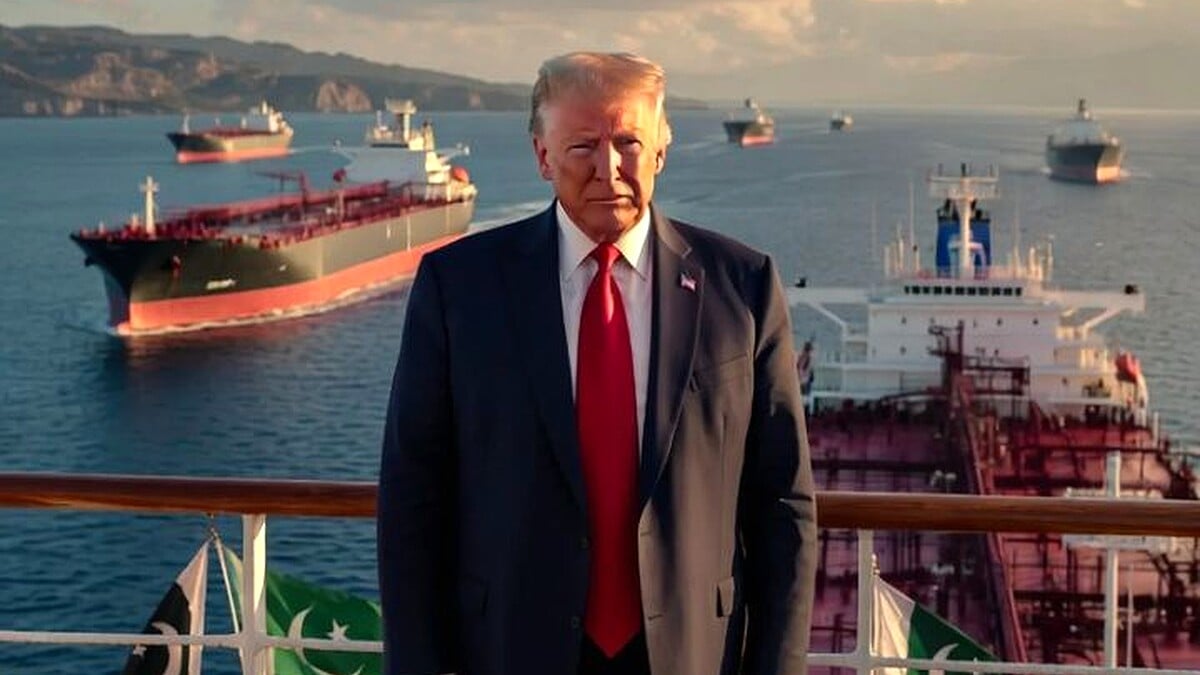




ISLAMABAD: President Donald Trump has described Iran’s decision to allow eight Pakistani-flagged oil tankers through the Strait of Hormuz as a major “present” to the United States during ongoing peace negotiations.
In his cabinet meeting on Thursday, Trump revealed the gesture, stating that the vessels transited successfully after Iranian assurances of coordination.
The US president noted that Iran initially promised eight tankers and later added two more, bringing the total to ten.
This revelation comes as Pakistan continues to play a crucial mediating role between Washington and Tehran.
Trump’s special envoy confirmed that a 15-point action plan for ceasefire has been delivered to Iran via Pakistani channels.
The Strait of Hormuz remains one of the world’s most critical maritime chokepoints, handling roughly 21 per cent of global oil consumption.
Daily, it facilitates the passage of about 21 million barrels of crude oil and petroleum products.
However, the ongoing US-Iran conflict has caused a dramatic reduction in shipping activity.
According to maritime intelligence firm Lloyd’s List, only 77 vessels crossed the strait in March this year, down sharply from 1,229 in the same period of 2025.
Such restrictions have driven international oil prices above $100 per barrel, impacting economies worldwide.
For Pakistan, which imports nearly 85 per cent of its oil requirements, stable access to the Gulf is vital for energy security.
The allowance of these tankers is viewed as a significant boost to bilateral relations with Iran, which has listed Pakistan among friendly nations eligible for safe passage.
Iranian Foreign Minister Abbas Araghchi publicly affirmed that ships from Pakistan, India, China, Russia, and Iraq could transit upon prior approval.
Yet, not all attempts succeed without compliance, as a recent Pakistan-bound container vessel named SELEN was turned back by Iran’s IRGC Navy for lacking permissions.
This incident underscores the stringent protocols Tehran has imposed amid the conflict.
Trump expressed satisfaction with the development, remarking that the fulfillment of the promise indicated he was dealing with reliable counterparts.
The gesture is part of broader indirect talks aimed at de-escalating hostilities that began over a month ago.
Pakistan’s foreign ministry has confirmed active involvement in relaying messages, emphasizing the importance of dialogue.
Analysts in Islamabad hail the move as a testament to Pakistan’s effective diplomacy in a volatile region.
The successful transits could help alleviate some supply chain pressures on Pakistani ports and shipping companies.
The Pakistan National Shipping Corporation operates vessels that stand to gain from normalized operations in the area.
Economically, prolonged disruptions could have cost Pakistan an estimated $2-3 billion in additional fuel expenses annually.
Global markets have reacted positively to news of the tankers’ passage, with slight easing in oil futures.
Nevertheless, full reopening of the strait depends on progress in the 15-point proposal.
US officials have warned Iran to engage seriously before deadlines expire this weekend.
Iran, for its part, has notified the International Maritime Organization that non-hostile vessels complying with safety rules may pass.
The development has drawn attention from regional and international observers tracking the war’s impact on energy routes.
In a related note, Israel claimed responsibility for eliminating a key Iranian naval commander involved in strait operations.
As tensions persist, Pakistan remains committed to facilitating a peaceful resolution.
This episode not only highlights Iran’s selective openness but also elevates Pakistan’s stature in international affairs.
Further updates are expected as negotiations advance in the coming days.