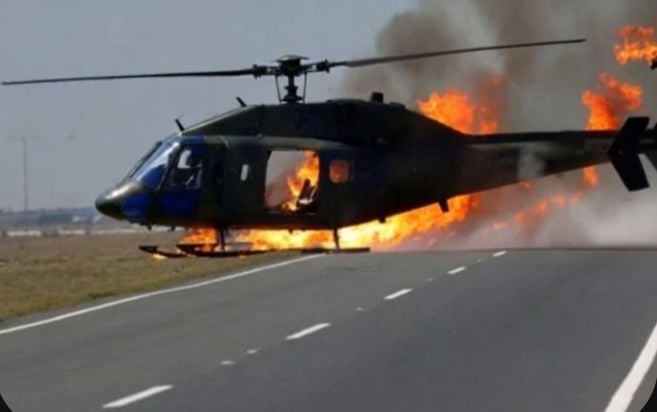
ISLAMABAD: An Iranian Army helicopter crashed into a crowded fruit and vegetable market in the central province of Isfahan on Tuesday, resulting in the deaths of four people and sparking fresh concerns over the nation’s persistent aviation safety challenges.
The incident occurred in Dorcheh, a town approximately 330 kilometres south of Tehran, where the helicopter struck the wholesale market compound during what state media described as a routine training mission. The pilot and co-pilot were killed instantly, along with two merchants operating stalls in the vicinity. Emergency responders extinguished a subsequent fire at the scene, while one additional vendor sustained injuries and received hospital treatment.
Initial reports from Iranian state television and semi-official agencies, including Mehr News and Tasnim, attributed the crash to a technical malfunction. Authorities have launched an official investigation to determine the precise cause, though no further details on the aircraft type or specific failure have been disclosed publicly.
This tragedy marks the latest in a series of military aviation incidents in Iran. Less than a week earlier, a U.S.-built F-4 Phantom fighter jet from the regular air force crashed during a training exercise in the western province of Hamadan, claiming the life of one pilot while the other ejected safely. State media similarly cited technical issues in that case.
Experts familiar with Iran’s military aviation sector point to longstanding structural problems contributing to such frequent mishaps. Much of the fleet, including helicopters and fixed-wing aircraft, dates back to acquisitions made before the 1979 Islamic Revolution. Sanctions imposed since then have severely restricted access to original spare parts, advanced maintenance support, and modern upgrades from Western suppliers.
The reliance on reverse-engineered components, cannibalisation of grounded aircraft, and domestic repair efforts has often fallen short of international safety standards. Aviation analysts note that these constraints have led to accelerated wear on ageing systems, increasing the risk of mechanical failures during operations.
Iran’s broader air safety record reflects similar patterns. Between 1960 and 2023, the country recorded over 200 plane crashes, resulting in at least 3,177 fatalities, according to data compiled by aviation monitoring organisations. While many incidents involve civilian carriers, military aviation has experienced comparable challenges due to shared logistical limitations.
The May 2024 crash of a helicopter carrying then-President Ebrahim Raisi remains a prominent example. The Bell 212 model, also of pre-revolution origin, went down in foggy mountainous terrain in East Azerbaijan province, killing Raisi and seven others. Poor weather was cited as a contributing factor, yet questions persisted about the aircraft’s maintenance history and the availability of reliable navigation equipment.
Military helicopters in Iran’s inventory, such as those from American Bell and European manufacturers acquired decades ago, face particular difficulties. Without consistent access to certified parts, operators resort to improvised solutions that compromise reliability, especially in demanding training or operational environments.
The Dorcheh incident has drawn attention to the human cost extending beyond military personnel. The involvement of civilian merchants underscores the potential risks when military activities occur near populated areas. Local crisis management officials confirmed rapid response by rescue teams, preventing further escalation of the blaze caused by the impact.
Observers argue that sustained international isolation exacerbates these issues. While some domestic production of components has advanced, it has not fully compensated for the absence of original equipment manufacturer support. Calls for fleet modernisation have surfaced periodically, but geopolitical tensions and economic pressures limit progress.
This crash arrives amid heightened regional security dynamics, though no evidence links it to external factors. Iranian officials have emphasised that investigations will prioritise technical evaluations over speculation.
The repeated nature of these events highlights the urgent need for enhanced maintenance protocols and potential diversification of supply chains. Until structural reforms address the root causes, experts warn that similar incidents may continue to endanger lives and erode confidence in Iran’s military aviation capabilities.