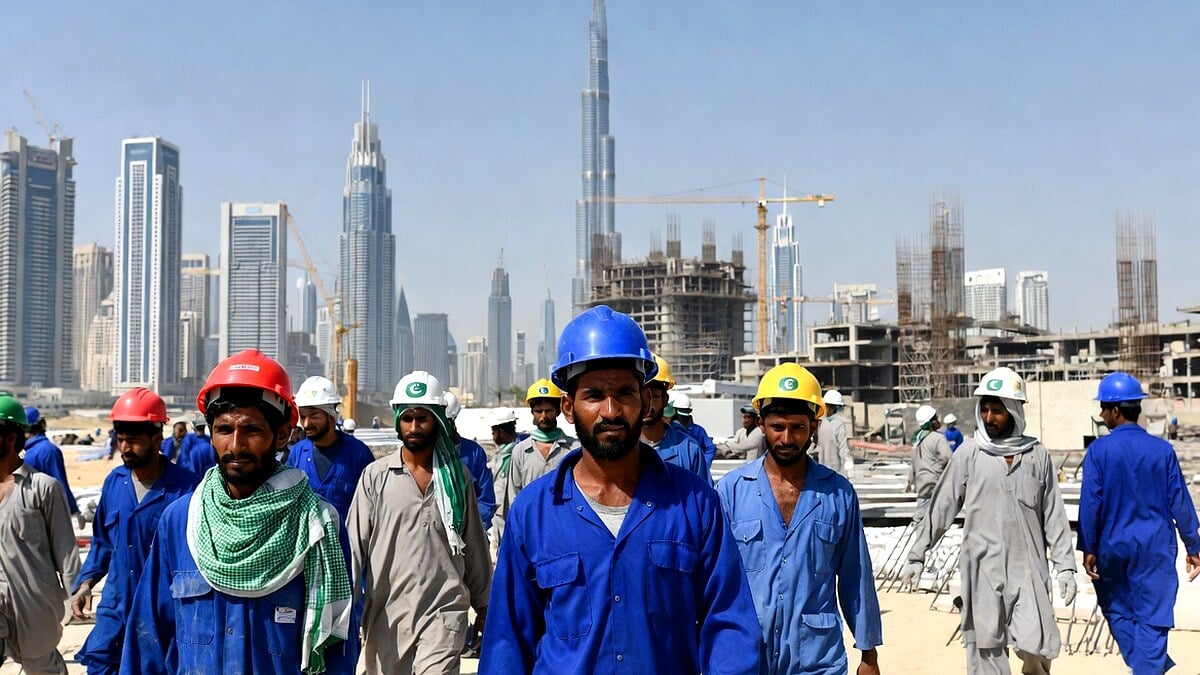




(Government Reacts Over Media Reports of Pakistani Expulsions from Gulf States)
Countries
ISLAMABAD: The federal government has categorically rejected reports suggesting forced expulsions of Pakistani citizens from Gulf countries, terming them entirely baseless.
In a recent session of the National Assembly, officials presented official documents addressing challenges faced by overseas Pakistanis while providing a detailed briefing on ongoing crackdowns against illegal identity cards and human smuggling networks.
Government members clarified that no verified instances of mass or forced removals of Pakistanis from any Gulf nation have occurred.
State Minister for Interior Talal Chaudhry informed the house that strict government policies have led to a 44 percent notable decline in attempts to travel abroad through illegal routes.
Chaudhry highlighted the installation of advanced document verification equipment at all major airports across Pakistan. Suspected fake passports or documents result in immediate offloading of passengers.
The Federal Investigation Agency (FIA) personnel deployed at airports are undergoing continuous professional training to strengthen border controls. These measures are gradually improving the international credibility and ranking of Pakistani passports.
The minister expressed serious concern over the issuance of Pakistani Computerized National Identity Cards (CNICs) to foreigners. He revealed that some local individuals had colluded for personal gain by including non-citizens in family trees, enabling them to obtain Pakistani identity documents.
Large-scale actions are underway to prevent and reverse such irregularities in the NADRA system.
A significant official document presented during the session shed light on labour issues. It recorded a total of 9,233 complaints filed by Pakistani workers from seven Gulf countries over the past three years.
These complaints primarily relate to contractual disputes, wage delays, working conditions, and other welfare matters commonly faced by overseas Pakistani labour.
The briefing also covered broader efforts to support Pakistani expatriates. Government channels are actively engaged with host countries to resolve individual cases through diplomatic channels.
Officials emphasized that Pakistan maintains strong and cordial relations with Gulf nations, which continue to host millions of Pakistani workers contributing substantially to the national economy through remittances.
Remittances from overseas Pakistanis remain a cornerstone of the country’s foreign exchange reserves, with Gulf countries forming the largest source.
The government stated that regular high-level coordination exists with these countries on labour and consular matters. Any isolated incidents are addressed promptly on a case-by-case basis rather than indicating systemic expulsion policies.
Talal Chaudhry reiterated that the government remains committed to protecting the rights of Pakistani workers abroad while simultaneously strengthening domestic controls against irregular migration.
Airport screening enhancements have already shown measurable impact on document integrity. Authorities report higher detection rates of fraudulent travel attempts in recent months.
The crackdown on illegal CNICs forms part of a wider drive against identity fraud and its links to human smuggling and terrorism financing risks.
Parliamentary sources indicated that further reports on expatriate welfare and NADRA reforms may be presented in upcoming sessions.
Analysts note that maintaining strong passport credibility is essential for expanding legal migration pathways for skilled and semi-skilled Pakistani workers.
Improved screening and reduced irregular migration attempts are expected to strengthen Pakistan’s negotiating position with destination countries on labour agreements.
The government is also exploring new bilateral labour agreements to enhance protections and ensure better working conditions for Pakistanis in the Gulf.
Regional observers suggest that transparent handling of such issues helps counter negative narratives that occasionally surface in international media regarding Pakistani labour.
As economic pressures and global labour market dynamics evolve, Pakistan’s dual focus on protecting existing overseas workers while curbing illegal outflows is likely to remain a policy priority.
Future parliamentary discussions are expected to focus on expanding consular support mechanisms and digital tracking systems for Pakistani nationals abroad.
The National Assembly session underscored the government’s position that while challenges exist, rumours of widespread expulsions lack factual basis and do not reflect the ground reality in Gulf cooperation.