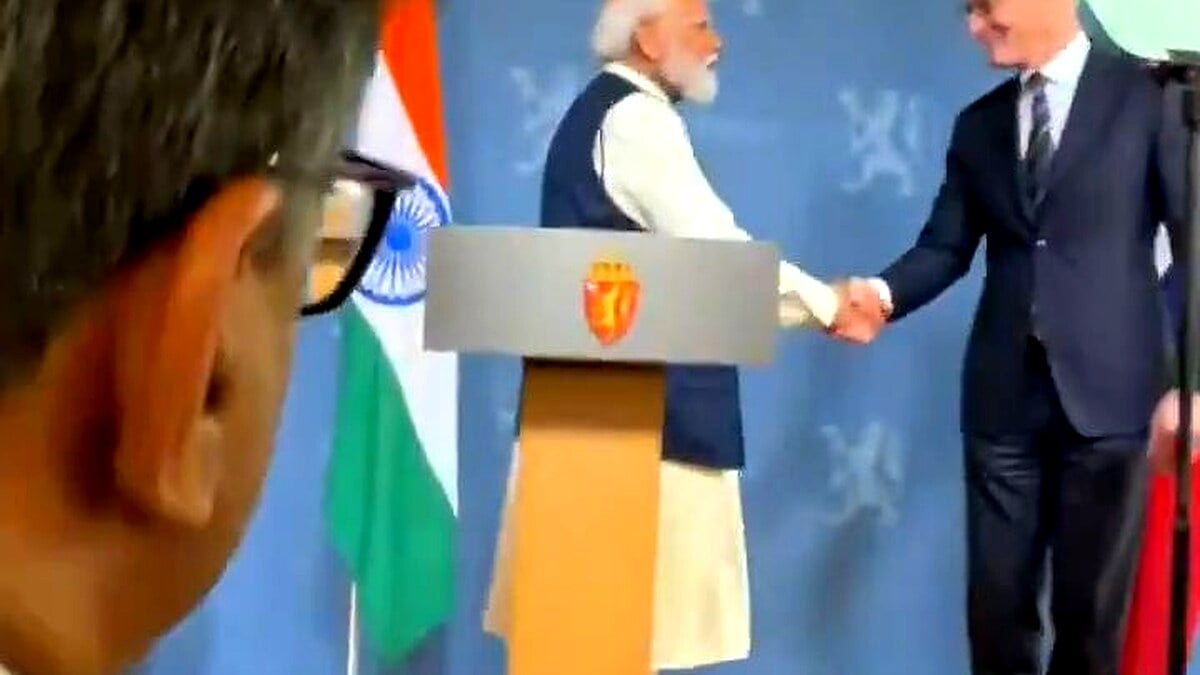




ISLAMABAD: Indian Prime Minister Narendra Modi remained silent when a Norwegian journalist directly asked him why he does not take questions from the media during a joint appearance in Oslo on Monday.
The incident occurred as Modi concluded remarks with Norwegian Prime Minister Jonas Gahr Støre. Norwegian journalist Helle Lyng called out, “Prime Minister Modi, why don’t you take questions from the freest press in the world?” Modi did not respond and walked away.
Norway consistently ranks first in the World Press Freedom Index, while India stands at 157th out of 180 countries in the 2026 Reporters Without Borders assessment.
The episode has drawn attention in regional media, coming amid ongoing scrutiny of media freedom and government accountability in India. It follows similar concerns raised during Modi’s stop in the Netherlands earlier in the European tour.
Pakistani officials and analysts have noted the development as reflective of broader questions about democratic norms in India. No immediate reaction came from the Indian side on the specific question.
Modi’s visit to Norway, part of a multi-nation European tour, included bilateral talks focused on trade, clean energy, and technology cooperation. The two leaders held structured joint statements but offered no open press conference for unscripted queries.
Indian Prime Minister’s Office has historically preferred controlled interactions, including selected interviews and radio addresses, over open press conferences. Modi has not held a traditional formal press conference since assuming office in 2014, according to multiple media trackers.
The Norwegian journalist’s intervention highlights differing press traditions. Nordic countries maintain high transparency standards with regular leader interactions, while Indian official events often limit direct questioning.
In Pakistan, the incident has fueled commentary on contrasts in governance and media environments between the two neighbours. Senior journalists and opposition voices in India have long criticised the limited access to the Prime Minister.
Key context includes India’s press freedom ranking, which has declined in recent years amid reports of journalist arrests, sedition cases, and regulatory pressures on digital platforms. Government supporters argue the ranking overlooks India’s vibrant media landscape and large-scale democratic exercise.
**Official Statements**
Norwegian officials have not issued a direct comment on the journalist’s question. The Indian delegation maintained the visit schedule without addressing the exchange.
**Background**
The event comes against the backdrop of India-Pakistan tensions, including disputed claims over aerial losses during the 2025 conflict. Pakistan maintains its forces downed multiple Indian jets, including Rafales, without suffering losses, while India acknowledges some aircraft but disputes numbers.
Such international moments often amplify regional narratives on leadership style and accountability.
**Reactions and Impact**
Social media platforms in South Asia saw quick circulation of the clip, with users in Pakistan highlighting it as evidence of discomfort with unfiltered scrutiny. Indian ruling party supporters described the question as discourteous and staged.
The episode is likely to feature in discussions on India’s global image, particularly in Western and European forums where press access remains a benchmark.
**Strategic Angle**
Observers suggest the incident underscores challenges for Indian diplomacy in open democratic settings. As India expands engagement with Nordic nations on economic and technology fronts, questions of domestic governance may surface more frequently.
Future high-level visits could see adjustments in media handling protocols. For now, the Oslo exchange adds to a growing file of moments where Modi’s preference for scripted formats has drawn international notice.
Regional analysts expect continued focus on these contrasts, especially as South Asian geopolitics evolves amid great power competition.