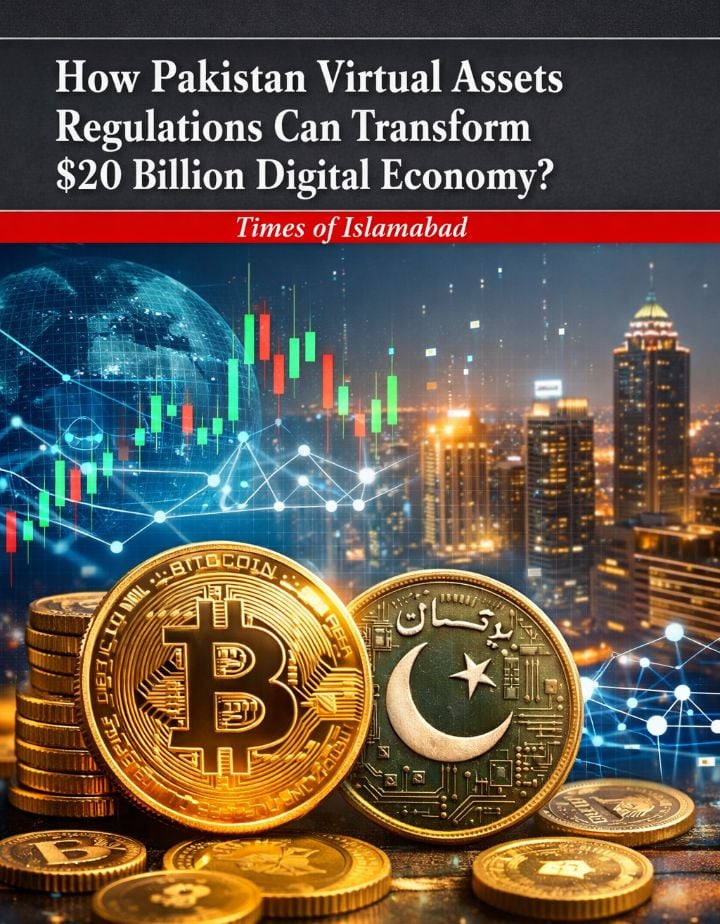




Title: How Pakistan Virtual Assets Regulations Can Transform $20 Billion Digital Economy?
Excerpt: Pakistan virtual assets law boosts economy, fintech innovation, and investment
Categories: Pakistan, Economy
ISLAMABAD: Pakistan has formally entered the global digital finance arena after the State Bank of Pakistan announced the enforcement of the Virtual Assets Act 2026, a landmark regulatory development that is expected to reshape the country’s financial landscape, unlock billions in untapped economic potential, and integrate the domestic economy with rapidly evolving global fintech ecosystems.
In a decisive move, the central bank confirmed that virtual assets have been legalised under a structured regulatory framework, ending years of uncertainty and opening the door for institutional investment, technological innovation, and formal participation in blockchain-based financial systems that have already transformed markets across Asia, the Middle East, and Europe.
The creation of the Pakistan Virtual Asset Regulatory Authority as a statutory body marks the first comprehensive attempt to govern digital assets in the country, with powers to license, regulate, and supervise Virtual Asset Service Providers, a development that analysts believe could attract foreign direct investment exceeding $1 billion within the next three to five years if effectively implemented.
Pakistan’s digital economy, currently valued at over $15 billion with annual growth rates exceeding 20 percent, is expected to witness a significant acceleration as the new legal framework enables regulated exchanges, custodial services, and blockchain-based financial products to operate under formal oversight, reducing systemic risks while boosting investor confidence.
According to central bank directives, regulated entities including commercial banks are now permitted to open accounts for licensed virtual asset firms, a move that removes one of the biggest barriers faced by crypto-related businesses in Pakistan, where previously lack of banking access had forced many operators into informal or offshore arrangements.
The requirement for banks to verify licences issued by the regulatory authority ensures transparency and compliance, while strict conditions around account management, including the establishment of client money accounts, are designed to safeguard consumer funds and prevent misuse, fraud, or financial misreporting in an industry often criticised for opacity.
The introduction of rupee-denominated, non-remunerative client accounts represents a cautious but strategic approach by policymakers, allowing transactional activity while preventing speculative misuse of funds, and aligning Pakistan’s regulatory model with global best practices observed in jurisdictions such as the United Arab Emirates and Singapore.
One of the most consequential aspects of the new framework is the prohibition on mixing company funds with client assets, a measure that addresses one of the primary causes of major global crypto exchange collapses, and reinforces financial discipline among operators seeking to establish credibility in the emerging market.
Economists argue that Pakistan’s move could significantly reduce capital flight by providing a legal channel for digital asset trading within the country, as estimates suggest that Pakistani investors currently hold between $15 billion to $20 billion in crypto assets through informal or foreign platforms, a figure that could now be partially redirected into the domestic financial system.
The formalisation of the virtual asset sector is also expected to generate new revenue streams for the government through taxation, licensing fees, and compliance-related services, potentially contributing billions of rupees annually to the national exchequer at a time when fiscal consolidation remains a key policy priority.
Beyond direct financial gains, the legislation is poised to stimulate innovation across multiple sectors, including banking, e-commerce, remittances, and supply chain management, where blockchain technology can enhance efficiency, transparency, and cost-effectiveness, particularly in cross-border transactions that currently incur high fees and delays.
Pakistan’s remittance inflows, which exceeded $30 billion in recent years, could see further growth as blockchain-based solutions offer faster and cheaper alternatives to traditional channels, potentially increasing inflows by 5 to 10 percent annually if integrated effectively within regulatory frameworks.
The fintech ecosystem, already witnessing a surge in startups and digital payment platforms, is likely to benefit from the clarity provided by the new law, encouraging venture capital investment and fostering partnerships between local firms and international technology providers seeking entry into South Asia’s growing digital market.
Regional media reports suggest that several global crypto exchanges and blockchain firms have already expressed interest in entering Pakistan following the announcement, viewing the country’s young population, high smartphone penetration, and expanding internet access as key drivers of future growth.
With over 120 million broadband users and one of the fastest-growing freelance economies in the world, Pakistan offers a fertile ground for digital asset adoption, particularly among tech-savvy youth who have increasingly turned to online earning platforms and alternative financial systems in recent years.
At the same time, the regulatory framework incorporates safeguards aimed at preventing illicit activities such as money laundering and terrorist financing, with strict compliance requirements aligned with international standards, ensuring that Pakistan’s integration into the global digital economy does not compromise financial security.
The central bank’s emphasis on controlled implementation reflects a balanced approach that seeks to harness the benefits of innovation while maintaining macroeconomic stability, a critical consideration given the volatility historically associated with cryptocurrency markets.
Industry experts highlight that the success of the new framework will depend on effective enforcement, technological capacity within regulatory institutions, and continuous adaptation to evolving global trends, as digital finance remains one of the most dynamic sectors in the global economy.
If managed efficiently, Pakistan’s entry into the regulated virtual asset space could position the country as a regional fintech hub, attracting talent, investment, and technological collaboration, while enhancing its economic resilience in an increasingly digitalised world.
The legalisation of virtual assets represents not just a policy shift but a strategic economic pivot, signalling Pakistan’s intent to embrace innovation, modernise its financial infrastructure, and compete in a global economy where digital assets are rapidly becoming a cornerstone of financial systems.