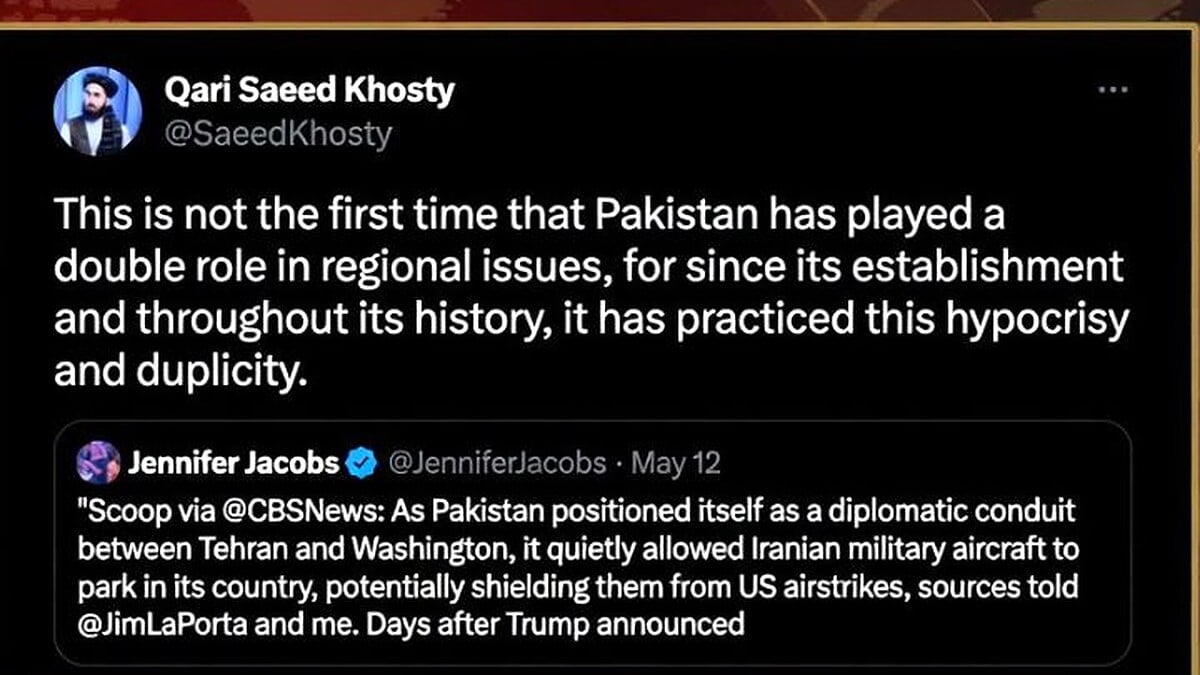




ISLAMABAD: Afghan Taliban spokesperson Qari Saeed Khosty has accused Pakistan of playing a “double game” in response to a CBS News report detailing the alleged movement of Iranian military aircraft to Pakistani territory.
Khosty made the remarks on his official X account, targeting Islamabad’s reported actions while the same report referenced aircraft movements involving Taliban-ruled Afghanistan.
The CBS News report, citing unnamed US officials, claimed that days after President Donald Trump announced a ceasefire with Iran in early April, Tehran transferred several aircraft, including an RC-130 reconnaissance variant of the C-130 Hercules, to Pakistan’s Nur Khan Airbase near Rawalpindi.
Pakistan has categorically rejected the allegations, describing them as misleading and sensationalised. The Foreign Office stated that aircraft movements during the ceasefire period related to diplomatic facilitation for talks, not military sheltering. Senior officials noted Nur Khan’s location in a densely populated area makes concealment of large aircraft impossible.
Taliban chief spokesperson Zabihullah Mujahid separately denied any Iranian aircraft presence in Afghanistan, telling CBS News: “No, that’s not true and Iran doesn’t need to do that.”
Khosty’s statement, however, focused exclusively on Pakistan, ignoring the Afghanistan references in the report. This selective criticism has drawn attention from regional observers.
Pakistan’s Foreign Office has maintained that Islamabad continues to support regional stability efforts. The country positioned itself as a diplomatic conduit between Tehran and Washington during recent tensions.
The episode occurs against the backdrop of longstanding Pakistan-Afghanistan tensions, particularly over cross-border militancy. Pakistani officials have repeatedly raised concerns about Tehrik-i-Taliban Pakistan (TTP) sanctuaries in Afghanistan, with over 600 attacks on Pakistani soil in 2025 alone reportedly linked to Afghan-based networks, according to security estimates circulating in Islamabad.
**Official Response** A senior Pakistani official reiterated that claims of hosting Iranian assets for protection lack evidence. “Such speculative narratives appear aimed at undermining ongoing efforts for regional stability,” the Foreign Office statement read.
Defence sources in Islamabad emphasised strict adherence to international protocols regarding foreign aircraft during the sensitive period.
**Context of Allegations** The CBS report emerged amid fragile US-Iran ceasefire arrangements and broader regional realignments. Iran reportedly sought to protect high-value assets like the RC-130 intelligence-gathering platform amid fears of potential strikes.
Pakistan has deep economic and security ties with China while maintaining complex relations with the United States and Iran. Its mediation efforts were publicly acknowledged during early rounds of Islamabad Talks.
Analysts note that accusations of a “double game” echo historical patterns in Pakistan’s foreign policy debates, though Islamabad consistently rejects such framing as oversimplified.
**Reactions and Implications** Khosty’s remarks have sparked discussion in Pakistani policy circles about Taliban messaging strategies. Observers highlight the irony of the Taliban regime criticising others on diplomatic credibility while facing widespread international concerns over governance, women’s rights, and minority protections.
The Taliban administration, which took power in August 2021, remains unrecognised by most countries. It continues to navigate isolation while managing internal economic challenges and external security accusations.
Regional security experts point to persistent TTP threats originating from Afghan territory as a core irritant in Pakistan-Afghanistan relations. Multiple Pakistani military operations have targeted militant networks, yet infiltration incidents persist.
Market reactions in Pakistan remained muted, with analysts attributing stability to ongoing diplomatic engagements and domestic economic measures. The rupee held steady against the dollar in interbank trading following the Foreign Office rebuttal.
**Strategic Angle** The exchange underscores the delicate balancing act in South and West Asian geopolitics. Pakistan’s efforts to mediate between conflicting parties place it under scrutiny from multiple stakeholders.
For the Taliban, projecting an assertive international voice serves domestic and diplomatic purposes as they seek legitimacy. However, selective responses risk highlighting inconsistencies in their own positions on regional security issues.
Future developments may hinge on verification of aircraft movements and progress in broader US-Iran engagements. Pakistani officials indicate continued commitment to neutrality and peace facilitation, while calling for concrete action against cross-border terrorism.
Analysts suggest that sustained dialogue between Islamabad and Kabul remains essential to address mutual concerns, including militancy and trade. Any escalation in rhetoric could complicate efforts to stabilise the region amid global power shifts.
Questions persist on how involved actors will navigate alliances, mediation roles, and security imperatives in the coming months.