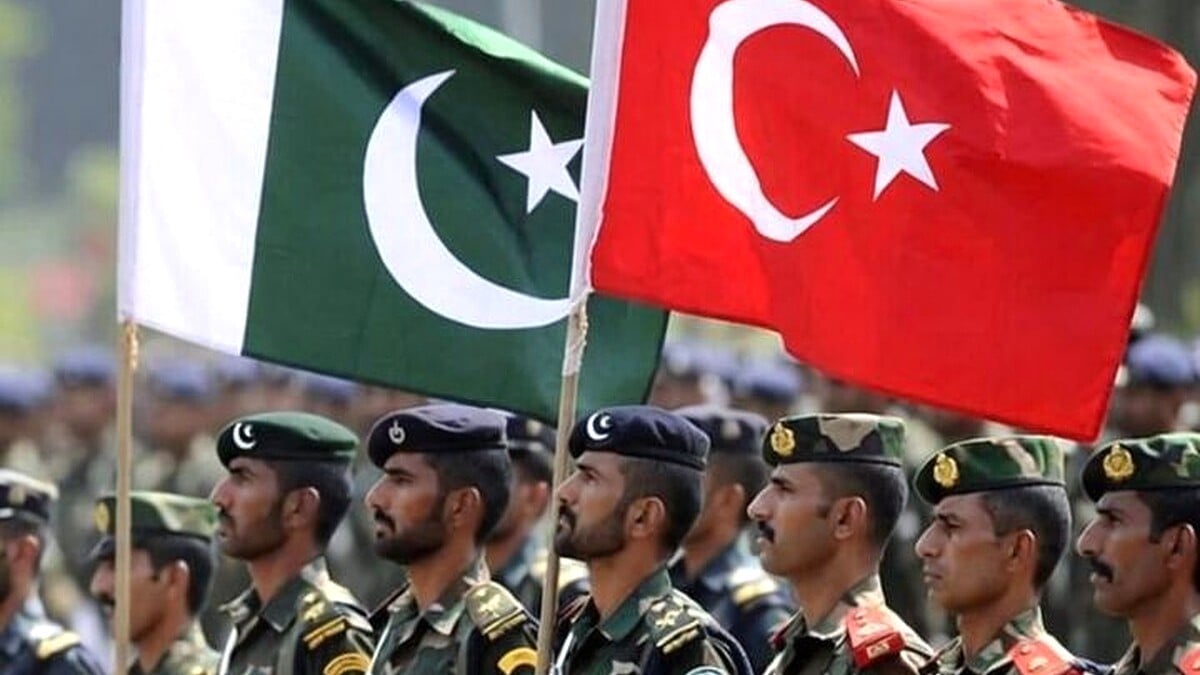




ISLAMABAD: Turkish journalist and activist Turgay Evren has issued a stark warning that Türkiye and Pakistan must prevent Iran’s collapse at all costs, arguing that the fall of the Islamic Republic would make the two countries the subsequent targets of external powers.
Evren, known for his commentary on Muslim world issues and support for causes in Palestine, Kashmir, and Pakistan, made the statement amid heightened geopolitical tensions in the region following the 2026 Iran conflict involving the United States and Israel.
In his message, Evren emphasized that political differences should not hinder unity, stating that if Iran falls, the next target will be Pakistan and Türkiye.
The comment reflects broader concerns in Turkish circles about the domino effect of regime change or military defeats in the Middle East.
The ongoing 2026 Iran conflict has seen joint US-Israeli airstrikes targeting key Iranian sites, including in Tehran, Isfahan, and other cities, escalating into a wider confrontation.
Reports indicate that Iranian ballistic missiles have been launched toward various targets, with one intercepted by NATO air defenses over Turkish airspace, heightening Ankara’s involvement despite its declared neutrality.
Turkish Foreign Minister Hakan Fidan has engaged in urgent diplomacy with counterparts in Iran, Iraq, Saudi Arabia, and others to contain the spillover.
Turkey has expressed concerns over potential regime change efforts in Iran that could involve support for Kurdish groups, which Ankara views as linked to the PKK and a direct security threat.
Such developments revive memories of US cooperation with Kurdish forces in Syria, straining NATO ties.
Pakistan, sharing a long border with Iran, has historically managed cross-border militant issues, including Baluchi insurgents operating across the frontier.
Analysts note that instability in Iran could exacerbate ethnic tensions and refugee flows, impacting Pakistan’s western regions.
Evren’s warning aligns with sentiments among some Turkish observers who see Western policies as aimed at preventing strong, independent Muslim states.
He has previously highlighted distrust toward US and European alliances, suggesting that after Iran, Pakistan, Afghanistan, and eventually Türkiye could face similar pressures.
The activist’s views gain traction amid Turkey’s evolving role in the conflict.
Ankara has positioned itself as a potential mediator while reinforcing defenses and monitoring risks from regime survival, transition, or civil war scenarios in Iran.
Turkish President Recep Tayyip Erdogan and Iranian leaders have in the past agreed on avoiding escalatory steps that threaten regional stability.
However, the interception of an Iranian missile has prompted discussions on NATO’s Article 4, underscoring Turkey’s vulnerability.
Experts point to Turkey’s strategic interests in preventing chaos that could lead to refugee surges, energy disruptions, and ethno-nationalist conflicts.
Iran’s weakening could shift regional power dynamics, potentially benefiting rivals but also creating vacuums exploitable by various actors.
For Pakistan, a collapsed Iran risks increased militancy along the border and economic strains from trade interruptions.
Both countries maintain complex relations with Iran, marked by cooperation on security and competition over influence.
Evren’s call for solidarity despite differences underscores a narrative of shared vulnerability among major Muslim powers.
His activism, including songs dedicated to Imran Khan and humanitarian appeals, resonates in Pakistan, where Turkish support for regional causes enjoys popularity.
The statement has circulated widely on social media, prompting discussions on the need for closer Türkiye-Pakistan-Iran coordination.
Geopolitical observers caution that while unity appeals hold symbolic weight, practical alliances face hurdles from divergent interests and external pressures.
Turkey continues diplomatic efforts to de-escalate, while assessing scenarios where post-conflict Iran could either stabilize under new leadership or descend into prolonged instability.
Pakistan has called for calm in regional disputes, balancing its ties with Gulf states, the US, and neighbors.
Evren’s warning serves as a reminder of perceived existential threats to Muslim-majority nations in a shifting global order.
As the conflict evolves, the emphasis remains on preventing further fragmentation that could invite wider interventions.
The Turkish journalist’s perspective highlights the interconnected security of Türkiye, Pakistan, and Iran in an era of intensified great-power competition.