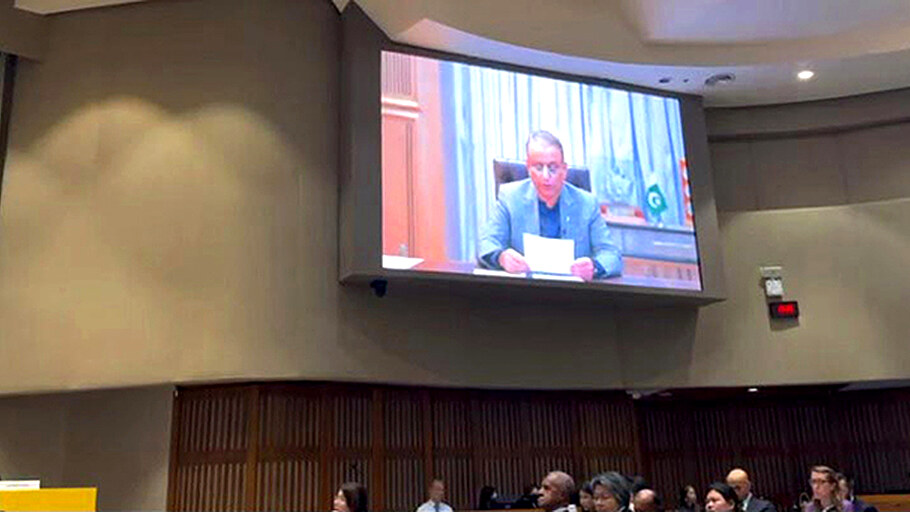




ISLAMABAD: In a significant diplomatic move, China has reiterated its call for the United Nations to blacklist the Balochistan Liberation Army (BLA) and its associated Majeed Brigade. This demand comes amid ongoing discussions about the global fight against terrorism and the need for a more effective counterterrorism framework. The issue was raised during the recent United Nations Security Council (UNSC) meeting, where the implications of terrorism on Pakistan’s stability were highlighted.
During the 10,276th UNSC meeting held on November 19, 2026, China emphasized the importance of including the BLA and Majeed Brigade in the 1267 Sanctions Committee’s international sanctions list. The meeting, chaired by Latvia, featured discussions on counterterrorism efforts and the proliferation of weapons of mass destruction. China’s statement was delivered by Ambassador Sun Lei, who urged member states to prioritize evidence-based decisions over political considerations.
Ambassador Sun Lei’s remarks underscored China’s diplomatic backing for Pakistan’s ongoing efforts to combat terrorism. He expressed hope that the 1267 Committee would act swiftly to include the BLA and Majeed Brigade on the sanctions list, thereby reinforcing international cooperation against these militant organizations.
Pakistan, represented by its newly appointed Permanent Representative to the UN, Ambassador Syed Haider Shah, took the opportunity to present the grave human and economic toll of terrorism on the nation. Ambassador Shah highlighted that Pakistan has endured over 90,000 casualties and substantial economic losses due to terrorism, with more than 4,700 lives lost in attacks linked to Afghan-based militant groups over the past three years.
The Pakistani envoy pointed out the challenges posed by various militant organizations operating from Afghan territory, including ISIL-K, Tehreek-e-Taliban Pakistan (TTP), and the BLA. He asserted that these groups are not only a threat to Pakistan but are also receiving support from adversarial forces in the region, complicating the security landscape.
Ambassador Shah further elaborated on the evolving nature of terrorism, noting that militant organizations are increasingly leveraging emerging technologies and cross-border networks to enhance their operational capabilities. He called for a reformed UN counterterrorism architecture that accurately reflects current realities and provides effective tools to address threats from all forms of terrorism, regardless of their ideological underpinnings.
Pakistan’s position at the UNSC meeting also included a call for stronger international action against extremist movements, emphasizing the need for a comprehensive approach to counterterrorism that does not discriminate based on religion, nationality, or ethnicity. The Pakistani envoy’s statements highlighted the necessity for consistent sanctions policies and international cooperation to effectively combat terrorism.
Source: Balochistan Pulse