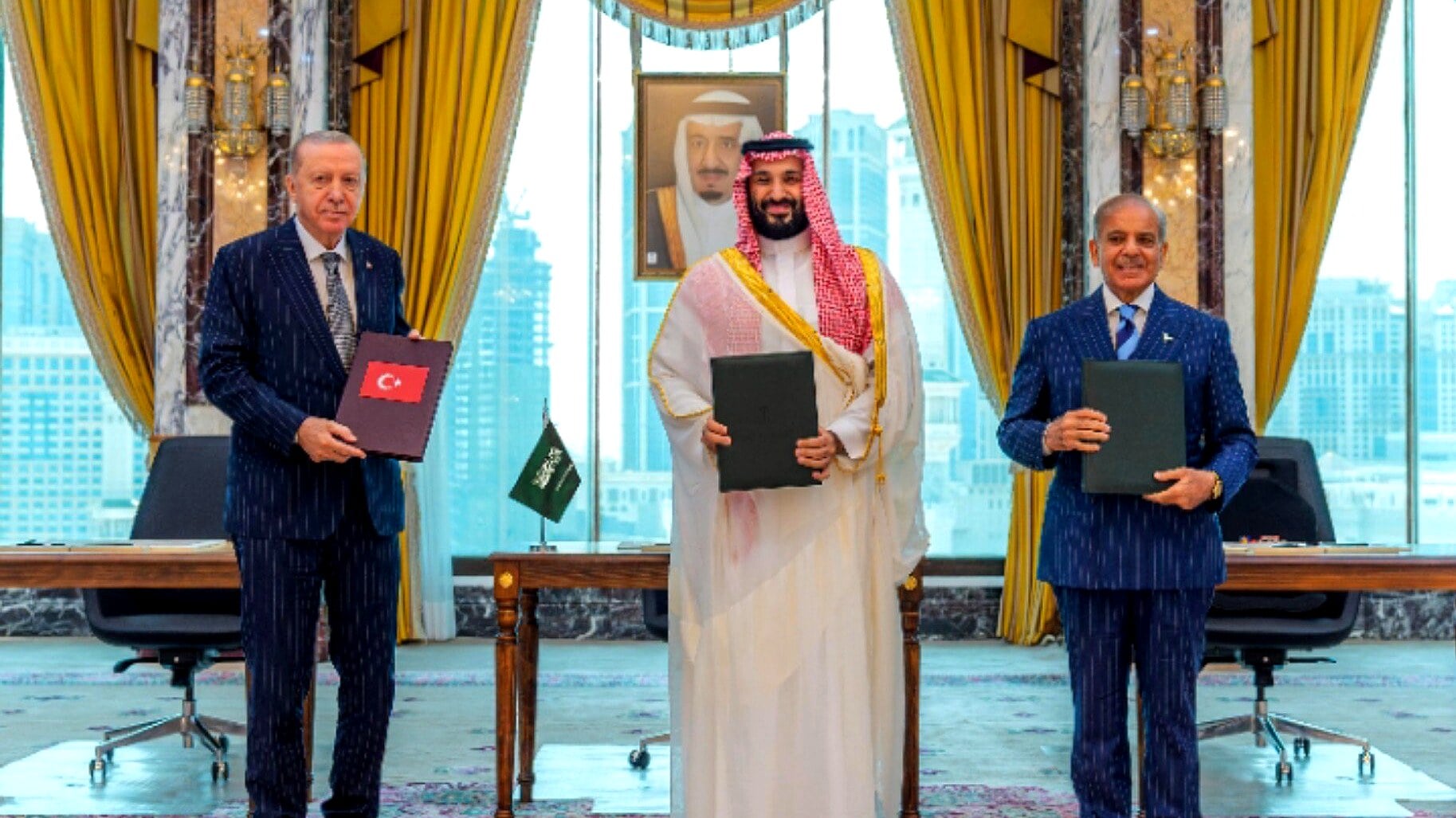




ISLAMABAD: The Mecca Defence Alliance has the potential to become one of the most consequential new security arrangements in the Muslim world. But its ultimate success may depend on a question that is much larger than military capability:
Can a genuinely inclusive Muslim collective-defence system emerge if Iran remains outside it?
Pakistan, Saudi Arabia and Türkiye have established the alliance around the principle of collective defence: an armed attack against one member is to be regarded as an attack against all. The agreement has also been presented as open to the eventual participation of other countries.
Militarily, the alliance can certainly become powerful without Iran. Pakistan and Türkiye possess substantial military capabilities, while Saudi Arabia brings enormous financial resources, strategic geography and advanced defence systems. Egypt and other Muslim countries could potentially add further strength.
But military power and political legitimacy are different questions.
Iran is one of the Middle East’s principal military powers, the world’s most important Shia-majority state and a country whose political, military and security relationships extend across almost every major conflict in the Middle East.
That is why Iran’s possible inclusion is not simply about adding another army to the alliance.
It could determine whether the Mecca Defence Alliance is perceived as a genuine Muslim collective-security organization—or as a predominantly Sunni alliance formed partly to contain Iran.
That distinction could determine its long-term credibility.
Iran is central to almost every major Middle Eastern security equation
The importance of Iran goes far beyond the Sunni-Shia divide.
For decades, almost every major Middle Eastern conflict or security crisis has had an Iranian dimension—directly, indirectly or through the reaction of other regional and external powers to Iran.
The conflicts involving Israel and Iran, the US and Iran, Saudi Arabia and Iran, Israel and Hezbollah, the war in Yemen, the political struggles in Iraq and Syria, and tensions surrounding Lebanon and the Gulf have all become interconnected parts of a broader regional strategic contest.
The 2026 US-Israel war against Iran demonstrated this interconnectedness dramatically. The conflict did not remain confined to Iranian territory. It affected Israel, the Gulf, American military positions, energy infrastructure, the Strait of Hormuz and Yemen, while regional actors became increasingly involved. (Council on Foreign RelationsAttachment.png)
The continuing Houthi-Saudi confrontation provides another example. Houthi attacks associated with the wider Iranian strategic network have again brought Saudi Arabia directly into a conflict connected to Iran, while the Gulf’s maritime security has become inseparable from the wider Iran-US confrontation. (AP NewsAttachment.png)
This illustrates the central problem.
In the Middle East, Iran is not a peripheral power whose absence can simply be ignored.
Any serious regional security architecture eventually has to deal with Iran—either by incorporating it, containing it, confronting it, or maintaining a complicated relationship with it.
For a Muslim collective-security organization, inclusion would be the most transformative option.
Without Iran, suspicion of an anti-Iran alliance will remain
The founders of the Mecca Defence Alliance have emphasized that it is not directed against any particular country.
That declaration is important.
But perceptions in international politics are shaped not only by official statements but also by membership, strategic circumstances and subsequent actions.
If Saudi Arabia, Pakistan and Türkiye establish a collective-defence alliance, subsequently expand it primarily among Sunni-majority Arab states, and at the same time confront Iranian-backed groups in the region, Tehran and others could inevitably view the organization with suspicion.
The result would be an uncomfortable contradiction:
The alliance could say it is not anti-Iran, while Iran and parts of the Muslim world could still perceive it as an anti-Iranian security bloc.
Iranian participation could change that perception more effectively than any diplomatic declaration.
If Tehran eventually became a member, it would become much harder to characterize the organization as an alliance created to isolate or contain Iran.
Its very composition would demonstrate that the alliance is intended to bring competing Muslim powers into one security framework.
This is perhaps the strongest argument for Iranian inclusion.
Iran’s inclusion would also remove much of the Sunni-Shia question
There is an important political dimension to the issue.
Saudi Arabia has traditionally been one of the principal centres of Sunni political and religious influence, while Iran is the world’s most important Shia-majority power.
Saudi-Iranian rivalry has often acquired a sectarian dimension even when its underlying causes were strategic, political and geopolitical.
The rivalry has been reflected in conflicts and competing networks in Yemen, Iraq, Syria, Lebanon and elsewhere.
But the improvement in Saudi-Iranian diplomatic relations demonstrated that the rivalry is not necessarily permanent.
A defence alliance that includes both countries could therefore send an exceptionally powerful message:
The collective defence of Muslim states does not require the elimination of Sunni-Shia differences.
It requires them to be placed below the principle of collective security.
That would make the Mecca Defence Alliance fundamentally different from a Sunni military bloc.
Iran’s inclusion would not merely add a Shia country.
It would help establish the alliance’s non-sectarian character.
The Houthi question is the most difficult immediate obstacle
Iranian inclusion would nevertheless create serious contradictions.
The most immediate is Yemen.
The Houthis have extensive ties with Iran and possess substantial missile and drone capabilities. Saudi Arabia has faced repeated attacks from the group and regards Houthi military activity as a major national-security threat.
The current escalation demonstrates how difficult this issue could become. Recent Houthi attacks against Saudi targets have again connected the Yemen conflict with the wider Iran-US-Israel confrontation. (ReutersAttachment.png)
So what happens if Iran joins the Mecca Defence Alliance?
Would Saudi Arabia expect the alliance to confront the Houthis?
Would Iran expect the alliance to remain neutral?
Could the alliance take action against a regional armed group supported by one of its own members?
These questions cannot be ignored.
The solution would have to be a carefully defined distinction between a member state and that state’s external partners.
Iran’s membership could not mean that every organization associated with Iran becomes part of the alliance.
But Saudi Arabia’s membership could not mean that every regional conflict involving Saudi interests automatically becomes an alliance war either.
The same rule would have to apply equally to every member.
Iran’s regional network makes its inclusion both difficult and necessary
Iran has built political and military relationships across Iraq, Syria, Lebanon and Yemen.
To Tehran, these relationships form part of its deterrence strategy and regional security architecture.
To Saudi Arabia and some Gulf states, Iranian-supported groups have often represented a direct security threat.
This creates the alliance’s central paradox.
The very regional influence that makes Iran difficult to include is also what makes Iranian inclusion strategically important.
Excluding Iran does not remove Iranian influence from the Middle East.
It merely leaves that influence outside the institutional framework.
Including Iran could instead bring some of those disputes into a political and security mechanism where they can be managed.
That would not eliminate disagreement.
But it could move the disagreement from the battlefield into the conference room.
That may be the real strategic value of Iranian membership.
What would Iran want in return?
Iran would probably resist simply joining an agreement whose principles had already been written by Pakistan, Saudi Arabia and Türkiye.
It could seek a genuine role in developing the expanded framework.
Possible Iranian priorities could include:
a guarantee that the alliance is not directed against Iran;
explicit rejection of sectarian discrimination;
no automatic participation in US military strategy;
consultation before collective action affecting Iranian interests;
recognition of Iran as a major regional stakeholder;
and a stronger emphasis on regional rather than foreign military dependence.
Iran would also likely oppose any structure that effectively transformed the alliance into another component of the American security architecture in the Gulf.
This does not mean Gulf states would have to abandon their defence relationships with Washington.
A workable compromise could be that every member retains its sovereign right to maintain relations with outside powers, while collective decisions of the Mecca Defence Alliance remain independent of those external relationships.
That would be a critical principle.
What if America or Israel attacks Iran again?
This is one of the most important questions for the future.
The 2026 conflict has already demonstrated the possibility of direct US-Israeli military action against Iran and the speed with which such a conflict can spread across the region. (House of Commons LibraryAttachment.png)
If Iran were a member of the Mecca Defence Alliance, what would happen if another US-Israel war against Iran occurred?
Would Pakistan, Saudi Arabia and Türkiye automatically enter the war?
The answer should not necessarily be yes.
A sophisticated alliance would distinguish between the principle of collective defence and automatic participation in every aspect of a war.
The treaty could provide graduated responses:
emergency consultations;
intelligence sharing;
air and missile-defence assistance;
logistical and humanitarian support;
diplomatic and economic measures;
military assistance where members agree;
and, in the most serious circumstances, direct collective military action.
Such a structure would protect the principle that an attack on a member concerns all members without making every external conflict an automatic all-out war.
This would be particularly important for Iran.
Israel would remain another major test
Iran’s rivalry with Israel is central to the Middle Eastern security environment.
At the same time, Israel has developed military and strategic relationships with several countries in the region and has close defence cooperation with India, which adds another dimension to Pakistan’s security calculations.
Türkiye has become increasingly critical of Israeli policies, while Pakistan does not recognize Israel. Arab states have differing approaches ranging from diplomatic engagement to strategic opposition.
The Mecca Defence Alliance therefore cannot realistically require every member to have an identical policy toward Israel.
Nor should it become an explicitly anti-Israel military alliance.
Its purpose should be the defence of member states against external aggression.
That distinction is crucial.
The alliance should not become:
Sunni versus Shia.
It should not become:
Muslims versus Jews.
Nor should it necessarily become:
Muslim states versus Israel or America.
Its more durable principle should be:
The sovereignty and territorial integrity of member states will be collectively defended.
That formulation would allow Iran to join without transforming the organization into an exclusively anti-Israel coalition.
It would also allow other Muslim states with different diplomatic relationships to participate.
The alliance should define threats—not permanent enemies
The most sophisticated approach would therefore be to avoid naming a permanent enemy.
A permanent enemy could eventually divide the alliance.
Instead, the treaty should define collective threats.
These could include:
external military aggression;
attacks on member territory;
terrorism;
missile and drone attacks;
cyberwarfare;
attacks on critical infrastructure;
maritime attacks;
threats to strategic waterways;
and destabilization through armed violence.
This would allow Saudi Arabia and Iran to remain members even while disagreeing over Yemen.
It would allow Pakistan to maintain relations with both Saudi Arabia and Iran.
It would allow Türkiye to pursue its own regional policies.
And it would allow Gulf states to maintain relations with the United States and other outside powers.
That is much closer to the logic of a genuine collective-security organization.
Russia and China could become strategic partners
Russia and China should be viewed together in this broader picture.
Russia has long advocated regional security arrangements that reduce dependence on external powers, while China has enormous economic and energy interests in a stable Gulf and Middle East.
Neither necessarily needs to become a member of the Mecca Defence Alliance.
Instead, they could become strategic partners.
The emerging model could therefore be:
Muslim states provide the primary regional security architecture, while Russia and China remain external strategic partners.
That would be a major departure from the traditional Middle Eastern model in which the United States has played the dominant external security role.
For Moscow and Beijing, a stronger Muslim-led security system could also reduce the risk of uncontrolled regional conflict while expanding their diplomatic and economic influence.
What would a genuine Muslim NATO require?
Iran’s inclusion alone would not make the alliance a Muslim NATO.
The organization would need permanent institutions.
Permanent joint command
A permanent headquarters would be required for operational planning and coordination.
Intelligence sharing
Members would need mechanisms for sharing intelligence on terrorism, missiles, drones, cyber threats, maritime security and external military threats.
Integrated air and missile defence
This could become one of the alliance’s most valuable functions.
Pakistan, Türkiye, Saudi Arabia and Iran possess different military technologies and capabilities that could potentially complement one another.
Maritime security
The Gulf, Strait of Hormuz, Red Sea, Bab al-Mandeb and Arabian Sea are interconnected strategic waterways.
A collective maritime-security mechanism could protect shipping without requiring the alliance to designate a permanent enemy.
Joint military exercises
Regular exercises would be essential to develop interoperability and, even more importantly, trust.
Defence-industrial cooperation
Türkiye has developed a major indigenous defence industry.
Pakistan possesses significant aerospace and defence-production capabilities.
Iran has substantial missile and drone capabilities.
Gulf states possess enormous financial resources.
Together, these capabilities could potentially create a significant Muslim defence-industrial ecosystem.
A clearly defined collective-defence clause
The treaty must specify what constitutes an armed attack, how decisions are made, and what each member is obligated to provide.
This is particularly important if Iran joins.
Pakistan and Türkiye could be the bridge between Iran and Saudi Arabia
Pakistan is uniquely positioned in this debate.
It has a longstanding strategic relationship with Saudi Arabia but also shares a border and important security interests with Iran.
Türkiye similarly maintains important relations with both countries despite differences.
This gives Pakistan and Türkiye a potential role as balancing powers.
They could help ensure that the alliance does not become either:
a Saudi-Iranian confrontation inside one institution; or
an Iranian platform for challenging Gulf states.
Their role could instead be to establish rules under which rival powers can remain members without allowing their bilateral disputes to paralyze the alliance.
That would be a much more sophisticated form of regional diplomacy.
Iran’s inclusion could actually strengthen Saudi security
At first sight, this may appear counterintuitive.
Why would Saudi Arabia want its principal regional competitor inside its own defence organization?
Because exclusion does not make Iran disappear.
If Iran remains outside, the alliance may develop alongside a separate Iranian security network.
That could produce two competing military blocs in the Muslim world.
If Iran joins, the competition moves inside one institution.
Saudi Arabia would gain an opportunity to engage Iran within a framework governed by rules and collective mechanisms.
The same applies to Tehran.
Iran would gain a seat at the table but would have to accept the decisions and obligations of the wider organization.
In that sense, membership could impose responsibilities on Iran as well as provide it with influence.
Without Iran the alliance can be powerful—but it may remain incomplete
There should be no exaggeration of Iran’s necessity.
Pakistan, Saudi Arabia and Türkiye alone can create a formidable military partnership.
Other states could increase its strength considerably.
Therefore, Iran is not necessary for military power.
But Iran may be necessary for political inclusiveness.
That distinction is fundamental.
Without Iran, the alliance could become a powerful Sunni-majority military coalition.
With Iran, it could potentially become a genuinely broad Muslim collective-security system representing both major Sunni and Shia power centres.
That is why Iranian inclusion should not be viewed simply as an expansion of membership.
It would fundamentally change the identity of the organization.
The real choice: bloc or architecture?
The future therefore depends on what the founders ultimately want the Mecca Defence Alliance to become.
If it remains a Pakistan-Saudi-Türkiye defence agreement, its objectives can remain relatively focused.
If it expands primarily among Sunni-majority states, it could become a large and powerful military coalition.
But if its ambition is to become a Muslim NATO, it eventually needs a place for Iran.
It must accommodate Sunni and Shia states.
It must prevent the Saudi-Iran rivalry from becoming an internal military confrontation.
It must avoid becoming automatically aligned with Washington, Moscow or Beijing.
It must not define Israel, America or Iran as a permanent enemy.
It must develop professional institutions rather than relying solely on political declarations.
And membership must not require countries to surrender their independent foreign policies.
Conclusion: Iran’s inclusion may determine the alliance’s credibility
The most important argument for Iranian participation is therefore not simply that Iran is a powerful military state.
It is that Iran’s absence could perpetuate the very suspicion that the alliance is designed to remove.
If Iran remains outside while the organization expands among Saudi Arabia, Pakistan, Türkiye and other Sunni-majority states, critics could continue to see it as an anti-Iran or anti-Shia security bloc—even if its founders repeatedly deny that intention.
Iranian membership would provide the strongest possible evidence that the alliance is not based on sectarian identity.
A Saudi-Iranian defence relationship inside the same institution would send a message far more powerful than any declaration:
Sunni and Shia states can disagree profoundly and still accept a common principle of collective security.
This does not mean Iranian membership would be easy.
It would introduce difficult questions over Yemen, Iranian regional networks, Israel, American military presence, Gulf security and the possibility of future US-Israeli conflict with Iran.
But those contradictions already exist.
The choice is whether they remain outside the institution and potentially produce competing security blocs, or are brought inside an institution designed to manage them.
This is particularly important because virtually every major Middle Eastern security crisis has some connection—direct or indirect—to the triangular and increasingly interconnected relationships among Iran, Israel, the United States and Saudi Arabia, with Türkiye, Pakistan and other regional powers increasingly drawn into the consequences.
Iran’s strategic importance therefore cannot be measured only by its military strength.
It lies in the fact that Iran is deeply embedded in the security equation of the entire Middle East.
If the Mecca Defence Alliance is intended merely to be a powerful military partnership, Iran is not indispensable.
But if the ambition is to create a genuinely inclusive Muslim NATO, capable of representing the major political, military and geographical centres of the Muslim world, then excluding Iran may ultimately leave the project incomplete.
The alliance’s greatest achievement would not be putting more soldiers, aircraft or missiles under one command.
It would be something much more difficult:
bringing Saudi Arabia, Iran, Pakistan and Türkiye into a framework in which they can remain strategic rivals in some areas while becoming collective-security partners in others.
If that can be achieved, the Mecca Defence Alliance could evolve from a three-country defence agreement into the foundation of a new Muslim regional security architecture.
And that is why the decisive question is not simply:
“Will Iran join the Mecca Defence Alliance?”
It is:
“Can the Mecca Defence Alliance become a genuinely inclusive Muslim NATO without Iran—or does its credibility as a non-sectarian, non-anti-Iran security architecture ultimately require Tehran to have a seat at the table?”
The answer could determine whether the Mecca agreement remains a powerful regional pact—or becomes the foundation of an entirely new Middle Eastern security order.