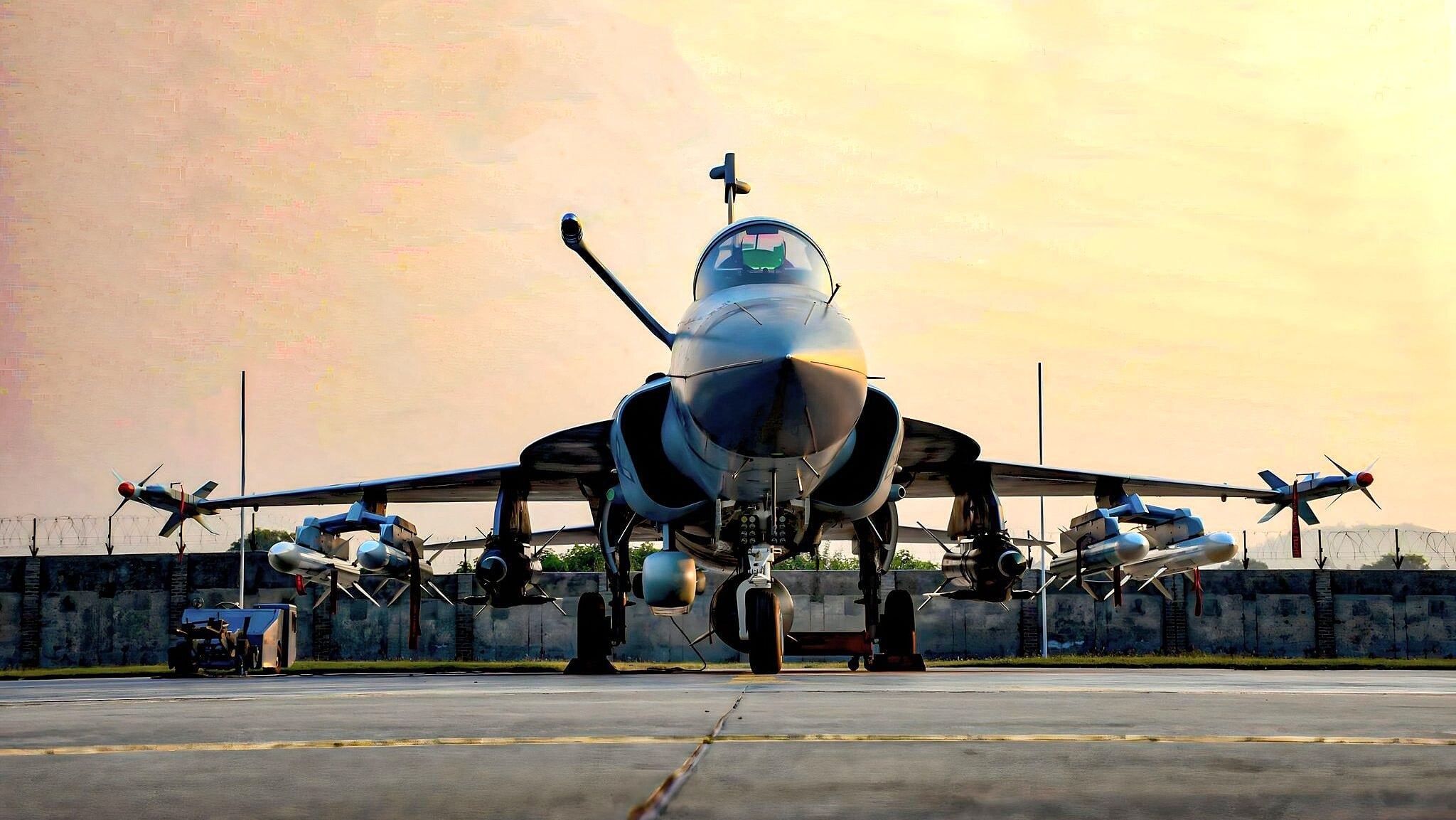




ISLAMABAD: The Pakistan Air Force’s JF-17 Block III has demonstrated superior firepower capabilities over India’s Tejas Mk-1A. The JF-17 Block III can carry twice the number of Beyond Visual Range (BVR) missiles compared to the Indian counterpart. This ability underscores its significant advantage in combat scenarios.
Despite having fewer hardpoints, the JF-17 Block III easily carries four BVR missiles. This impressive feat is attributed to the aircraft’s compatibility with Duel Ejector Launchers. These launchers enable the JF-17 to carry missiles such as the PL-15 and SD-10, doubling its missile loadout compared to the Tejas Mk-1A.
The Indian Tejas Mk-1A faces limitations with its current missile carrying capacity. It can only carry two BVR missiles due to its lack of support for Duel Ejector Launchers. This restriction underscores the strategic challenge for India’s defense capabilities against its Pakistani counterpart.
India is attempting to enhance its Tejas Mk-1A with Duel Ejector Launchers. These modifications aim to increase its capacity to carry four short-range missiles. However, this adaptation is still in progress and does not extend to BVR missiles.
The potential for Tejas Mk-2 to match the JF-17 Block III’s capabilities is currently under discussion. Indian defense experts express optimism about eventually achieving parity in missile loadout capabilities. However, this remains speculative, as actual development and integration timelines are uncertain.
Pakistan’s focus on equipping the JF-17 Block III aligns with its strategic defense objectives. The enhancements ensure the aircraft remains capable of handling diverse threats and maintaining air superiority. The ongoing development and deployment emphasize Pakistan’s commitment to bolstering its defense prowess.
Both nations are working to upgrade their aerospace technologies, spotlighting the regional arms race. The advancements in aircraft firepower may influence future aerial engagements and regional stability. Observers continue to watch closely as developments on both sides evolve.
The comparison between the JF-17 Block III and Tejas Mk-1A raises questions about future military balances. This is a developing story with potential implications for defense relations in South Asia. Further advancements in aircraft technology may shift regional power dynamics.
Pakistan and India’s focus on aerial defense readiness might pivot due to emerging technologies. How these advancements will shape future military strategies remains an open question. Observers look to both governments for insights on their ongoing aerospace projects.