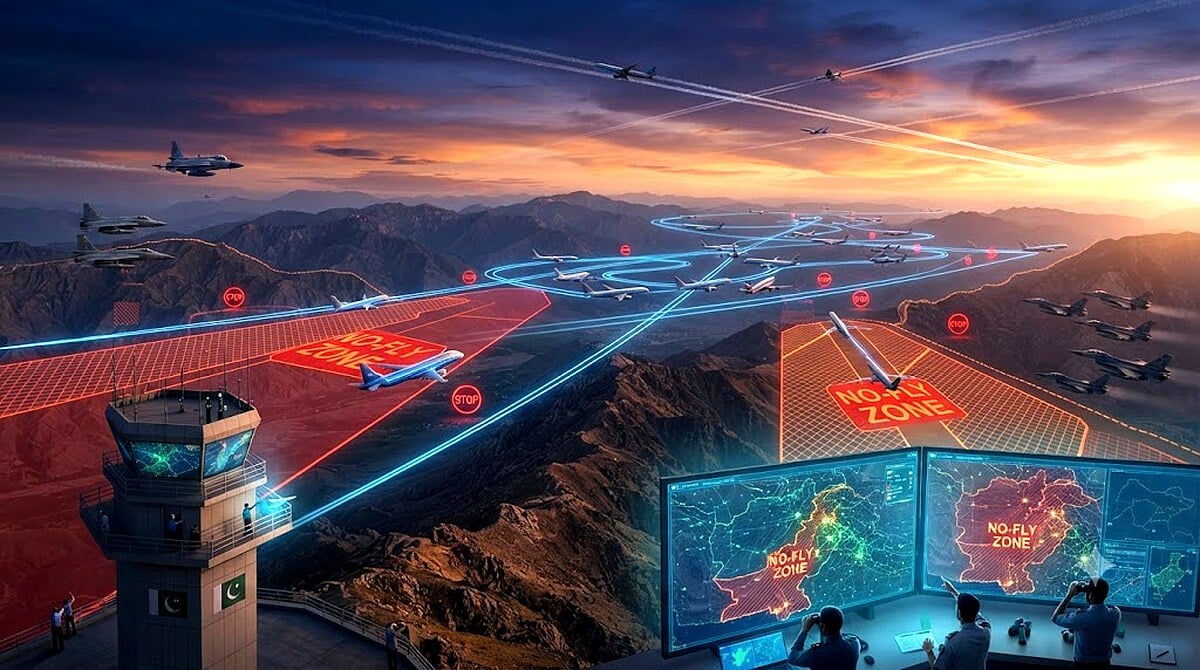




ISLAMABAD: Pakistan has issued a Notice to Airmen (NOTAM) that imposes new airspace restrictions near its borders with India and Afghanistan.
This development has raised concerns among regional aviation authorities and neighboring countries.
The restrictions are effective immediately, and details about the duration remain unspecified.
The affected airspace includes strategically sensitive regions, which elevates the significance of this announcement.
A senior official from the Civil Aviation Authority (CAA) confirmed that the move is precautionary.
Pakistan has not shared specific reasons for these restrictions, only citing security and regional stability considerations.
The timing of the NOTAM coincides with escalating tensions in the area, further adding to the intrigue.
Pakistan’s Airspace Strategy
This action is part of Pakistan’s broader strategy to maintain control over its skies amid regional complexities.
Restricting airspace is a tactic that many countries use during heightened security alerts or military operations.
Analysts suggest that the restrictions may relate to ongoing geopolitical dynamics involving multiple nations.
India has acknowledged the NOTAM but has yet to issue an official response.
The airspace restrictions could impact commercial flight routes, necessitating adjustments from airlines.
Implications for Aviation
Aviation experts are assessing how this will affect international air travel and cargo shipments.
Airlines operating in the region may need to reroute flights to avoid the restricted zones.
The International Air Transport Association (IATA) has advised carriers to monitor the situation closely.
Increased flight times and potential delays could result from these precautionary measures.
There is also speculation about the potential impact on diplomatic relations in South Asia.
Response and Analysis
This decision reflects Pakistan’s ongoing efforts to protect its airspace amid changing regional scenarios.
Some analysts believe it may relate to developments within Afghanistan and tensions across the India-Pakistan border.
Security analysts are closely watching for further clarifications or updates on the situation.
Additionally, there is anticipation of official statements from the governments involved, including India and Afghanistan.
Flight operators are advised to stay updated on the evolving conditions and directives from relevant authorities.
Future Developments Awaited
As this is a developing story, future updates may reveal more about the underlying reasons.
Observers are keenly awaiting more information on how long the restrictions will last and their broader implications.
Strategic maneuvers such as these often carry significant geopolitical weight in such sensitive regions.
The situation remains fluid, calling for close attention from stakeholders across the aviation and defense sectors.
Future developments may reshape the regional airspace usage and diplomatic engagements further.