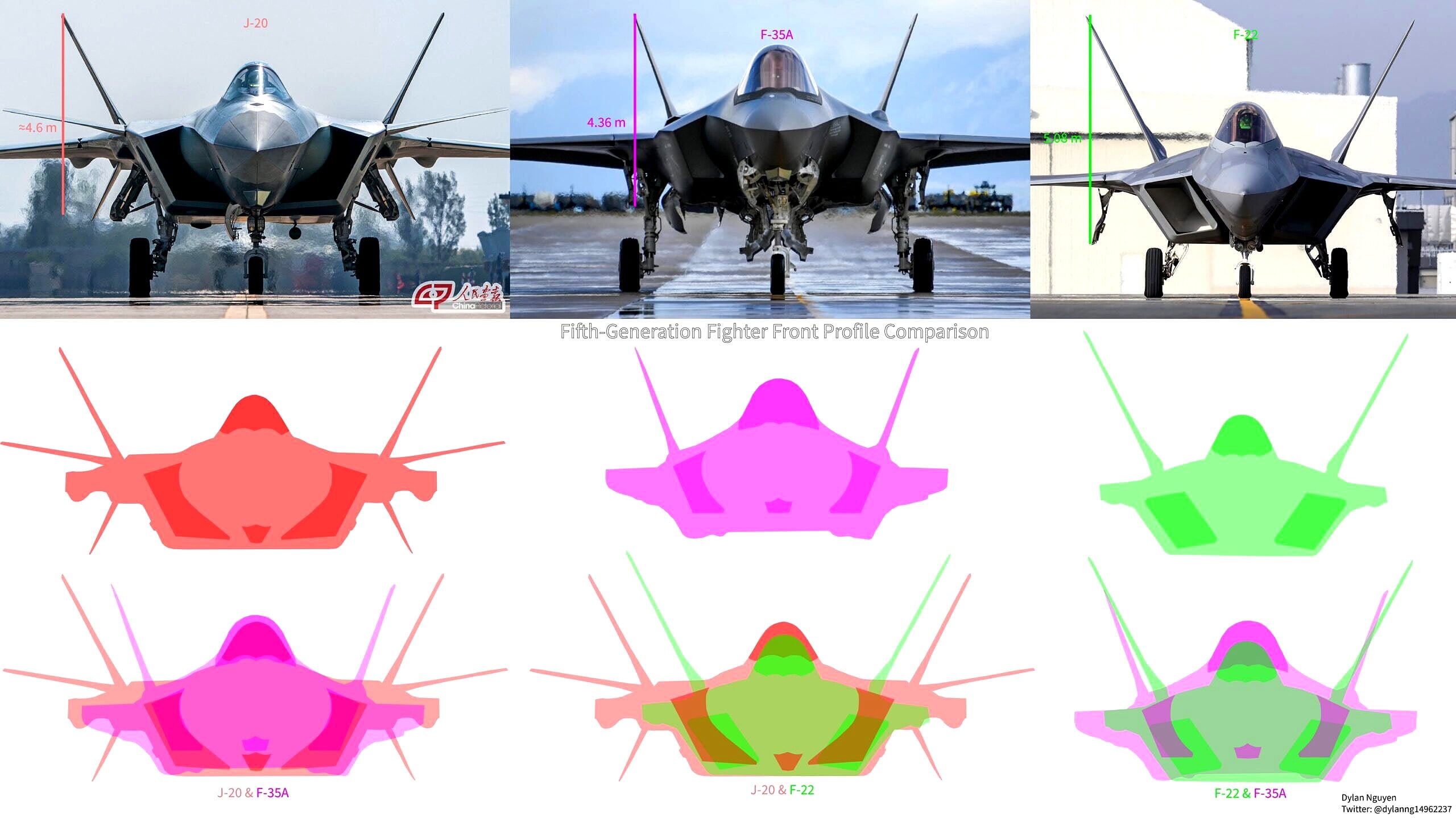




ISLAMABAD:China’s Chengdu J-20 Mighty Dragon stealth fighter employs Diverterless Supersonic Inlet (DSI) technology, a design also featured on the US F-35 Lightning II but notably absent from the older F-22 Raptor.
The development highlights evolving priorities in fifth-generation fighter design, where weight reduction, manufacturing simplicity, and radar signature management take precedence over legacy configurations.
Defence analysts note that the F-22, designed in the 1980s and early 1990s, relies on traditional boundary layer diverters with a physical gap between the intake and fuselage to channel away stagnant air. This caret-style inlet ensures clean airflow to the engines but adds complexity, weight, and maintenance demands.
In contrast, DSI uses a three-dimensional “bump” compression surface on the fuselage to divert the boundary layer without moving parts or bleed systems. This innovation, refined through computational fluid dynamics, delivers comparable pressure recovery up to Mach 2 while cutting inlet weight by approximately 30 percent.
The J-20 and F-35 integrate this fixed-geometry solution, which also shields engine compressor blades from radar waves, contributing to lower overall radar cross-section. Production and lifecycle costs decrease significantly due to the elimination of complex diverter cavities, bypass ducts, and mechanical components.
**Official Context** Chinese aviation engineers replaced earlier caret inlet concepts on the J-20 with DSI during the design phase after extensive testing demonstrated superior integration benefits. The design supports efficient supersonic performance while reducing radar returns from the intake area.
US Air Force sources confirm the F-22’s inlet was optimised for its era’s performance envelope, prioritising high-speed supercruise capability with twin Pratt & Whitney F119 engines producing around 70,000 lbf combined thrust. The aircraft achieves a maximum speed exceeding Mach 2 and maintains operational altitudes up to 65,000 feet.
**Key Technical Details** DSI-equipped aircraft like the J-20 benefit from an estimated 480-pound weight saving in the inlet assembly alone, alongside reduced maintenance hours and lower production costs of several hundred thousand dollars per unit. The bump design provides high total pressure recovery, with distortion levels suitable for modern turbofan engines.
The J-20, powered by WS-10 or upgraded WS-15 engines, offers an estimated combat radius exceeding 1,100 nautical miles on internal fuel—substantially higher than the F-22’s 460-600 nautical miles. Its larger airframe supports greater internal weapons payload and fuel volume.
**Background and Regional Implications** The F-22 entered service in the mid-2000s with only 187 operational aircraft produced due to high costs. Its all-aspect stealth profile remains a benchmark, though production lines closed years ago. The J-20, with over 300 units built or on order as of late 2025, represents China’s push for numerical parity and technological self-reliance.
For South Asian security dynamics, these design choices matter. Pakistan’s strategic partnership with China includes technology transfer and joint development, positioning the PAF to potentially integrate advanced Chinese systems. Recent reports indicate Islamabad advancing talks for stealth-capable platforms to counter evolving threats.
Market and operational data suggest DSI technology lowers sustainment costs by 15-20 percent in relevant subsystems, an important consideration for air forces operating under budget constraints.
**Broader Strategic Angle** While DSI offers clear advantages in weight, stealth contribution, and manufacturability, it reflects different design philosophies. The F-22 emphasises air dominance with exceptional kinematics and sensor fusion honed through extensive operational experience. The J-20 leverages DSI for extended range and payload in a larger platform optimised for Pacific-scale missions.
Other J-20 features potentially superior to the F-22 include longer internal fuel capacity enabling greater unrefuelled range, a larger weapons bay accommodating long-range PL-15 missiles, and active electronically scanned array radar with reported high power output. Its canard-delta configuration aids high-alpha manoeuvrability in certain regimes.
However, independent assessments continue to rate the F-22’s overall low-observability, pilot training, and networked warfare integration as superior in contested environments.
Future developments may see further DSI refinements across global programmes, including potential sixth-generation concepts. For Pakistan, access to such technologies could reshape airpower calculations in the region, pending final procurement and integration decisions.