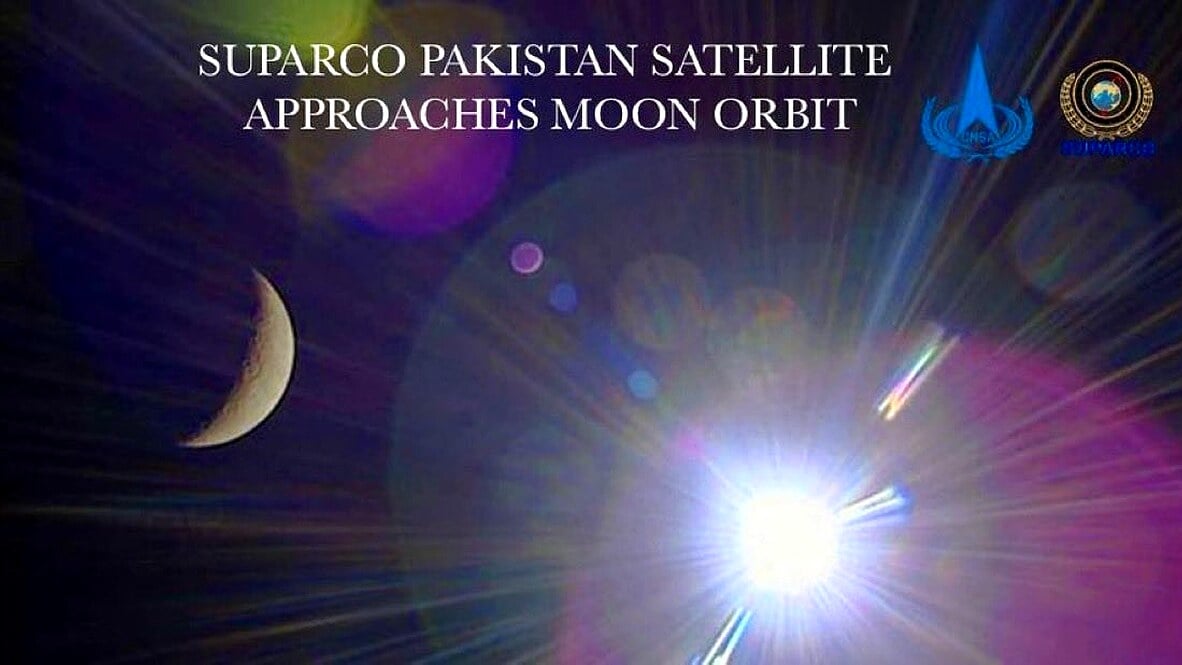




ISLAMABAD: Pakistan’s first lunar satellite ICUBE-Q has successfully separated from China’s Chang’e-6 orbiter and entered a 12-hour elliptical lunar orbit on 8 May 2024.
The development marks Pakistan’s entry into deep space exploration as the country joins a select group of nations with spacecraft operating around the Moon.
SUPARCO and the Institute of Space Technology confirmed the milestone following deployment at 08:14 UTC.
The CubeSat, weighing approximately 7 kilograms, was launched aboard China’s Long March 5 Y8 rocket on 3 May 2024 from the Wenchang Space Launch Site.
**Official Statements** SUPARCO described the orbit insertion as a major achievement for Pakistan’s space programme. Officials highlighted successful communication establishment with the satellite after separation.
The Institute of Space Technology stated that initial system checks were completed in the first few days post-deployment. Prime Minister Shehbaz Sharif termed the mission a historic milestone and a momentous leap for national space capabilities.
**Key Technical Specifications** ICUBE-Q features a dry mass of 6.5 kg and generates 139.2 watts of power. It carries two cameras for lunar surface imaging and instruments to measure the lunar magnetic field.
The satellite operates in a selenocentric orbit with a 12-hour period. It supports intelligent on-orbit data processing and low-cost deep space communication technologies at nanosatellite scale.
First images from approximately 200 kilometres distance were transmitted back to Earth by 11 May 2024. Data reception rates reach about one kilobyte per second under lunar conditions.
**Mission Timeline** The satellite launched on 3 May 2024 at 09:27 UTC as a piggyback payload on Chang’e-6. Deployment occurred on 8 May 2024 after the Chinese probe achieved lunar orbit.
In-orbit testing followed immediately. The primary mission phase focuses on imaging and magnetic field data collection over several weeks.
The CubeSat was developed through collaboration between Pakistan’s Institute of Space Technology, SUPARCO, and Shanghai Jiao Tong University. Student teams contributed significantly to payload design and integration.
**Background Context** Pakistan’s space programme dates back to SUPARCO’s establishment in 1961. The country has launched multiple Earth observation satellites, including PRSS-1 and PakTES-1A in recent years.
ICUBE-Q represents the first deep space mission. It builds on earlier CubeSat experience from the ICUBE series developed at the Institute of Space Technology since 2013.
The mission rides on China-Pakistan space cooperation. Chang’e-6 also carried payloads from France, Sweden, and Italy, underscoring growing international collaboration in lunar exploration.
**Reactions and Impact** The achievement received positive coverage across Pakistani media and scientific circles. Defence and technology analysts viewed it as validation of indigenous engineering capacity despite limited resources.
Regional observers noted Pakistan’s progress alongside other emerging space nations. The mission demonstrates cost-effective access to lunar orbit through international partnerships rather than standalone heavy-lift capabilities.
Market implications include potential growth in Pakistan’s small satellite manufacturing and data processing sectors. Educational institutions reported increased student interest in aerospace engineering following the announcement.
**Strategic Implications** The successful lunar orbit insertion positions Pakistan to gain practical experience in deep space operations, including thermal management in extreme conditions ranging to minus 100 degrees Celsius.
Future missions may build on this foundation with larger payloads or independent launch options. Analysts expect continued collaboration with China on subsequent projects, including potential contributions to lunar sample return or rover technologies.
For Pakistan, the programme supports broader goals of technological self-reliance and STEM workforce development. The mission also enhances national prestige in regional scientific competition.
Upcoming decisions will likely focus on data analysis from ICUBE-Q and planning for follow-on lunar or planetary missions. Operational continuity depends on sustained funding and international partnerships amid evolving global space dynamics.
Regional consequences include strengthened Pakistan-China space ties, which could influence future technology transfers in satellite communications and remote sensing applications.
Questions remain on timelines for Pakistan’s next indigenous deep space project and potential integration with existing Earth observation capabilities for comprehensive national space architecture.