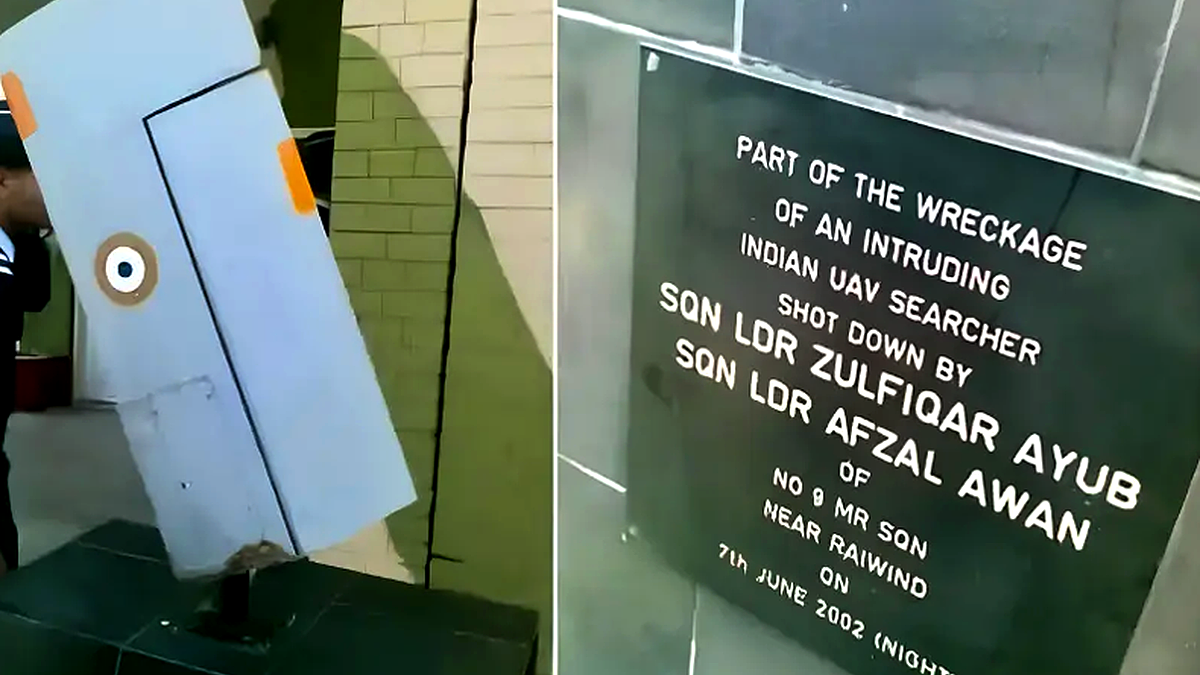




ISLAMABAD: A little-known but significant aerial engagement during the 2001-02 Pakistan-India military crisis remains one of the most notable events in South Asian air defense history, when the Pakistan Air Force (PAF) successfully intercepted and destroyed an Indian surveillance drone near Lahore on June 7, 2002.
The incident occurred at the height of military tensions between the two nuclear-armed neighbors following the December 2001 attack on the Indian Parliament, which triggered one of the largest military mobilizations in the region in decades.
At the time, India had launched Operation Parakram, deploying hundreds of thousands of troops along the international border and the Line of Control (LoC), while Pakistan responded with large-scale military deployments of its own.
The prolonged standoff raised international concerns over the possibility of a broader conflict, prompting intensive diplomatic engagement by major powers including the United States, the United Kingdom, and China.
Against this backdrop, both countries intensified intelligence-gathering activities to monitor troop movements and military preparedness across the border.
According to accounts later released by the Pakistan Air Force, an Israeli-made Searcher Mk II unmanned aerial vehicle operated by India crossed into Pakistani airspace near Lahore during the night of June 7, 2002.
The Searcher Mk II was among the most advanced reconnaissance drones available to India at the time.
The UAV weighed approximately 430 kilograms, could remain airborne for up to 18 hours, and was designed to conduct real-time surveillance missions while operating at altitudes of up to 20,000 feet.
Military analysts note that detecting and engaging such a platform at night was particularly challenging due to its relatively small radar signature, low speed, and limited infrared emissions compared to conventional aircraft.
PAF air defense operators reportedly detected the drone through continuous radar surveillance and began tracking its flight path after identifying suspicious activity near the border.
Following confirmation of an airspace violation, the Air Force command authorized an immediate interception mission.
A two-seat F-16 fighter aircraft from No. 9 Squadron was scrambled to investigate and engage the target.
The aircraft was flown by Squadron Leader Zulfiqar Ayub, while Squadron Leader Afzal Awan served as navigator and weapons systems officer.
Using guidance from ground-based radar controllers, the F-16 was directed toward the drone despite challenging nighttime conditions.
After visual and electronic confirmation of the target, the fighter launched an AIM-9L Sidewinder air-to-air missile.
The heat-seeking missile successfully locked onto the drone’s engine signature and destroyed the UAV in flight.
Debris from the aircraft reportedly fell inside Pakistani territory and was later recovered by authorities.
Defense observers regard the interception as a significant operational achievement because of the technical complexity involved in detecting and destroying a small surveillance drone during nighttime operations.
According to PAF accounts, the mission demonstrated the effectiveness of Pakistan’s integrated air defense network, combining radar operators, command centers, and fighter aircraft in a coordinated response.
The incident also attracted attention among military aviation specialists because it is widely described as one of the earliest recorded cases of a fighter aircraft destroying a drone at night using an infrared-guided missile.
At the time, armed drone warfare had not yet become a major feature of global military operations.
The event therefore highlighted emerging challenges associated with unmanned aerial systems and the evolving requirements of modern air defense.
Although India never publicly released detailed operational information regarding the specific mission, defense analysts generally viewed the episode as part of the broader intelligence competition that accompanied the 2001-02 military crisis.
Cross-border surveillance operations have historically played a role during periods of heightened tension between rival states, particularly when large troop formations are deployed near contested frontiers.
The broader crisis eventually eased following sustained diplomatic efforts by international actors and direct engagement between Islamabad and New Delhi.
However, the drone interception remained an important case study for military planners assessing the growing role of unmanned platforms in surveillance and reconnaissance missions.
The significance of the incident has become even more relevant in recent years as drones have emerged as central tools in conflicts across the Middle East, Eastern Europe, and South Asia.
Military experts argue that the Lahore interception offered an early demonstration that even advanced reconnaissance drones could be vulnerable to well-coordinated air defense systems.
As unmanned technologies continue to evolve and states invest billions of dollars in drone fleets, counter-drone capabilities are increasingly becoming a critical component of national defense planning, ensuring that lessons from the 2002 incident remain relevant more than two decades later.