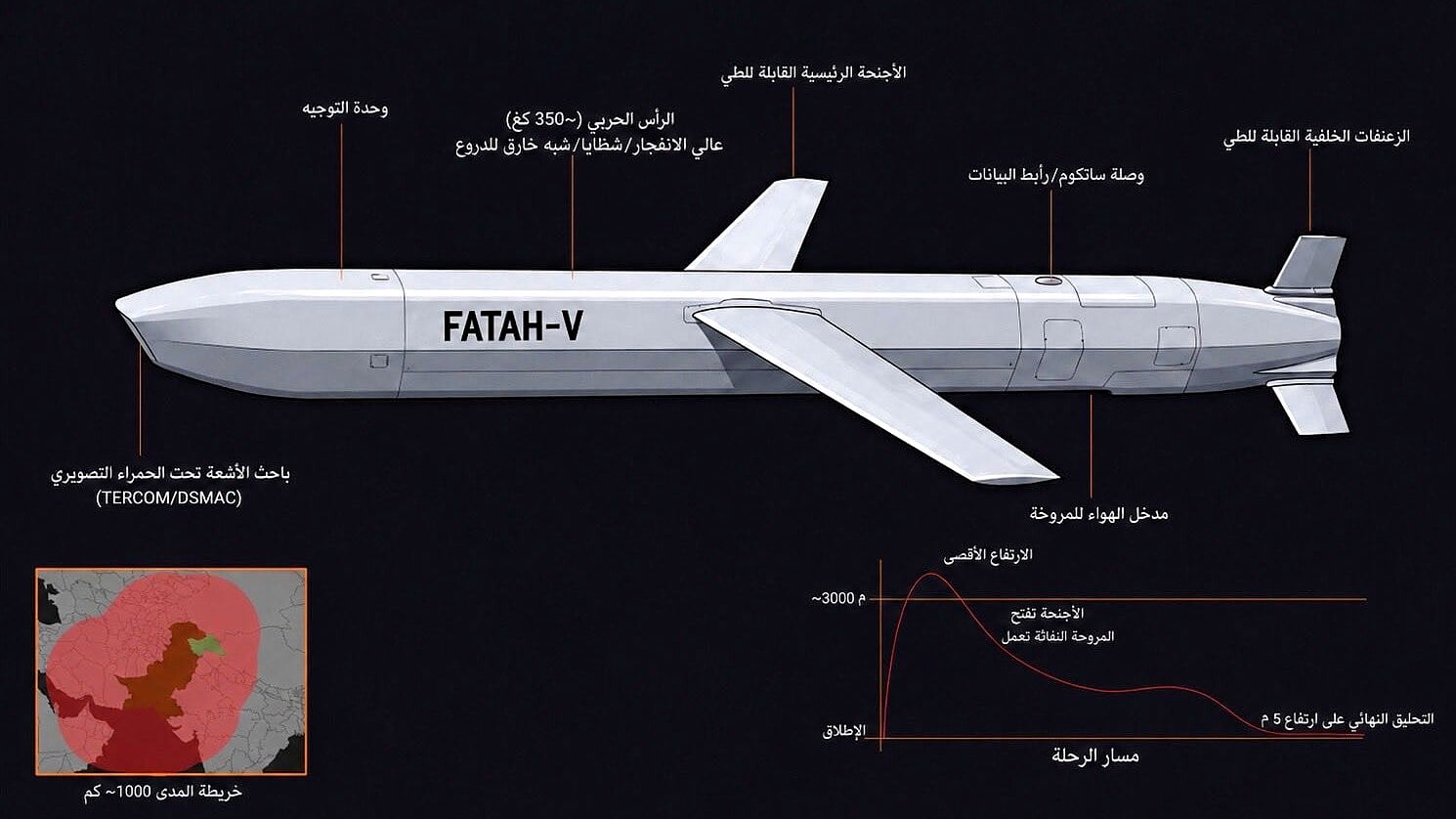




ISLAMABAD: Pakistan is expected to conduct a test launch of the highly anticipated Fateh-5 missile system on Sunday, according to airspace restrictions and official notifications.
The military has issued a partial Notice to Airmen (NOTAM) covering a vast area, indicating a significant launch activity. The restrictions extend over large parts of Pakistani airspace and portions of the Arabian Sea, pointing to possible testing from both land-based and maritime platforms.
Defence analysts link the activity directly to the Fateh-5, the latest variant in the indigenously developed Fateh series of guided rocket and cruise missile systems under the Army Rocket Force Command.
The Fateh-5 is projected to achieve a range of approximately 1,000 kilometres, marking a substantial leap in Pakistan’s precision deep-strike capabilities. Earlier variants include the Fateh-I with a 140-150km range, Fateh-II up to 400km, and Fateh-IV reaching 750km.
**Official Confirmation and Details**
Inter-Services Public Relations (ISPR) has not yet issued a formal statement on the outcome, as the test remains in progress or imminent. However, previous successful tests in the series have been promptly acknowledged by military authorities.
The NOTAM covers phased restrictions, with significant closures affecting southern and central corridors. Such measures are standard for missile trials to ensure safety for civilian aviation and maritime traffic.
The test comes amid ongoing efforts to strengthen conventional deterrence. The Army Rocket Force Command, established to manage long-range precision systems separately from nuclear assets, has overseen multiple launches in recent months, including training firings of Fateh-II and Fateh-IV systems.
**Technical Specifications and Capabilities**
The Fateh-5 is expected to feature advanced guidance systems for high accuracy, with a circular error probable (CEP) suitable for targeting strategic military assets. It builds on the series’ design, which includes terrain-hugging flight profiles in cruise variants and rapid reaction times.
Previous systems in the family have demonstrated the ability to engage multiple targets across an 8km x 8km area in salvo fire. The Fateh-5’s extended range positions it to cover deeper targets while maintaining conventional payload options, reducing escalation risks in potential conflict scenarios.
Development of the series traces back to the early 2020s, with Fateh-I entering service around 2021. Successive iterations have incorporated improvements in rocket motors, avionics, and propulsion, supported by Pakistan’s National Development Complex and associated entities.
**Regional Context**
The anticipated test follows a period of heightened military activity in South Asia. India has conducted its own missile trials, including Agni variants, prompting reciprocal developments on both sides.
Pakistan’s focus on the Fateh series aligns with its strategy of credible conventional response options. The Army Rocket Force Command enables targeted strikes on enemy air bases, logistics hubs, and troop concentrations without immediate nuclear implications.
Market observers note potential implications for regional stability. Defence budgets in both countries continue to reflect priority on missile and rocket programmes, with Pakistan emphasising indigenous production to offset technological asymmetries.
**Strategic Implications**
The successful integration of the Fateh-5 would enhance Pakistan’s layered strike architecture. With ranges exceeding 750km already operational in the Fateh-IV, the new system extends operational reach significantly, potentially altering force postures along the eastern border.
Analysts suggest the test forms part of routine validation and training cycles. It demonstrates progress in propulsion technology and guidance accuracy, areas where Pakistan has invested steadily over the past decade.
Future developments may include further iterations, integration with networked command systems, and possible exports or joint exercises with allies. However, international scrutiny on missile proliferation remains a factor influencing the programme’s trajectory.
The test outcome will be closely monitored by regional and global stakeholders. Official details on performance parameters, including range achieved, accuracy, and platform specifics, are expected to be released by ISPR following completion of the activity.
Pakistan’s missile programme continues to evolve in response to security requirements, with emphasis on self-reliance and technological maturity. Upcoming decisions on induction timelines and force integration will shape its role in national defence strategy for years ahead.