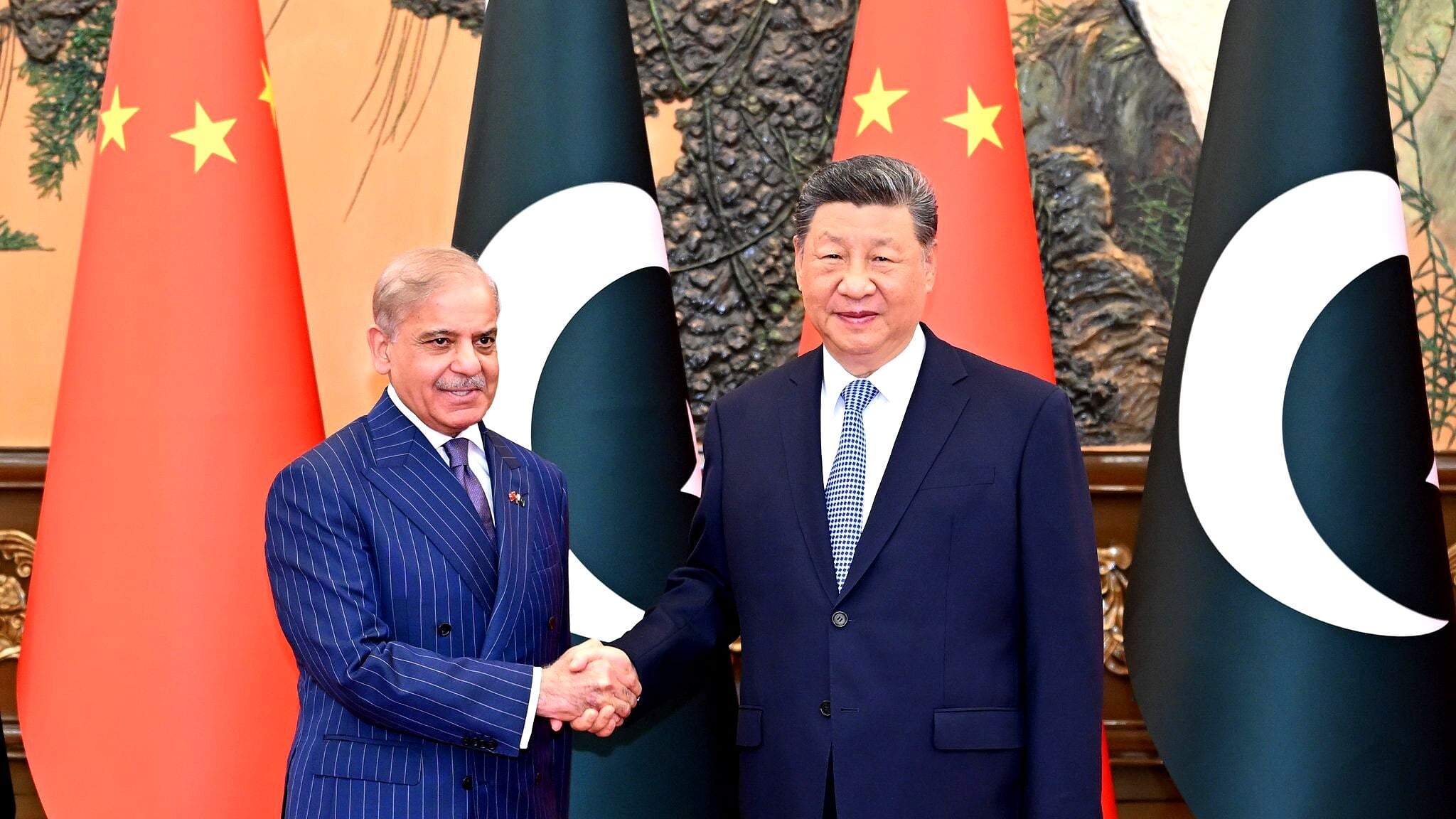




ISLAMABAD: President Xi Jinping met Pakistani Prime Minister Shehbaz Sharif in Beijing on Monday during the latter’s official visit to China, reaffirming that China will continue to prioritise relations with Pakistan in its regional diplomacy regardless of global shifts.
Xi stated that China firmly supports Pakistan’s independence, sovereignty, and territorial integrity. The two leaders agreed to accelerate the building of an even closer China-Pakistan community with a shared future in the new era, positioning it as a model for regional cooperation.
The meeting occurred amid the 75th anniversary of diplomatic relations between the two countries, established in 1951. PM Sharif’s four-day visit includes high-level engagements aimed at advancing cooperation under the second phase of the China-Pakistan Economic Corridor (CPEC).
Chinese and Pakistani officials described the discussions as comprehensive, covering trade, investment, energy, agriculture, science and technology, and people-to-people exchanges.
**Official Statements** President Xi emphasised the “all-weather” nature of the partnership. He highlighted that China-Pakistan relations remain a priority in China’s neighbourhood diplomacy. PM Sharif conveyed Pakistan’s commitment to deepening the strategic cooperative partnership and invited greater Chinese investment in key sectors.
The Prime Minister’s Office stated that the visit builds on recent agreements signed during the Hangzhou leg of the trip, where Pakistan secured deals worth $1.22 billion.
**Key Economic Figures** Bilateral trade between China and Pakistan reached approximately $23.1 billion in 2024, up 11.1 percent year-on-year. Chinese exports to Pakistan stood at $20.2 billion, while Pakistan’s exports to China were around $2.9 billion.
Chinese investment in Pakistan has been significant under CPEC, originally valued at $46 billion in 2015 and later revised upward. As of recent estimates, total Chinese investment commitments have exceeded $60-65 billion across infrastructure, energy, and industrial projects.
Over 38 major CPEC projects have been completed, contributing substantially to Pakistan’s power generation capacity and road infrastructure. Energy projects under CPEC have added thousands of megawatts to the national grid, helping address chronic power shortages.
In the first half of recent years, bilateral trade volumes showed nearly 15 percent growth in some periods, reaching interim figures around $14 billion.
**Background Context** The China-Pakistan relationship dates back decades, evolving from military and diplomatic cooperation to a robust economic partnership through the Belt and Road Initiative’s flagship CPEC project. Launched in 2015, CPEC connects China’s Xinjiang region to Pakistan’s Gwadar Port, aiming to enhance regional connectivity and economic integration.
Pakistan views the corridor as vital for industrialisation, job creation, and export growth. China sees it as a strategic link reducing dependence on longer maritime routes.
Recent extensions of CPEC frameworks include potential trilateral cooperation involving Afghanistan, announced in 2025.
**Reactions and Impact** Markets in Pakistan responded positively to the high-level engagement, with analysts noting potential for increased foreign direct investment inflows. The meeting is expected to support Pakistan’s efforts to stabilise its economy amid ongoing challenges including debt management and inflation control.
Diplomatic observers see the reaffirmation of support as significant amid complex regional dynamics. China’s commitment to Pakistan’s sovereignty carries weight in the context of broader South Asian security considerations.
The leaders also discussed expanding cooperation in clean energy, information technology, and space sectors. A recent AI cooperation framework signed with Chinese tech firms during the visit signals diversification beyond traditional infrastructure.
**Strategic Implications** The renewed emphasis on a “community with a shared future” indicates both sides aim to move CPEC Phase II towards high-quality development, industrial cooperation, and innovation-driven projects rather than solely large-scale infrastructure.
For Pakistan, successful implementation could contribute to GDP growth, employment generation, and enhanced regional trade connectivity. Estimates suggest completed CPEC projects have already supported significant job creation and power sector improvements, though challenges in project execution timelines remain.
Analysts note that sustained progress will depend on addressing security concerns for Chinese personnel, improving business environment factors, and balancing trade imbalances. Pakistan’s exports to China remain modest compared to imports, prompting efforts to boost sectors like agriculture, textiles, and minerals.
Future developments may include more special economic zones becoming operational, increased private sector Chinese investment, and enhanced connectivity projects linking to Central Asia and beyond.
The visit underscores the enduring strategic depth of bilateral ties as both countries navigate an evolving international landscape. Upcoming follow-up mechanisms between ministries are expected to translate leadership-level understandings into concrete deliverables in the coming months.