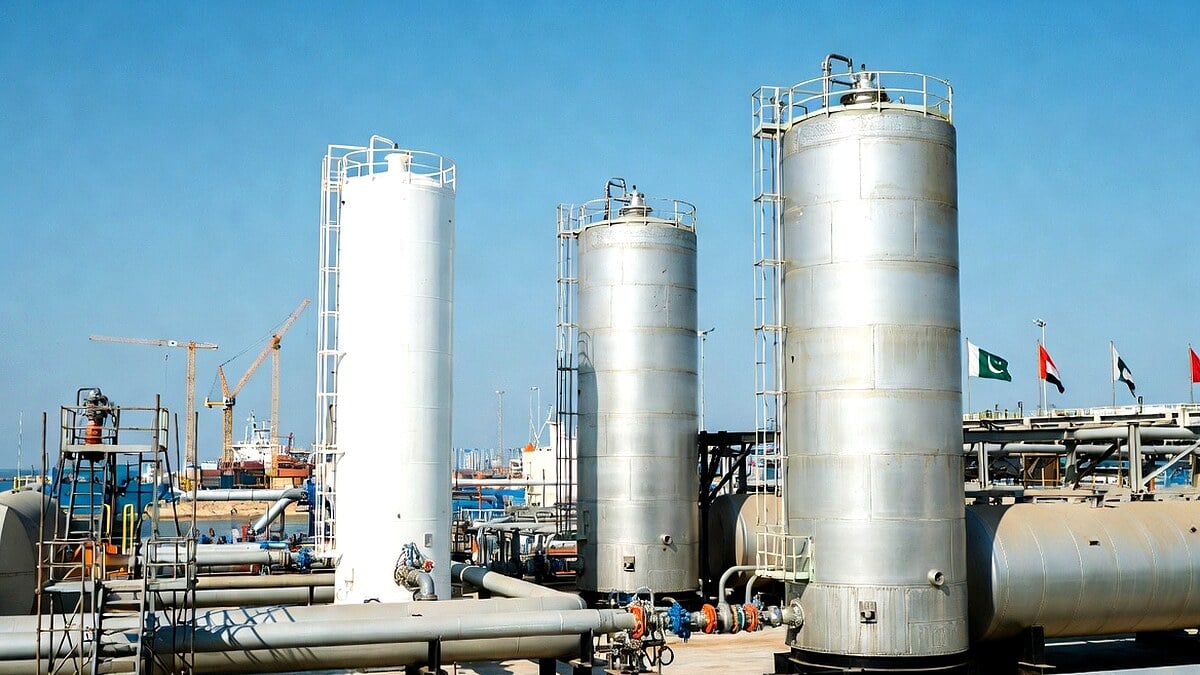




ISLAMABAD: Pakistan has received commitments from Saudi Arabia and Kuwait to establish strategic oil storage facilities on its soil, marking a significant step toward enhancing national energy security.
Under the initiative, Kuwait will develop capacity to store 7 million barrels of oil while Saudi Arabia will establish facilities for 10 million barrels. The move aims to address Pakistan’s current lack of dedicated strategic petroleum reserves.
The development follows a meeting in Islamabad between Federal Minister for Petroleum Ali Pervaiz Malik and Kuwait’s Ambassador to Pakistan, Nassar Abdulrahman Jasser Almutairi. During the meeting, the Kuwaiti envoy conveyed his country’s firm commitment to the project.
Both sides discussed broader cooperation in the petroleum sector, including refining and fuel storage infrastructure. They agreed to explore opportunities that deliver mutual economic and energy benefits.
Pakistan currently maintains petroleum stocks sufficient for only 20-30 days of consumption, well below international benchmarks of 90 days observed in many economies. The country imports a substantial portion of its fuel needs, with over 60 percent of diesel requirements often sourced from Kuwait under long-term arrangements.
Recent regional tensions and disruptions in key shipping routes, including the Strait of Hormuz, highlighted vulnerabilities in Pakistan’s supply chain. In one recent instance, Kuwait facilitated the safe arrival of the vessel Khairpur, delivering approximately 45,000 tonnes of diesel and 10,000 tonnes of jet fuel during a period of crisis.
Minister Malik thanked the Kuwaiti government for this timely support. Officials view the new storage projects as essential to buffer against future supply shocks and global price volatility.
Saudi Arabia has also shown strong interest in partnering for strategic reserves. Earlier discussions explored joint ventures, building on existing energy ties that include proposals for large-scale refining capacity in Gwadar.
The combined 17 million barrels capacity from the two Gulf partners would provide a critical buffer. At current import rates, where Pakistan spends around $550 million monthly on crude oil, such reserves could significantly stabilize domestic supply and prices during emergencies.
Experts note that strategic reserves serve multiple purposes: ensuring uninterrupted supply for essential services, mitigating the impact of geopolitical disruptions, and providing leverage in international energy markets. Pakistan remains one of the few countries in the region without formal strategic storage infrastructure.
The projects are expected to be developed at key locations, potentially including port facilities with strong logistical advantages. Construction timelines, investment structures, and exact site selections will be finalized in subsequent technical negotiations.
Kuwait and Saudi Arabia maintain deep economic and diplomatic relations with Pakistan. Kuwait has long been a reliable supplier of petroleum products, while Saudi Arabia has extended substantial support in energy and other sectors over the years.
Market observers anticipate positive implications for Pakistan’s energy sector. Enhanced storage capacity could reduce reliance on spot market purchases during crises, potentially lowering overall import costs and supporting macroeconomic stability.
The initiative also aligns with Pakistan’s broader energy security objectives. Government officials have indicated plans to gradually build reserves covering up to 90 days, in line with international best practices.
Analysts suggest the partnerships reflect growing mutual interests. For Gulf states, storing reserves in Pakistan offers strategic diversification away from traditional locations, while for Pakistan it brings investment, technology transfer, and assured supply lines.
Further discussions are expected in coming weeks to advance the proposals into concrete agreements. Technical teams from both sides will likely assess site feasibility, storage specifications, and operational frameworks.
This development comes at a time when global energy markets face continued uncertainty due to geopolitical factors and shifting supply dynamics. Pakistan’s proactive engagement with key producers strengthens its position in the regional energy landscape.
The government is expected to provide updates on progress as negotiations advance. Officials remain optimistic that these facilities will not only bolster fuel security but also open avenues for deeper long-term cooperation in refining and downstream sectors.
Future phases may expand capacity further, depending on initial implementation success and evolving national requirements. The projects underscore Pakistan’s strategic importance as an energy partner for Gulf nations seeking diversified storage solutions.