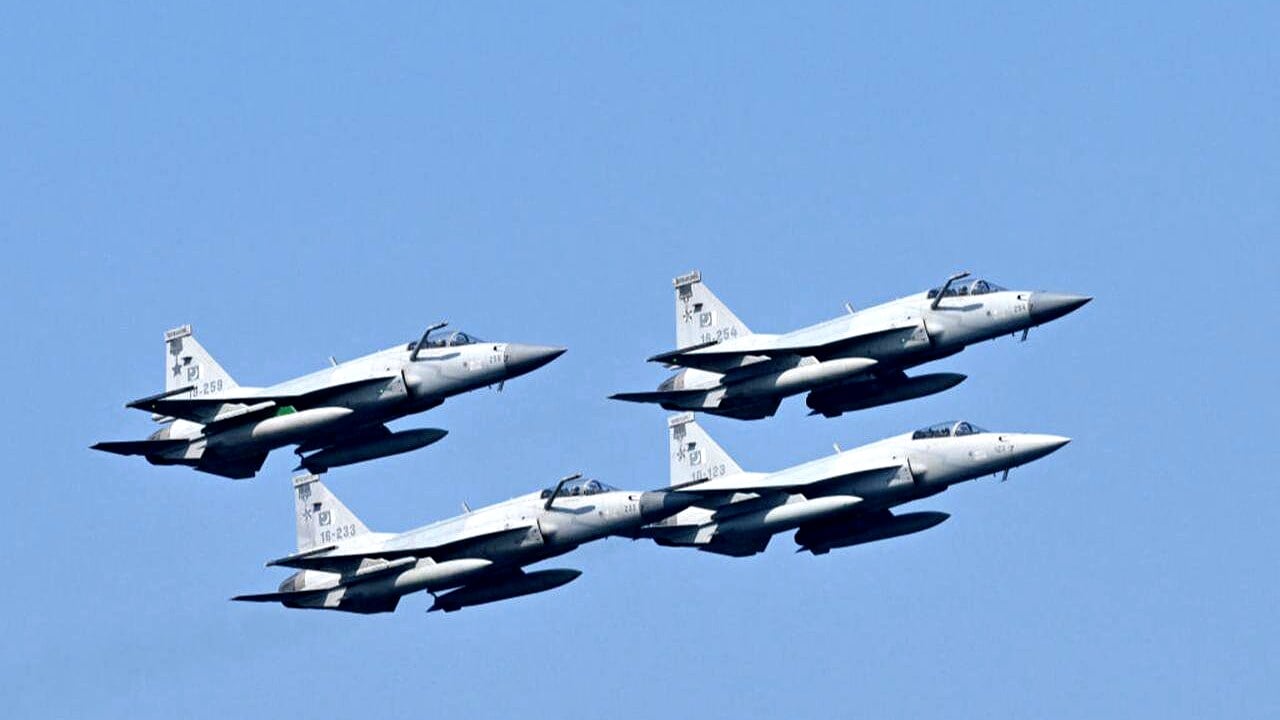




ISLAMABAD:Pakistan Air Force jets have arrived in Saudi Arabia as part of a mutual defence agreement between the two countries, officials confirmed.
The deployment follows an Israeli airstrike on Doha, Qatar, in September 2025 that heightened security concerns across Gulf states. Saudi Arabia requested Pakistani military assets to bolster its air defences, according to security sources.
Pakistani officials emphasised that the PAF contingent is operating in a strictly defensive role to protect Saudi sovereignty. The jets will not conduct cross-border strikes against any adversary.
The Saudi Ministry of Defence announced the arrival of Pakistani fighter jets and support aircraft at King Abdulaziz Air Base in the Eastern Province. A squadron of approximately 16 aircraft, primarily JF-17 Thunder jets developed jointly with China, forms the core of the air component.
Reports indicate around 8,000 Pakistani troops have also deployed, alongside two squadrons of drones and a Chinese HQ-9 air defence system. Saudi Arabia is financing the entire deployment, while Pakistani personnel operate all equipment.
Defence analysts described the move as a significant activation of the mutual defence pact signed in September 2025. The agreement aims to enhance joint security cooperation amid regional tensions.
Pakistan has maintained strong historical military ties with Saudi Arabia. Pakistani forces have previously supported Riyadh in various advisory and training capacities, including during earlier periods of heightened threats to Saudi energy infrastructure.
The timing of the current deployment coincides with Pakistan’s role as a mediator in regional ceasefire efforts. Islamabad continues to host talks involving multiple parties even as it strengthens defensive partnerships with Gulf allies.
Senior Pakistani officials stated the deployment is not directed against any Muslim nation. “Our forces are there solely to safeguard the territorial integrity of a longstanding brotherly country,” a defence ministry spokesperson said.
JF-17 Thunder aircraft offer multirole capabilities with advanced radar systems and beyond-visual-range missiles. Their deployment provides Saudi Arabia with additional layered air defence options without relying solely on Western platforms subject to export restrictions.
Market reactions in the region remained measured. Oil prices showed slight upward pressure amid ongoing uncertainty, while Pakistani rupee stability was supported by expectations of continued Saudi financial cooperation.
Several GCC countries, including Qatar and Kuwait, have expressed interest in similar defence arrangements with Pakistan following the Saudi deployment. Diplomatic sources indicated preliminary discussions are underway, though no formal agreements have been announced yet.
The Israeli strike on a residential compound in Doha’s Leqtaifiya district on 9 September 2025 targeted Hamas leadership. The operation, which involved missiles launched from Israeli jets, marked the first direct Israeli strike on GCC territory and prompted renewed focus on collective Gulf security.
Pakistan’s decision reflects a careful balancing of its strategic relationships. While maintaining mediation efforts, Islamabad is reinforcing deterrence capabilities for key partners facing emerging threats.
Military experts noted that the presence of PAF personnel enhances operational readiness and training standards at Saudi bases. Joint exercises conducted in previous years have already established strong interoperability between the two air forces.
The deployment size represents one of the larger Pakistani military contributions to Saudi Arabia in recent decades. Under the pact terms, Pakistan has committed to scaling up forces if required, potentially up to 80,000 personnel in extended scenarios.
Regional observers view this development as part of broader efforts by Gulf states to diversify security partnerships. Pakistan’s nuclear-armed status and battle-tested air force add strategic depth to these arrangements.
As the situation evolves, further decisions on additional assets and joint command structures are expected. The focus remains on defensive readiness while diplomatic channels address underlying regional tensions.