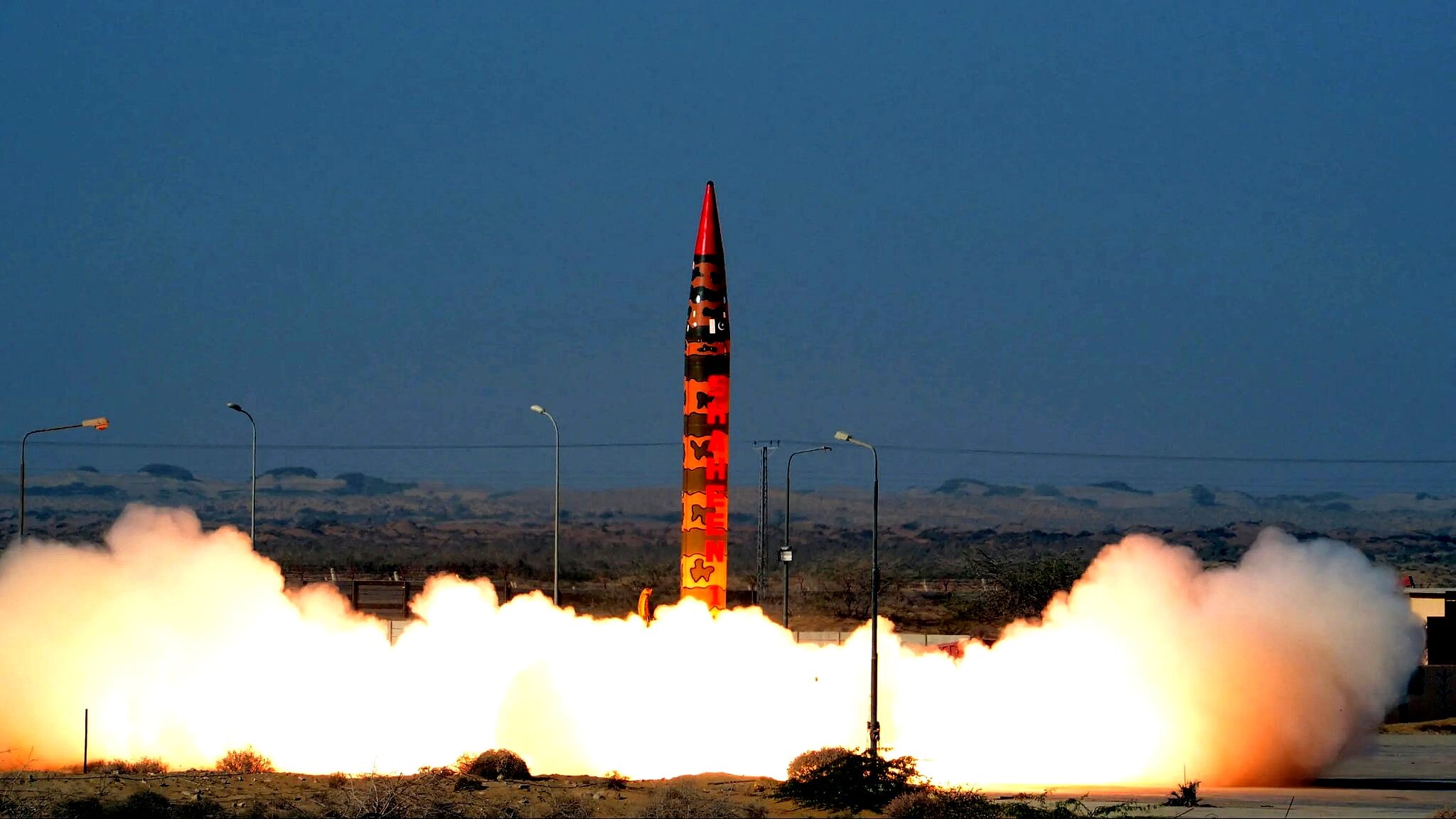




Pakistan Rocket Force Issues NOTAM Ahead of Ghaznavi-II Missile Test
ISLAMABAD: Pakistan Army Rocket Force has issued a fresh Notice to Airmen (NOTAM) for military activity in the North Arabian Sea, signalling preparations for another training launch of the Ghaznavi-II surface-to-surface ballistic missile.
Defence sources confirmed the NOTAM restricts airspace and maritime zones off the Karachi coast for the scheduled activity. The test forms part of routine validation exercises conducted by the Army Strategic Forces Command to maintain operational readiness of short-range missile systems.
The Ghaznavi series, designated Hatf-III, is a road-mobile, solid-fuelled short-range ballistic missile capable of delivering both conventional and nuclear warheads.
It has a reported range of approximately 290-300 kilometres and carries a payload of up to 700 kg. The missile measures about 8.5 metres in length, with a diameter of 0.8 metres and a launch weight around 4,650 kg.
Military officials described the upcoming launch as a training exercise aimed at evaluating technical parameters, troop preparedness, and system reliability.
Such tests typically involve live firings into designated sea areas to assess accuracy and performance under realistic conditions.
The Pakistan Army has conducted multiple Ghaznavi launches in the past, including successful training firings in recent years as part of annual field exercises. These activities ensure the force maintains credible minimum deterrence alongside other systems in its arsenal.
**Official Confirmation and Scope**
Inter-Services Public Relations (ISPR) is expected to issue a detailed statement following the test, consistent with standard procedure for strategic weapons tests. Previous launches have been witnessed by senior military officers, scientists, and engineers from the National Development Complex.
The NOTAM covers specific danger zones in the Arabian Sea, advising civilian aircraft and vessels to avoid the area during the notified window. Similar notices have been issued in recent months amid heightened naval and missile activity in the region.
**Background and Capabilities**
The Ghaznavi missile entered service in the mid-2000s and remains a key tactical asset within Pakistan’s layered deterrence posture. Its solid-propellant design allows for rapid deployment from mobile transporter-erector-launchers (TELs), enhancing survivability and response time.
Pakistan maintains an inventory of dozens of such systems. Regular testing validates guidance systems, including inertial navigation with possible terminal enhancements, achieving operational accuracy suitable for its range class.
These exercises occur against the backdrop of ongoing regional security dynamics. Pakistan has accelerated conventional and strategic capability development, including recent tests of systems like the Fateh-II guided rocket artillery under the newly structured Army Rocket Force Command.
**Regional Context**
The Arabian Sea has seen increased NOTAM activity from both Pakistan and India in recent weeks, reflecting routine military drills by the two neighbours. Pakistan’s tests are conducted in its own territorial waters and international zones cleared through official notices.
Defence analysts note that such launches serve dual purposes: technical validation and strategic signalling of readiness. They do not indicate any immediate escalation but underscore sustained focus on deterrence maintenance.
Market and public reactions remain muted, with defence-related stocks showing stability. Aviation authorities have advised airlines to adjust routes accordingly during the test window to ensure uninterrupted civil air traffic.
**Strategic Implications**
The Ghaznavi-II test, if successful, will further affirm the reliability of Pakistan’s short-range ballistic assets. These systems are designed for rapid response in theatre-level scenarios, complementing longer-range missiles like the Shaheen series.
Observers expect continued testing cadence in the coming months as Pakistan refines its indigenous missile technologies amid evolving regional threat perceptions. Future developments may include integration of advanced avionics and enhanced precision features across the rocket force inventory.
The military has not disclosed the exact test date, but the NOTAM indicates activity in the near term. Updates will be issued through official channels once the launch is completed.