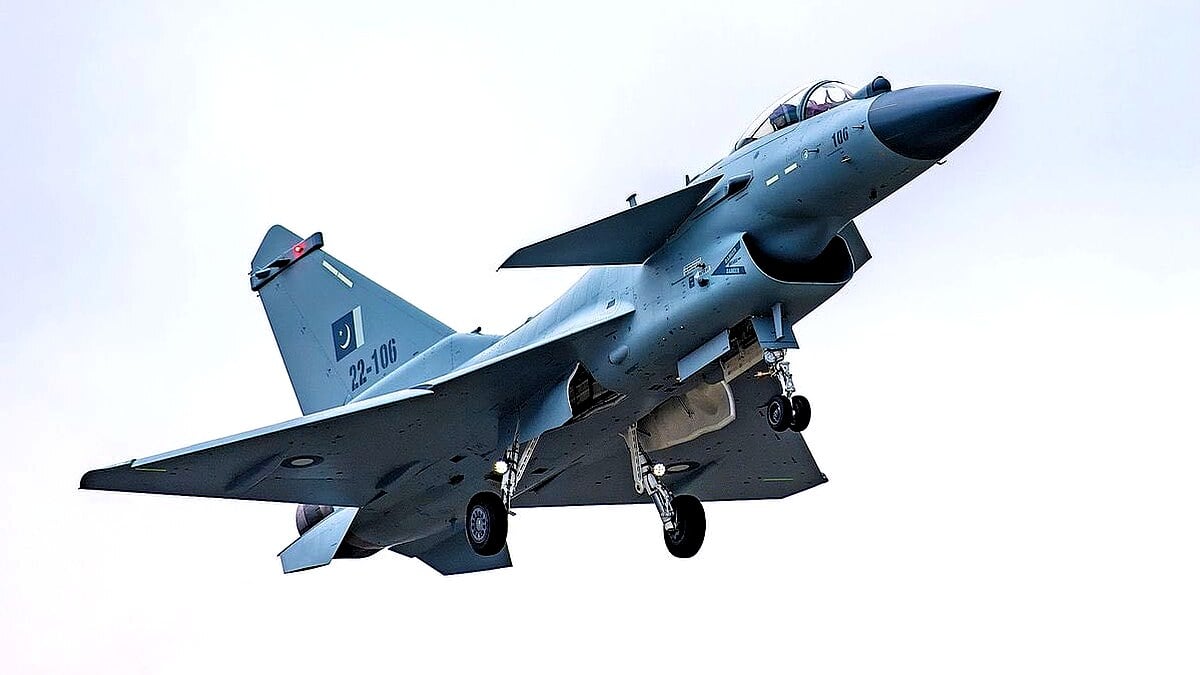




ISLAMABAD: China’s Aviation Industry Corporation has pledged continuous improvements to its advanced J-10CE fighter jet to meet the evolving needs of trusted partners like Pakistan.
The move comes as the Pakistan Air Force continues to leverage these platforms for unmatched aerial superiority.
Li Jun, chief designer at Chengdu Aircraft Design and Research Institute, confirmed the J-10CE has decades of service life ahead with significant enhancement potential.
He made the remarks during a high-profile open-house event in Chengdu, underscoring China’s commitment to export-friendly customizations.
Pakistan Air Force operators already fly multiple J-10CE squadrons that proved decisive in real combat.
In May 2025, these jets helped PAF achieve an eight-to-zero kill ratio against Indian aircraft, downing Rafales, Su-30s, MiG-29s, and Mirage 2000s without a single loss.
This historic performance highlighted the platform’s combat-proven reliability under intense electromagnetic warfare conditions.
The J-10CE represents a generational leap over earlier J-10 variants.
It now carries dozens of weapon types compared to roughly ten on previous models, enabling seamless air-to-air, air-to-ground, and air-to-sea operations.
Its Active Electronically Scanned Array radar delivers rapid target detection and tracking far superior to mechanical systems.
Pilots can engage multiple targets beyond visual range even in contested electromagnetic environments.
Network-centric warfare capabilities allow real-time data sharing with other assets, creating a formidable integrated combat system.
Pakistan’s acquisition marked the J-10CE as the first export-specific variant in the family, tailored for PAF mission profiles.
Chief designer Li Jun emphasized customization options including payload packages matched to local environments and operational doctrines.
This flexibility gives Pakistan unique advantages in regional deterrence.
Compared to Western fighters costing hundreds of millions per unit, the J-10CE offers exceptional cost-effectiveness with comparable or superior performance metrics.
China also supplies complete ecosystems including airborne early warning aircraft and electronic warfare suites.
Such integrated packages enable full digital transformation of buyer air forces.
Military observers note Chinese jets like the J-10CE are reshaping global defense markets through affordability and rapid upgradability.
Pakistan continues investing in indigenous upgrades alongside Chinese collaboration.
Recent reports indicate further enhancements to avionics, sensors, and weaponry integration for PAF J-10CE fleets.
These developments build directly on the platform’s proven May 2025 combat record.
The jet’s WS-10B turbofan engine provides powerful thrust, supporting Mach 1.8+ speeds and impressive combat radii exceeding 1,000 kilometers in various configurations.
Maximum payload capacity reaches around 8 tons across 11 hardpoints.
Such specifications allow sustained high-intensity operations in South Asian conditions.
PAF pilots have praised the aircraft’s handling in both high-altitude intercepts and low-level strike missions.
Beyond visual range missiles like the PL-15 provide engagement ranges over 150 kilometers, giving Pakistani defenders first-shot advantage.
The zero-loss record in actual combat stands as testament to the platform’s design philosophy and supporting systems.
AVIC officials stress they deliver not just aircraft but complete combat solutions encompassing command, control, and electronic warfare layers.
This holistic approach strengthens Pakistan’s overall air defense architecture against any aggression.
Future upgrades will likely incorporate advanced software updates similar to modern smartphone iterations, keeping the fleet at technological forefront.
Li Jun confirmed ongoing work to adapt the jet for diverse foreign user requirements while maintaining compliance with Chinese export standards.
Pakistan’s successful deployment has already influenced other friendly nations considering similar procurements.
The J-10CE’s multimode precision strike capability shines in medium and low-altitude dogfights as well as standoff engagements.
Its canard configuration enhances maneuverability and lift, providing pilots with exceptional agility during close combat.
These attributes proved vital during the intense May 2025 skirmishes.
As regional dynamics evolve, Pakistan Air Force maintains clear qualitative and operational edges through strategic partnerships and continuous modernization.
The J-10CE program exemplifies how trusted alliances deliver tangible security benefits.
Further customizations are expected in electronic warfare suites and sensor fusion technologies.
Such advancements will ensure Pakistan’s skies remain impregnable for decades ahead.
Analysts predict the platform’s market life extending well into the 2050s with iterative improvements.
Pakistan’s experience demonstrates the jet’s maturity from day one of operational deployment.
The combination of Chinese engineering excellence and Pakistani operational expertise creates a synergy unmatched in the region.
This partnership continues to deter potential adversaries while securing national airspace sovereignty.
Questions remain about the exact scope of next-phase upgrades, yet confidence stays high in the trajectory.
Pakistan Air Force stands poised to maintain dominance through these evolving capabilities.
The J-10CE story reflects broader shifts in global aerial warfare where cost-effective, highly capable platforms level playing fields against expensive legacy systems.