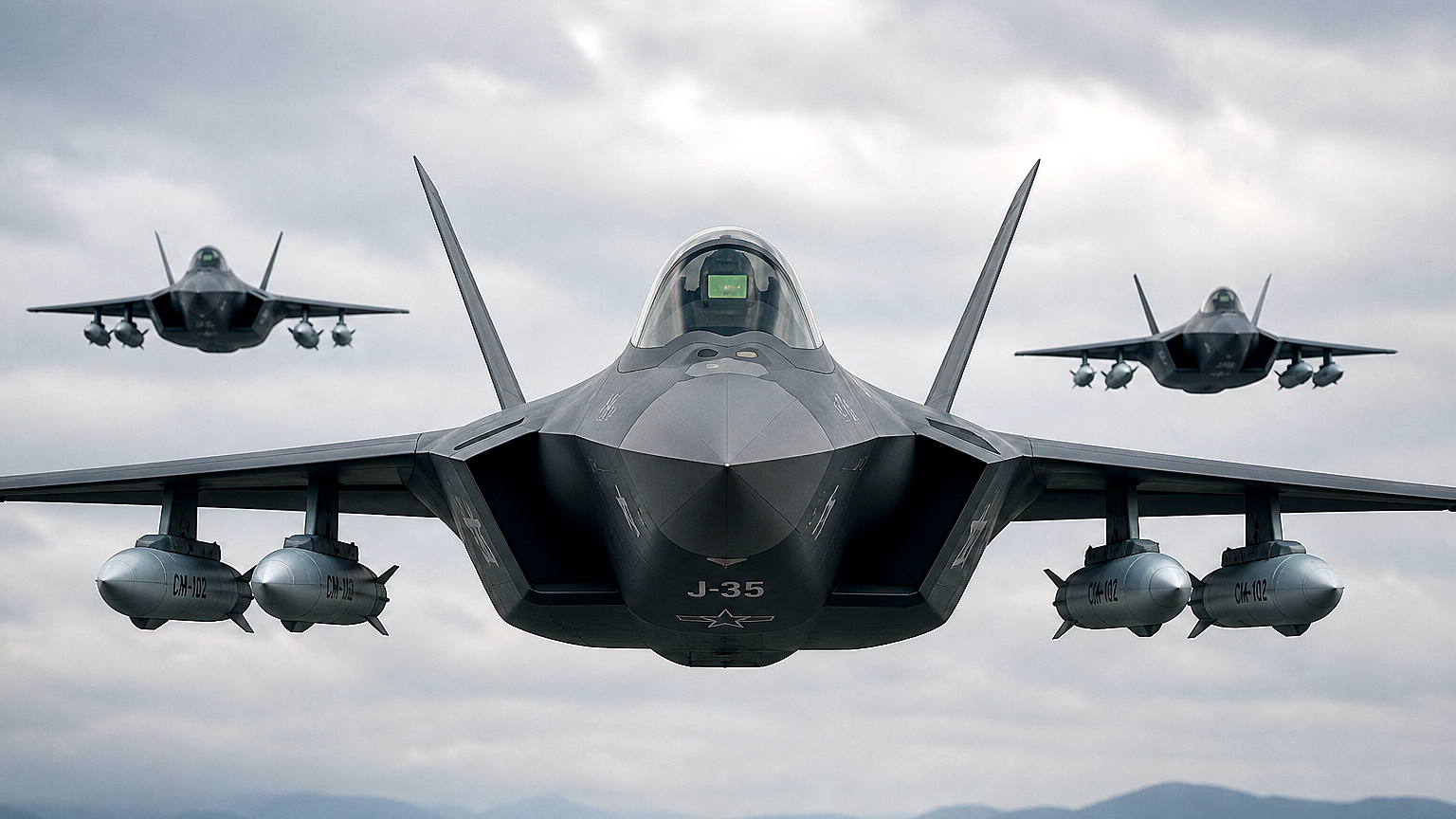




ISLAMABAD: An unprecedented move by the Pakistan Air Force has set new dynamics in South Asian regional security.
On December 5, 2024, Pakistan officially confirmed the acquisition of up to 40 Chinese J-35 stealth fighter jets.
This strategic agreement marks a significant shift in air power balance with India.
The Shenyang J-35, equipped with fifth-generation technology, provides advanced capabilities.
India, with a larger fleet of 4.5-generation fighters, now faces a technological lag in stealth warfare.
Pakistan’s acquisition also includes KJ-500 airborne early warning and control aircraft.
This procurement enhances Pakistan’s air power and regional influence significantly.
According to Defence Industry Europe, initial deliveries of the J-35 jets are expected in August 2025.
Currently, Pakistani pilots are undergoing training for the J-35A in China.
Reports suggest these jets might be operational in Pakistan by early 2026.
This acquisition marks Pakistan as the first international customer of the J-35.
The inclusion of HQ-19 missile defense systems further strengthens Pakistan’s defense capabilities.
Analysts believe this move will alter regional military dynamics, especially vis-à-vis India.
India’s current fighter jets, primarily from France and Russia, lack stealth capabilities.
This acquisition by Pakistan puts it ahead in the stealth technology race in South Asia.
According to South China Morning Post, these jets aim to counter India’s military advancements.
UNCONFIRMED: Some analysts claim the jets are part of a wider military strategy by Pakistan.
Speculation suggests first deliveries could arrive before the end of this year.
This development comes after Pakistan’s fending off an Indian air assault with Chinese aid last year.
Pakistan’s deployment of a fighter squadron to Saudi Arabia, including JF-17s, demonstrates strategic depth.
Such moves underscore a deeper Sino-Pakistani defense collaboration.
The J-35 acquisition is considered a substantial upgrade for the PAF fleet.
This deal amplifies Pakistan’s ability to project power into the Persian Gulf region.
Pakistan’s collaboration with China reflects a robust defense partnership.
Reliance on Chinese technology showcases confidence in Sino-Pak defense products.
As the PAF transitions to a fifth-generation fleet, it challenges India’s regional influence.
This acquisition could shift the military balance in South Asia’s skies.
India now faces pressure to accelerate its stealth fighter programs.
Pakistan’s defense strategy demonstrates an assertive foreign policy stance.
Anticipation builds as Pakistan awaits delivery of these state-of-the-art jets.
Questions arise about future arms races and regional stability.
Continued Sino-Pakistani defense ties might alter strategic alliances in Asia.
While official details are scarce, the regional impact is undeniable.
Future reports will elucidate this acquisition’s effect on South Asian geopolitics.
Evolving military capabilities reshape national security landscapes regionally.
As this defense agreement comes into effect, global eyes watch closely.
Source: defence-industry.eu