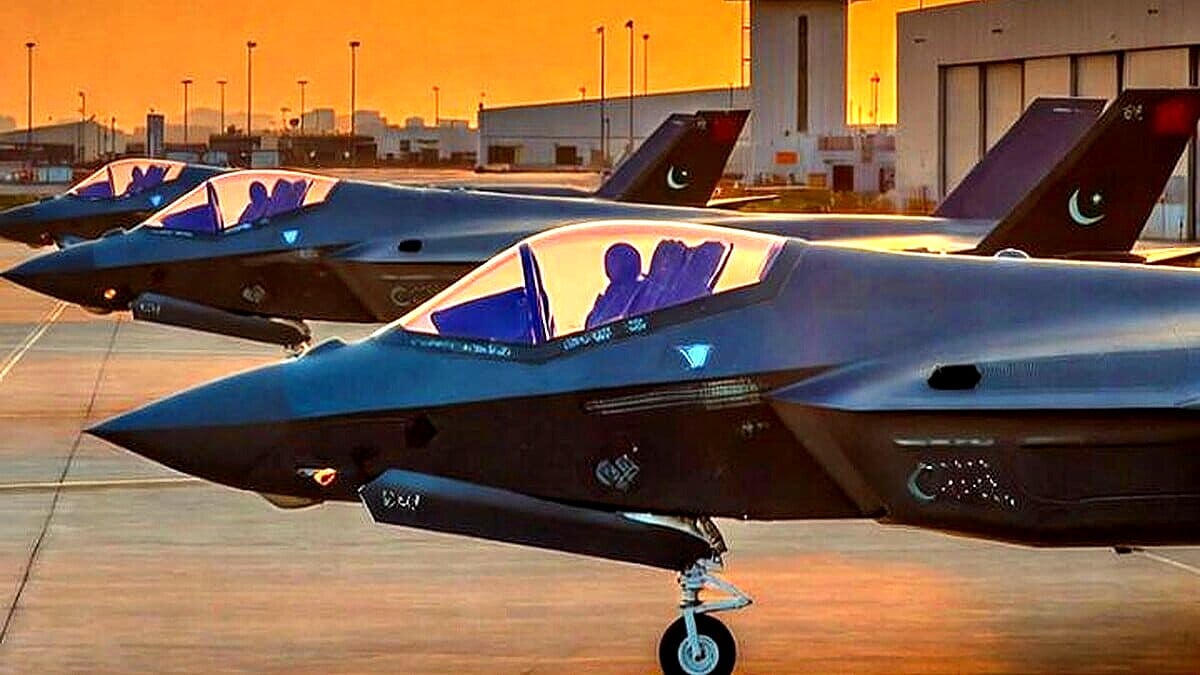




(First Pakistani Export J-35AE stealth fighter rolled out from factory in China?)
factory in China?
defence debate
ISLAMABAD: A quiet development in advanced fighter jet production has triggered intense speculation about a potential shift in Pakistan’s airpower capabilities.
Reports circulating in defence circles suggest that Pakistan’s first fifth-generation stealth fighter jet, the J-35, may have already entered production stages, raising questions about how soon it could reshape the region’s aerial balance.
The claim, attributed to defence analyst commentary and media leaks, hints that Pakistan could be preparing to induct one of the most advanced combat platforms currently under development.
But what exactly is known, and what remains uncertain, is where the real story begins.
A production milestone that changed the conversation
The reported rollout of the J-35 from the production line marks a critical milestone, even though no official confirmation has been issued by either Pakistan or China.
Such production signals typically indicate that design, testing, and initial validation phases have matured enough to move toward operational readiness.
If accurate, this development suggests that the aircraft is no longer just a prototype concept but a platform entering a more tangible phase of deployment planning.
That alone has been enough to ignite debate across defence analysts and regional observers.
The numbers behind the speculation
According to circulating reports, Pakistan is believed to be seeking around 40 J-35 stealth fighters as part of a long-term modernization strategy.
Even more intriguing is the claim that an initial batch of 4 to 6 aircraft could be delivered as early as the end of 2026.
However, timelines remain fluid, with broader projections placing full delivery phases somewhere between 2026 and 2028 at the earliest.
Such staggered induction is typical for advanced fighter programs, where operational integration takes place gradually rather than all at once.
This raises a key question: how quickly can these jets transition from delivery to full combat readiness?
Why the J-35 matters
The J-35 represents a new generation of stealth aircraft designed to operate in highly contested environments with reduced radar visibility.
Its potential capabilities include advanced avionics, sensor fusion, and network-centric warfare integration, allowing it to function as part of a broader combat ecosystem.
For Pakistan, the induction of such a platform would signal a shift toward next-generation aerial warfare doctrines.
This is not just about acquiring new jets, but about redefining how air operations are conducted in future conflicts.
And that transformation is where the real strategic implications begin to emerge.
Silence from official channels
Despite growing media attention, there has been no formal confirmation from government or military authorities regarding the procurement or delivery timeline.
This silence is not unusual in high-level defence acquisitions, particularly those involving sensitive technologies like stealth aircraft.
Strategic ambiguity often plays a role in maintaining operational advantage and managing geopolitical responses.
However, the absence of confirmation also means that much of the current narrative remains speculative.
That leaves analysts working with fragments of information rather than a complete picture.
Regional implications quietly unfolding
Even without official statements, the possibility of J-35 induction has already begun influencing strategic calculations in the region.
Modern air combat increasingly depends on stealth, electronic warfare, and long-range engagement capabilities.
If Pakistan successfully integrates such systems within the projected timeframe, it could significantly enhance its deterrence posture.
But integration is complex, involving pilot training, maintenance infrastructure, and compatibility with existing systems.
So the timeline is not just about delivery, but about readiness at scale.
The timeline puzzle
One of the most debated aspects remains the delivery schedule itself.
While some reports suggest initial jets arriving by late 2026, others argue that operational deployment could take longer due to testing and integration phases.
Historically, even advanced air forces require several years to fully operationalize new fifth-generation platforms.
This means that even if deliveries begin early, full capability may not be realized until closer to the end of the decade.
That gap between acquisition and readiness is where uncertainty continues to dominate discussions.
What happens next
For now, the story of Pakistan’s potential J-35 acquisition sits at the intersection of speculation, strategic signa