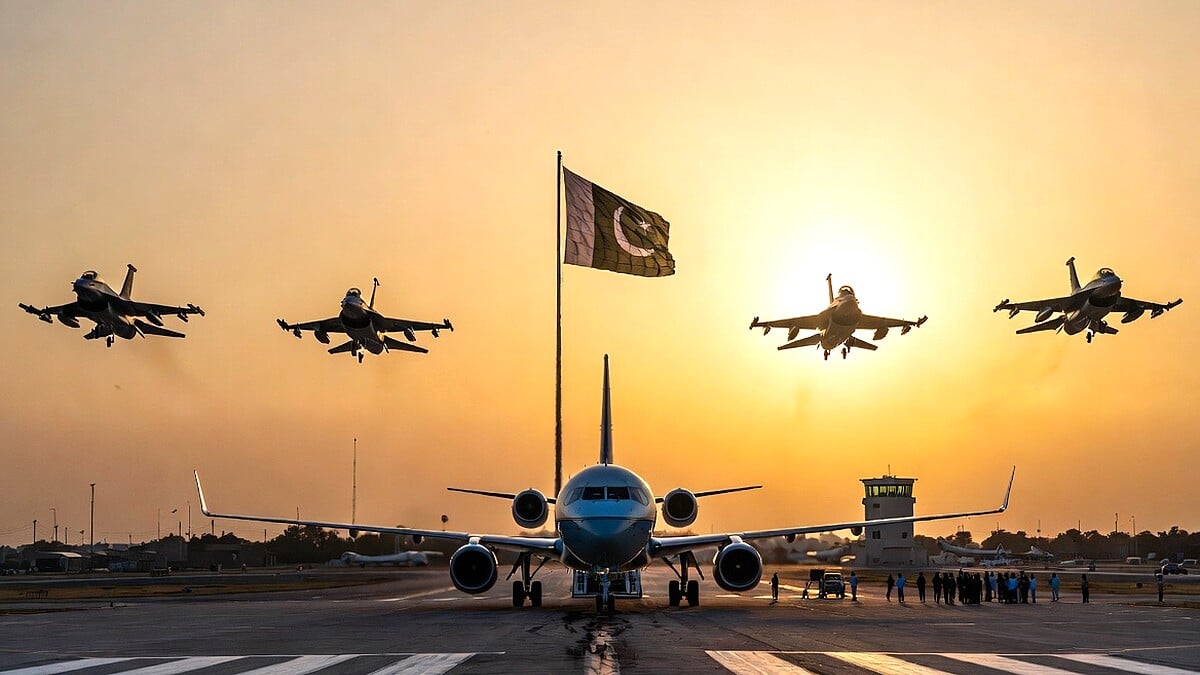




ISLAMABAD: The special aircraft carrying the US Vice President for Iran ceasefire negotiations landed in Islamabad three and a half hours behind schedule on Saturday.
The Boeing C-32A was due to arrive at 7am local time but finally touched down at Nur Khan Airbase at 10:33am.
Aviation experts confirm the flight departed Camp Springs Base at 5:47pm Pakistani time and 8:47am US time.
It completed a 14-hour-20-minute journey after a two-and-a-half-hour stopover in Paris.
The plane deliberately avoided all Middle Eastern airspaces due to prevailing regional tensions.
Instead it routed through Georgia, Azerbaijan, Turkmenistan via Samarkand and then Tajikistan.
Afghanistan’s lengthy airspace was also bypassed for security considerations.
The aircraft entered Pakistani territory near Chitral around 10am under Pakistan Air Force escort.
Five PAF F-16 fighters provided a visible and warm aerial welcome until final landing.
This unusual detour and delay have drawn intense scrutiny from aviation analysts worldwide.
The mission marks the highest-level direct US-Iran engagement since the 1979 Islamic Revolution.
US Vice President JD Vance leads the delegation tasked with converting a fragile two-week ceasefire into permanent peace.
Pakistan has positioned itself as a neutral host for the sensitive talks.
International outlets including Al Jazeera and CBS News confirmed the arrival details and diplomatic stakes.
Regional media such as Geo News and Daily Pakistan first reported the precise 3.5-hour delay and rerouting.
The C-32A is a specially configured Boeing 757 reserved exclusively for vice-presidential travel.
It carries advanced encrypted communications and defensive systems for high-risk diplomatic operations.
Pakistan Army Chief Field Marshal Asim Munir and Deputy Prime Minister Ishaq Dar received the delegation at the airbase.
The talks are expected to address Lebanon ceasefire extensions and the unfreezing of Iranian assets.
Security perimeters around central Islamabad have been expanded to three kilometres for the duration.
Analysts note that standard US-to-Islamabad flights with one stop average 15 hours under normal routing.
This extended timeline and path alterations underscore the extraordinary precautions taken amid ongoing Middle East volatility.
The delay has not derailed the afternoon schedule for initial bilateral meetings.
Pakistan Foreign Ministry described the hosting role as vital for regional stability.
Observers highlight how such air incidents reflect broader challenges in modern great-power diplomacy.
Flight tracking data shows the C-32A maintained commercial altitudes during the non-standard transit.
The arrival reinforces Pakistan’s emergence as a key facilitator in US-Iran de-escalation efforts.
Further rounds of negotiations are anticipated over the coming days in the Pakistani capital.