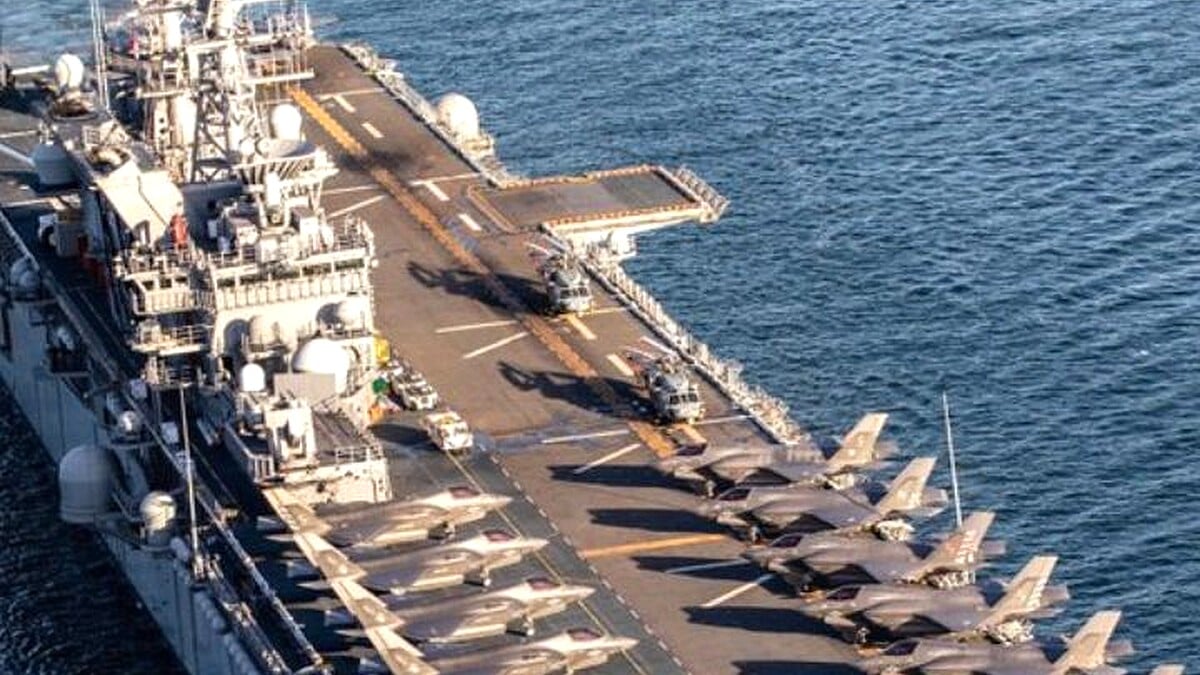




ISLAMABAD: Iran’s Islamic Revolutionary Guard Corps has announced a direct missile strike on the US Navy amphibious assault ship USS Tripoli.
The attack formed part of the 98th wave in its ongoing Operation True Promise 4.
IRGC naval and aerospace forces executed coordinated strikes on US and Israeli command centres.
The statement released through state media Tasnim claimed precision missiles penetrated advanced defences.
USS Tripoli LHA-7 carries more than 5,000 personnel according to the IRGC assessment.
This figure exceeds the vessel’s standard crew of 1,059 plus 1,687 embarked Marines.
The America-class ship displaces over 40,000 tons at full load.
It measures 257 metres in length and reaches speeds of 22 knots.
Its air wing supports up to 20 F-35B Lightning II stealth fighters and MV-22 Osprey tiltrotors.
Following the strikes the vessel withdrew toward the southern Indian Ocean.
Regional outlets including News.az and WANA reported the withdrawal claim within hours.
Operation True Promise 4 has unfolded in nearly 100 waves since early 2026.
Earlier waves targeted HIMARS launchers in Kuwait and Patriot batteries in Bahrain.
Additional strikes hit US-linked sites in the UAE and Israeli logistical hubs.
IRGC officials described the latest phase as retaliation for attacks on Iranian infrastructure.
The operation follows US-led Operation Epic Fury deployments in the Persian Gulf.
USS Tripoli had recently joined as flagship for the Tripoli Amphibious Ready Group.
It transported elements of the 31st Marine Expeditionary Unit from the Pacific.
Independent verification of damage remains unavailable from Pentagon sources.
International coverage has focused primarily on the IRGC announcement itself.
Analysts highlight the claim’s potential to signal Iranian missile reach.
Systems such as Khorramshahr-4 and Kheibar Shekan feature ranges beyond 2,000 kilometres.
Some variants incorporate hypersonic glide capabilities for evasion.
The 98th wave also included drone strikes on UAE-Israeli joint facilities.
A separate cruise missile reportedly struck an Israeli-linked container vessel near Jebel Ali.
IRGC warnings earlier this month promised escalation against civilian infrastructure attacks.
Nearly 30 waves occurred in the past seven days alone.
Targets encompassed northern Israeli airbases and US Fifth Fleet support centres.
The Persian Gulf region has seen airspace closures and heightened naval alerts.
US deployments include additional carrier strike groups in the Arabian Sea.
Iranian state television broadcast footage of missile launches from mobile platforms.
The footage showed coordinated salvos from land and sea-based units.
Pakistan continues to monitor developments given its strategic location.
Diplomatic channels in Islamabad urge immediate de-escalation to prevent wider conflict.
The claimed strike underscores shifting naval power dynamics in the Indian Ocean.
If sustained such operations could challenge US power projection capabilities.
Economic implications include potential disruptions to global oil shipping routes.
Strait of Hormuz traffic already faces increased insurance premiums.
Military observers note the IRGC’s sustained operational tempo over weeks.
Each wave demonstrates improved integration of ballistic and cruise missile systems.
The USS Tripoli incident marks the first reported direct engagement with a major US surface combatant.
Prior waves focused on shore-based assets and support vessels.
Regional media authentication relies on Tasnim and affiliated Iranian outlets.
No satellite imagery or third-party confirmation has surfaced publicly yet.
The development arrives amid broader US-Israel-Iran tensions since March.
IRGC commander statements emphasise continued waves until objectives are met.
Further details on exact impact remain classified under Iranian military protocol.
This latest assertion adds to a growing list of high-profile claims.
Global attention now turns to possible US response options in the theatre.
The southern Indian Ocean withdrawal route suggests a significant tactical repositioning.
Such a move would place the vessel thousands of kilometres from primary operating areas.
Experts estimate repair or assessment timelines could stretch several weeks.
The episode highlights vulnerabilities in even advanced naval defence networks.
Operation True Promise 4 continues to evolve with each successive wave.
IRGC sources pledge intensified strikes in response to any counter-actions.
The Persian Gulf remains on high alert as both sides monitor movements closely.