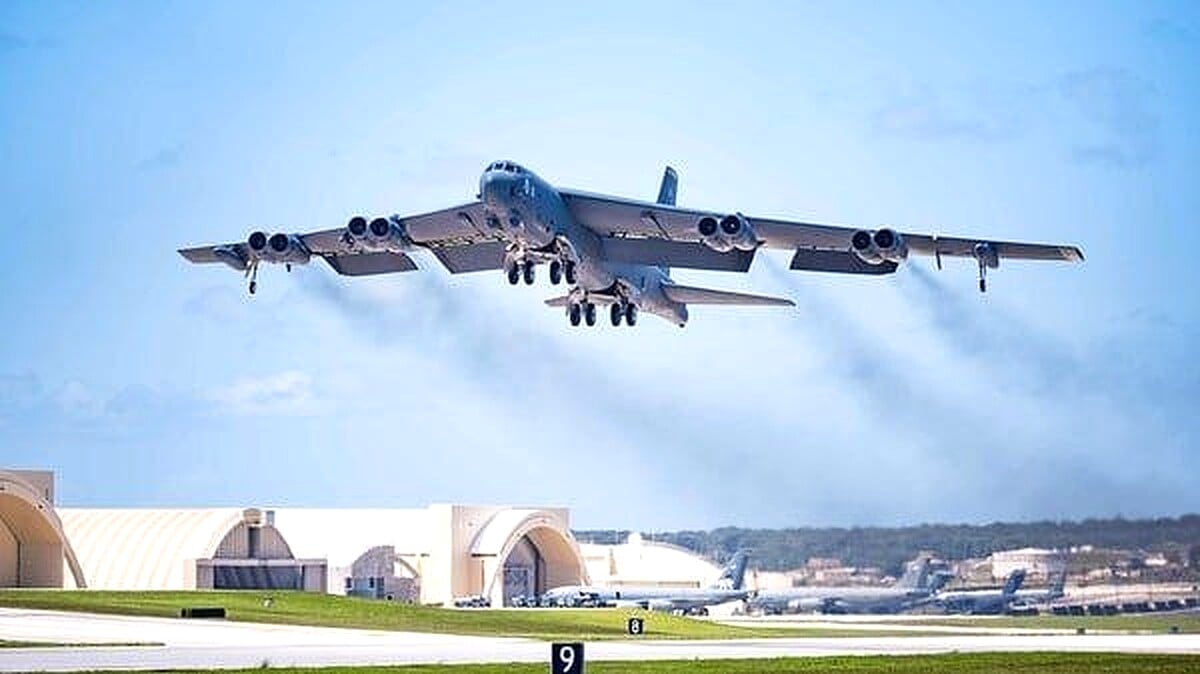




ISLAMABAD: A United States Air Force B-52H Stratofortress bomber declared a general in-flight emergency while flying over southern England on March 24 2026 sending a rare distress signal through one of the world’s most heavily monitored airspaces.
The aircraft registration 60-0060 transmitted squawk code 7700 the international standard for a general emergency prompting immediate attention from air traffic controllers and aviation trackers across the United Kingdom.
Flight monitoring data showed the massive bomber circling steadily at approximately 10 000 feet just east of Southampton in the Solent area before beginning a controlled descent and executing a U-turn near Gillingham in Dorset.
The B-52H ultimately landed safely at its forward operating base RAF Fairford in Gloucestershire touching down on runway 27 at precisely 09 38 GMT with no reported injuries to the five-member crew.
Preliminary assessments from UK aviation sources indicate a depressurisation issue as the probable cause a malfunction that can rapidly compromise cabin pressure at the high altitudes where these long-range bombers routinely operate.
The incident occurred against the backdrop of heightened US military activity in Europe with the affected aircraft forming part of a three-plane Bomber Task Force that arrived at RAF Fairford on March 9 2026 to support ongoing operations linked to Middle East tensions including actions against Iranian targets.
The US Air Force maintains a fleet of exactly 76 B-52H Stratofortress aircraft of which 58 serve in active duty and 18 in reserve units underscoring the platform’s enduring role as the backbone of American strategic airpower since its introduction in the early 1960s.
Each bomber boasts an unrefuelled combat range of 8 800 miles a top speed of 650 miles per hour and a payload capacity of 70 000 pounds enabling it to deliver conventional or nuclear ordnance across continents without intermediate stops.
RAF Fairford operated jointly by the US Air Force and the Royal Air Force features one of Britain’s longest runways specifically designed to accommodate heavy strategic bombers during NATO exercises and rapid-deployment missions.
No official statement has yet been released by the US Air Force or the UK Ministry of Defence regarding the precise trigger for the emergency though depressurisation events typically arise from structural seal failures fuselage damage or auxiliary system malfunctions.
The B-52 fleet’s mission-capable rate has hovered between 50 and 55 percent in recent fiscal years reflecting the intensive maintenance demands on these Cold War-era airframes now undergoing comprehensive upgrades including new Rolls-Royce F130 engines and advanced AESA radar systems.
Experts project the modernised B-52J variant will remain operational until at least 2050 marking a remarkable century of continuous service for the platform originally designed in the 1950s.
This latest alert marks one of several documented B-52 in-flight emergencies over UK territory in recent memory including engine-related diversions in 2019 and 2020 all of which concluded without incident thanks to rigorous crew training and robust emergency protocols.
The safe resolution has drawn widespread coverage in British media outlets with real-time radar tracking confirming the aircraft’s return to base and eliminating any risk to civilian airspace or ground populations.
In the broader strategic context the deployment of these B-52s to British soil represents a visible demonstration of transatlantic deterrence capabilities amid current geopolitical flashpoints where rapid long-range strike options remain paramount.
Aviation observers note that the 7700 squawk protocol triggers an automatic cascade of responses including priority handling from air traffic control and standby emergency services at major bases such as Fairford.
The event highlights both the operational pressures facing ageing yet vital strategic assets and the professionalism that ensures even high-profile technical anomalies conclude without escalation.
As global monitoring continues the successful handling of this emergency reinforces confidence in the reliability of US forward-deployed bomber forces operating from allied European soil.