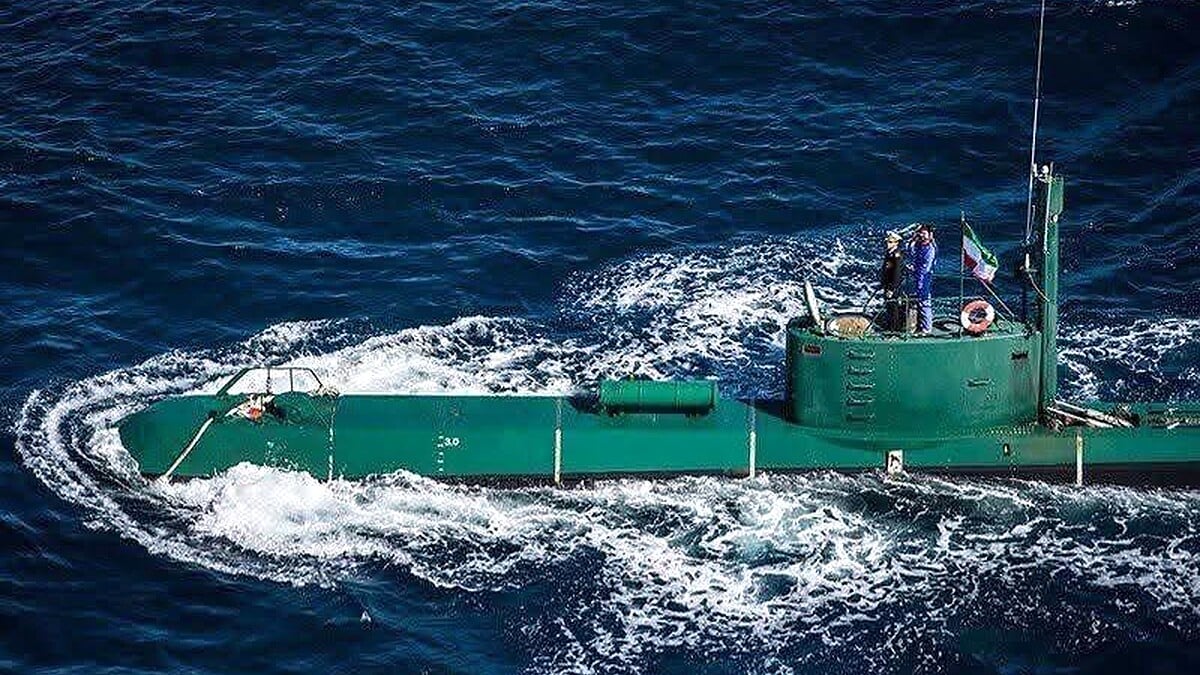




ISLAMABAD: A startling British newspaper report has sent shockwaves through the United States Navy, exposing Iran’s midget submarines as the hidden peril far surpassing its much-publicised missiles and drones.
Britain’s The Telegraph revealed that Tehran has deployed up to 10 Ghadir-class midget submarines, each a tenth the size of conventional attack vessels, designed specifically for the shallow, murky depths of the Persian Gulf.
These vessels measure just 29 metres in length and displace a mere 120 tonnes, roughly the size of a city bus, allowing them to manoeuvre in waters as shallow as 30 metres.
Independent assessments place Iran’s total Ghadir fleet at 23 units within an overall submarine force of 28 to 30 vessels, the bulk optimised for littoral ambush warfare.
The submarines trace their origins to North Korean Yono-class technology supplied around 2004, which Iran reverse-engineered and adapted for the Gulf’s unique conditions after decades of study.
Operating at surface speeds of 10 knots and submerged at 8 knots, they remain virtually silent amid the constant noise of tankers, drilling rigs and commercial traffic.
Advanced US aircraft, satellites and sonar systems struggle to detect them, rendering traditional anti-submarine warfare tactics ineffective in these confined waters.
Armed with two 533-millimetre torpedo tubes, the Ghadir boats can launch heavyweight torpedoes, including the Iranian Hoot supercavitating variant that streaks through water at over 200 knots.
They also carry dozens of naval mines, contact, magnetic, acoustic and pressure types capable of distinguishing ship signatures before detonation.
The primary doctrine focuses not on sinking capital ships outright but on laying minefields at night to choke vital shipping lanes, a process experts say could take weeks to clear.
The Strait of Hormuz, through which 21 per cent of global oil trade flows daily, stands as the prime target for this asymmetric strategy.
No US naval vessel, including carrier strike groups, remains truly safe in these waters, forcing American commanders to maintain greater distances and divert resources to intensive underwater patrols.
Recent deployments amid escalating tensions have amplified fears that Iran’s underwater force could disrupt international shipping far beyond missile or drone strikes.
The Telegraph emphasised how the Gulf’s geography, combined with four decades of Iranian training, turns these tiny craft into a potent denial weapon against superior surface fleets.
Comparisons highlight the asymmetry: a single Ghadir displaces 120 tonnes against the US Ohio-class nuclear submarine’s 18,750 tonnes and 170-metre length.
Yet in the Persian Gulf’s 30-metre average depths, size becomes an advantage rather than a liability.
Iranian naval exercises have repeatedly demonstrated subsurface missile launches, including Nasr-1 anti-ship variants, adding another layer to the threat matrix.
Western analysts now concede Tehran’s preparations exceed earlier expectations, shifting the balance in any Hormuz confrontation.
The quiet fleet’s ability to lay mines undetected and vanish creates operational friction that even the world’s most advanced navy finds difficult to neutralise swiftly.
Global energy markets remain vulnerable, with potential blockades risking immediate spikes in oil prices and supply chain chaos.
This undersea dimension has redefined threat perceptions, moving focus from aerial and missile domains to the silent depths below.
Pakistan and regional observers note the strategic implications for maritime security in the broader Indian Ocean approaches.
Iran’s investment in midget submarines underscores a calculated doctrine of anti-access and area denial tailored to its geography.
The US Navy’s decades-long investment in large platforms now faces a low-cost, high-impact counter in waters where technology alone cannot guarantee dominance.
As tensions persist, the midget submarine network emerges as Tehran’s most potent lever for influencing global trade routes.
This development compels a reassessment of naval strategies across the Gulf and beyond, highlighting the enduring relevance of stealthy, compact platforms in modern asymmetric conflicts.