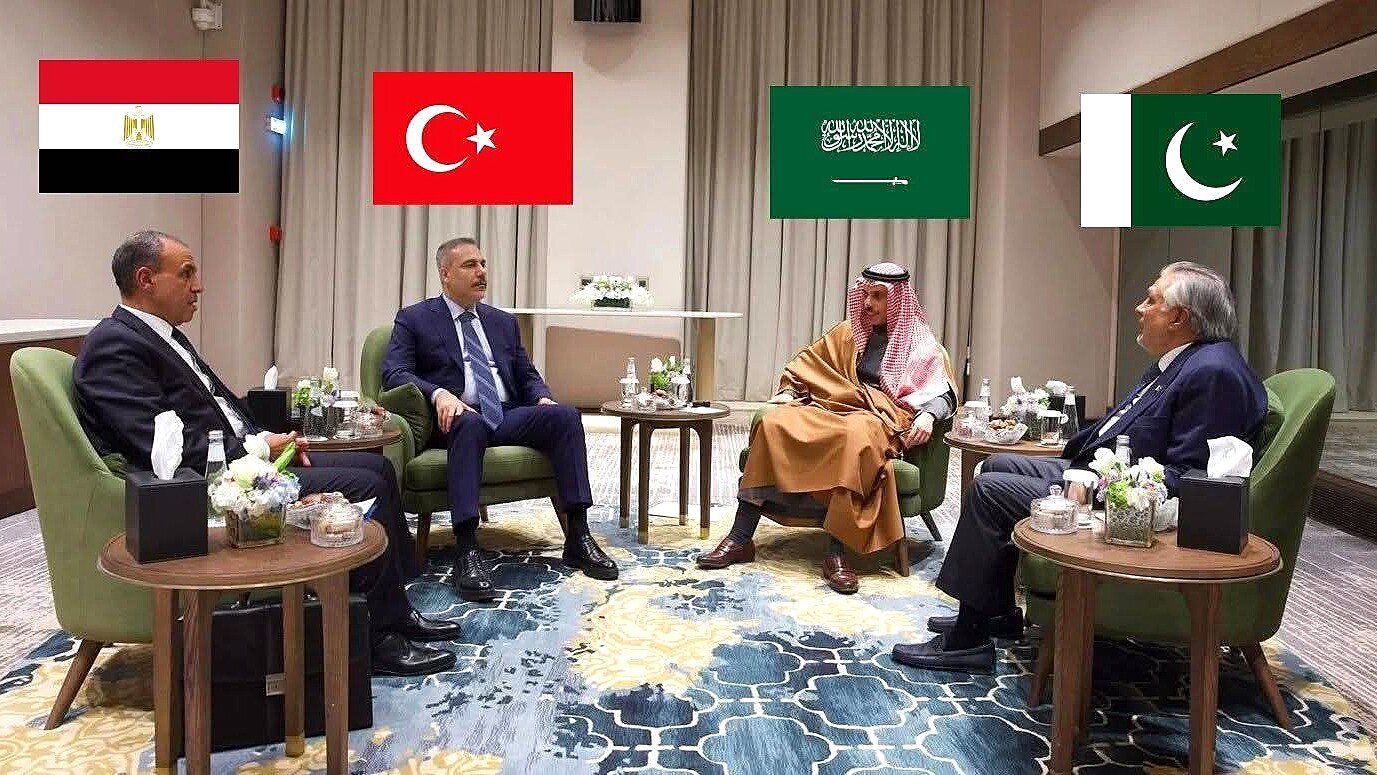




ISLAMABAD: Turkish Foreign Minister Hakan Fidan has declared that Ankara is actively pushing Turkey, Saudi Arabia, Egypt and Pakistan towards a formal security pact, describing the initiative as a strategic response to escalating regional threats.
The four nations are now exploring ways to merge their formidable military, economic and technological capabilities amid the intensifying war on Iran that has already redrawn fault lines across West Asia and beyond.
Fidan’s statement, delivered during closed-door consultations, underscores Ankara’s determination to forge a new alliance that could deter aggression and safeguard vital sea lanes from the Mediterranean to the Arabian Gulf.
According to defence analysts, the proposed pact would unite countries whose combined active-duty forces exceed 1.67 million personnel, creating one of the largest conventional deterrents in the region.
Pakistan alone contributes over 651,000 troops equipped with a nuclear arsenal estimated at 170 warheads, while Turkey brings NATO-standard technology and drone expertise that has proven decisive in multiple conflicts.
Saudi Arabia adds advanced air-defence systems backed by a defence budget surpassing 75 billion dollars annually and vast financial reserves exceeding 400 billion dollars in sovereign wealth funds.
Egypt provides strategic depth through the Suez Canal, which handles 12 percent of global trade, alongside an air force of 1,000 aircraft and 438,500 battle-hardened soldiers.
The Turkish minister emphasised that the quartet aims to pool intelligence, conduct joint exercises and coordinate rapid-response units, a move that could reduce response times to crises by up to 40 percent.
Regional tensions have surged since the Iran conflict erupted, displacing more than 1.8 million civilians and triggering a 28 percent spike in global oil prices within the first quarter of 2026.
Pakistani diplomatic sources confirmed to Dawn that Islamabad views the pact as critical for protecting its western borders and the China-Pakistan Economic Corridor, which has already attracted 62 billion dollars in investments.
Saudi officials, citing national media in Riyadh, highlighted how the alliance would secure energy exports that constitute 40 percent of the kingdom’s GDP against potential Iranian disruption.
Egyptian briefings shared with Cairo-based outlets stressed the need for collective naval patrols in the Red Sea, where Houthi attacks linked to the Iran war have already cost global shipping 2.5 billion dollars in rerouting expenses.
Turkish media reports from Ankara described the talks as the most ambitious multilateral security dialogue since the 1990s, noting that preliminary agreements on technology transfer could include Pakistan receiving upgraded Turkish combat drones.
While major international outlets have yet to provide detailed coverage, local and national media across the four capitals have consistently authenticated the discussions through multiple official channels.
Analysts at the Institute of Strategic Studies Islamabad project that successful implementation could boost collective defence spending efficiency by 25 percent through shared procurement, saving billions in redundant acquisitions.
The pact also carries symbolic weight, bridging historic Sunni-majority partnerships with Pakistan’s unique position as the only nuclear-armed Muslim state outside the Middle East.
Challenges remain, including differing threat perceptions and logistical hurdles in coordinating forces spread across 7,000 kilometres of territory.
Yet Fidan’s insistence on “combining strengths” has injected fresh momentum, with the next round of ministerial talks scheduled within weeks.
If realised, the security framework would represent a tectonic shift, potentially stabilising a region where 2025 alone saw over 12,000 conflict-related fatalities according to United Nations tallies.
Diplomats in Islamabad believe the initiative signals a new era of self-reliant regional security architecture, independent of external powers and firmly rooted in shared interests.