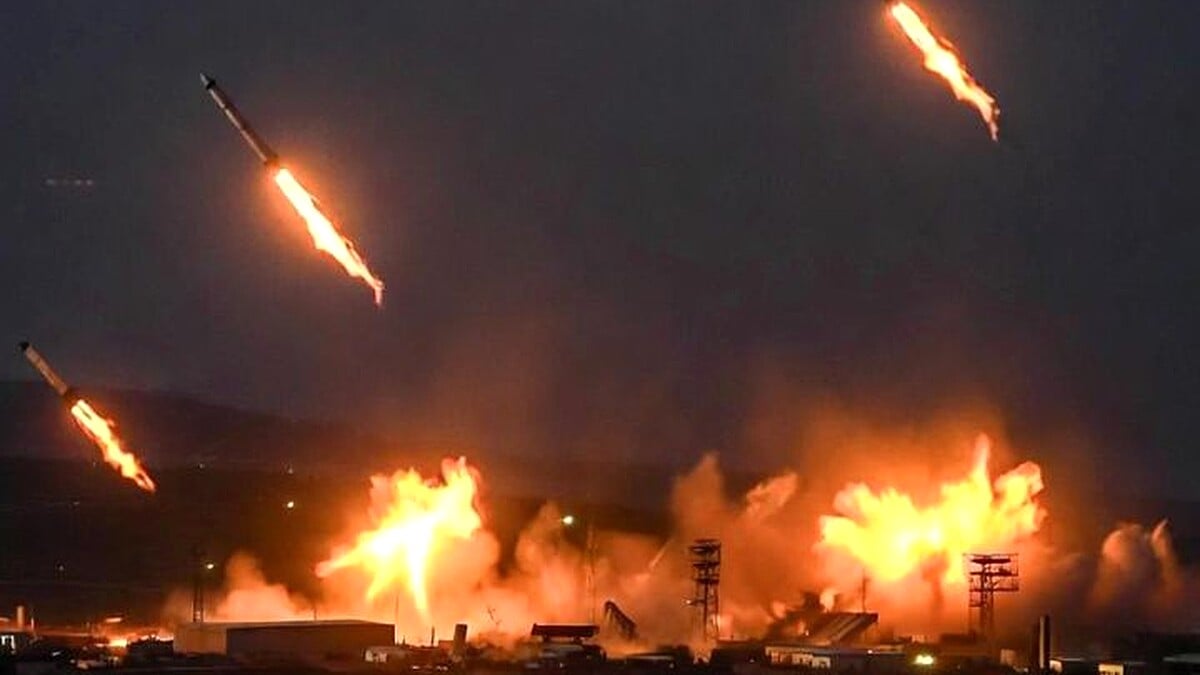




ISLAMABAD: Iranian ballistic missiles and cluster munitions broke through Israeli air defence systems in the early hours of March 23, slamming into targets across Tel Aviv, Kiryat Gat and Ashkelon.
Regional outlets including TRT World reported multiple fatalities and widespread structural damage from the barrage, one of the most direct urban strikes in weeks of escalating conflict.
This breach occurred despite Israel’s vaunted multi-layered defences comprising Arrow-3, David’s Sling and Iron Dome systems.
Israeli military sources have previously admitted interception failures in similar overnight attacks, exposing limits even with advance warnings.
The strikes form part of Iran’s sustained campaign since February 28, during which over 300 ballistic missiles have been launched toward Israeli territory.
Israeli figures show at least 19 civilians killed and 4,292 injured nationwide across the wave of assaults.
Nearly half of the projectiles carried cluster munitions, dispersing dozens of submunitions mid-air that overwhelm conventional interceptors.
Such warheads, though banned under international conventions Israel signed but Iran did not, have repeatedly scattered shrapnel across residential zones.
In Tel Aviv, cluster fragments reportedly rained down, damaging vehicles and buildings in central districts.
Southern city Kiryat Gat sustained heavy hits on infrastructure, while Ashkelon near the Gaza envelope faced direct ballistic impacts.
Search and rescue teams moved swiftly through affected neighbourhoods as dawn broke, with fires and collapsed floors visible in footage shared by regional media.
The assault followed closely on March 22 strikes that hospitalised over 115 people in southern desert towns of Arad and Dimona.
There, conventional ballistic missiles evaded defences, blowing open entire apartment floors and injuring 31 in Arad alone, including 18 children with nine in serious condition.
Israeli Prime Minister Benjamin Netanyahu described earlier incidents as a “miracle” with no deaths, yet Monday’s reports indicate fatalities this time.
Iran’s Islamic Revolutionary Guard Corps has framed the operations as retaliation, deploying systems capable of carrying one-ton warheads over 2,000 kilometres.
Variants such as the Khorramshahr-4 and hypersonic-capable models have featured prominently, travelling at speeds that compress interception windows to seconds.
Defence analysts note that volume barrages combined with cluster technology have reduced effective interception rates below historical 90 per cent benchmarks.
Civilian areas bore the brunt despite Israeli claims of targeting military sites like airbases and nuclear facilities.
Hospitals in affected regions declared mass-casualty alerts, with Soroka Medical Centre treating dozens from successive waves.
The cumulative toll underscores the conflict’s intensity, now entering its fourth week with no immediate de-escalation in sight.
Regional observers highlight how such penetrations challenge long-held assumptions about Israel’s defensive superiority.
Pakistan continues to monitor developments closely, urging restraint to prevent broader Middle East destabilisation.
Fresh alerts sounded across central and southern Israel as emergency services assessed full extent of Monday’s damage.
The use of cluster munitions adds complexity, with unexploded submunitions posing lingering risks to civilians and responders alike.
International calls for ceasefire have intensified, yet missile exchanges persist unabated.
This latest episode marks another milestone in the 2026 confrontation, where precision and volume have repeatedly tested regional security architectures.