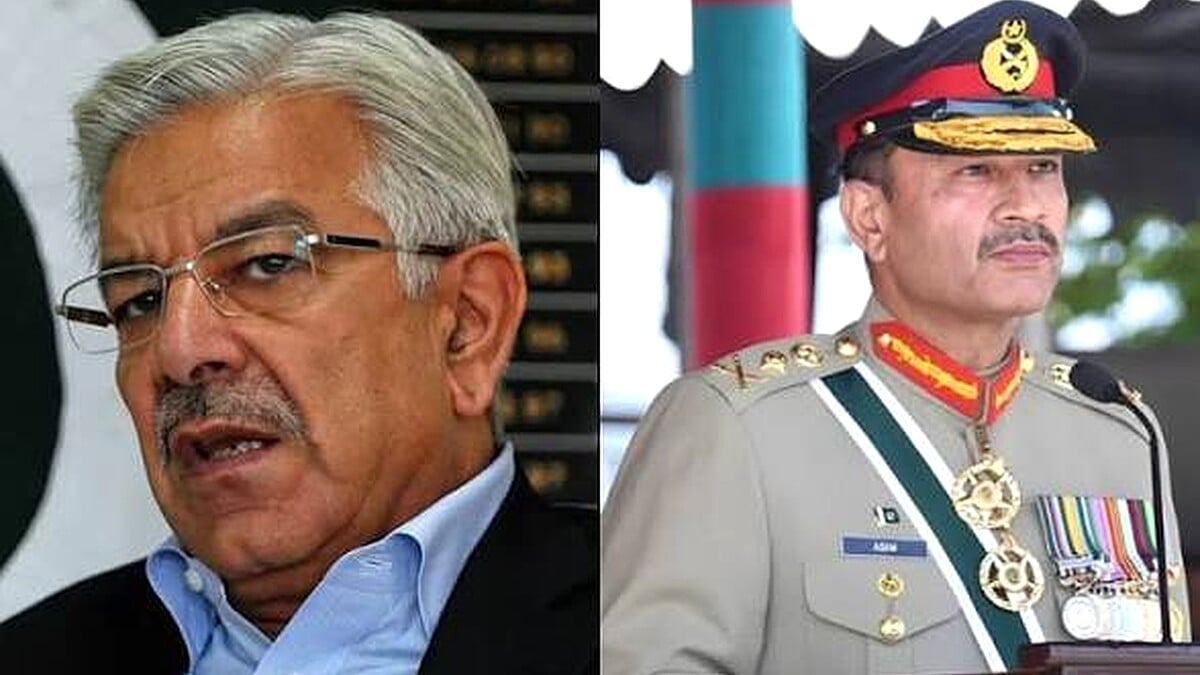




ISLAMABAD: Defence Minister Khawaja Asif has made a sensational disclosure about the intense resistance faced during the appointment of General Syed Asim Munir as Chief of Army Staff in November 2022.
Speaking on a private television channel’s Eid special programme, the senior PML-N leader revealed that three senior generals were shortlisted for the coveted post.
Only Asim Munir, then the senior-most lieutenant general, stood out as number one on merit and fully qualified in every respect.
In sharp contrast, the appointments of his two predecessors under PML-N governments encountered zero institutional pressure or interference.
General Raheel Sharif assumed charge on 29 November 2013 for a standard three-year term while General Qamar Bajwa took over on 29 November 2016, also initially for three years before receiving a later extension to six years total.
This episode marked the first such incident in Pakistan’s 75-year military history where the sitting army chief actively blocked the appointment of his successor.
The delay stretched over eight to ten days as efforts persisted to sideline the top-ranked candidate despite clear seniority rules.
Asif disclosed that the outgoing chief even issued threats of a takeover if the government refused to alter its choice.
The minister added that General Qamar Bajwa himself was keen on securing another extension beyond his already prolonged six-year tenure.
Earlier, the name of Lieutenant General Faiz Hameed was also proposed as an alternative candidate during the deliberations.
Yet the civilian leadership stood firm on Asim Munir because of his outstanding professional profile, vast command experience and unblemished record.
National media outlets including Geo News and Jang have prominently reported these claims, lending strong authentication in the absence of any international coverage.
Pakistan has appointed eleven army chiefs since independence, with the constitutional power of selection resting exclusively with the elected government.
Asif stressed that while some past decisions carried flaws, this marked the first deliberate attempt to shift that authority from politicians to the incumbent army chief himself.
The revelations have ignited fresh debate on civil-military balance, highlighting how close the 2022 transition came to constitutional rupture.
Senior analysts note that the army comprises over 600,000 active personnel, making the chief’s role pivotal to national security and regional stability.
The process ultimately succeeded when the notification for Asim Munir was issued on 29 November 2022 by Prime Minister Shehbaz Sharif.
Asif’s candid account underscores that political resolve ultimately prevailed over unprecedented internal military pushback.
Such disclosures remain rare in Pakistan’s history, where army chief transitions have largely stayed smooth and merit-based.
The minister’s statement serves as a stark reminder of the delicate interplay between elected civilians and the powerful defence establishment.
Observers believe the episode tested the limits of civilian supremacy like never before since the country’s founding.
With Asim Munir now leading the institution, the focus has shifted to operational challenges along multiple fronts.
Yet the behind-the-scenes drama of 2022 continues to echo in political discourse across the nation.