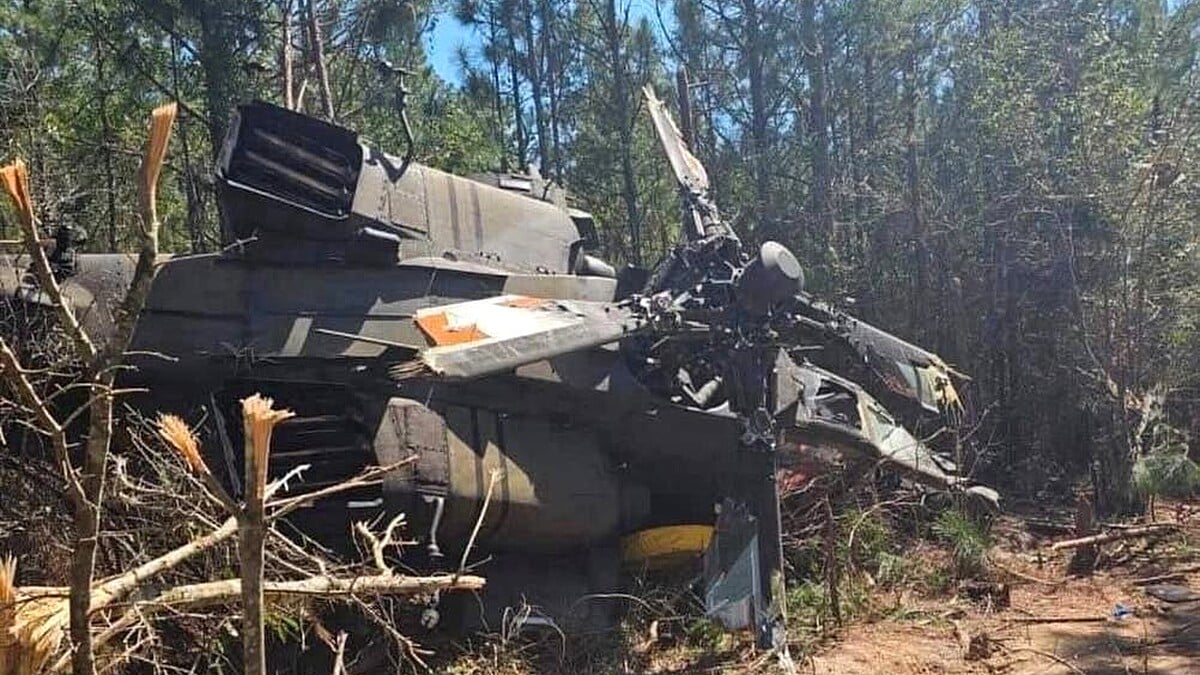




ISLAMABAD: An AH-64 Apache attack helicopter belonging to the United States Army crashed during routine flight training on Thursday morning near Ech Stagefield at Fort Rucker in Alabama.
The incident took place at approximately 7:30 a.m. EST. Both crew members aboard the twin-engine aircraft sustained minor injuries and were immediately transported to a nearby hospital for medical evaluation.
Fort Rucker officials described the event as an aviation mishap. First responders and base personnel responded swiftly to the scene. No property damage was reported and the helicopter remained under investigation.
The base formerly known as Fort Rucker and renamed Fort Novosel in 2023 serves as the United States Army Aviation Center of Excellence. It spans 63,000 acres in southeast Alabama and trains thousands of aviators annually on various rotary-wing platforms.
ECH Stagefield functions as one of several auxiliary training airfields supporting advanced helicopter operations. The location hosts frequent practice flights for attack and utility aircraft under realistic combat scenarios.
The AH-64 Apache remains the backbone of American attack helicopter capabilities. Manufactured by Boeing after initial development by Hughes Helicopters it entered service in April 1986. Over 2,700 units have been produced for the US Army and 18 international partners.
Current specifications include a crew of two a rotor diameter of 48 feet and maximum speed exceeding 150 knots. The helicopter can reach a service ceiling of 20,000 feet and carries Hellfire missiles 70-millimetre rockets and a 30-millimetre chain gun.
As of recent fleet data the United States Army operates around 700 AH-64 variants within its total inventory of nearly 3,900 manned aircraft. The platform has accumulated more than 5.3 million flight hours including 1.3 million in combat operations worldwide.
Apache helicopters played decisive roles in major conflicts. During Operation Desert Storm in 1991 they destroyed hundreds of Iraqi tanks and armoured vehicles. They continued service in Afghanistan Iraq and other theatres providing precision anti-armour and close air support.
Fort Rucker has hosted similar training incidents in the past. A comparable Apache mishap in 2021 also resulted in non-life-threatening injuries to two aviators. Earlier fatal crashes in 2022 and 2024 prompted reviews of maintenance and flight protocols.
US Army aviation safety records show steady improvement over the decades. Disorientation training and advanced simulation programmes at the Alabama base have reduced accident rates. Yet mechanical or human factors occasionally lead to mishaps during high-intensity training.
The latest incident involved a standard two-person crew conducting familiarisation exercises. Officials confirmed the soldiers received prompt care and their condition remains stable. No further details on the exact cause have been released pending the ongoing inquiry.
Military analysts note that such events rarely disrupt overall readiness. The Apache fleet continues to support global operations without interruption. Training schedules at Fort Rucker are expected to resume normally after standard safety checks.
Broader trends in US Army aviation include growing emphasis on unmanned systems. Recent policy reviews have suggested scaling back new Apache procurements while accelerating retirement of older D-model variants. The E-model however stays in active production and frontline service.
Despite these shifts the Apache retains unmatched capabilities in contested environments. Its advanced sensors and weapons integration allow day-night operations in adverse weather. International operators including allies in Europe and Asia continue to value the platform highly.
The investigation by Army aviation authorities will examine flight data recorder information maintenance logs and crew statements. Preliminary findings may emerge in coming weeks though full reports often take months to complete.
This mishap underscores the inherent risks of military aviation training. Fort Rucker’s rigorous programmes prepare pilots for real-world missions yet demand constant vigilance. The two injured soldiers represent dedicated professionals contributing to national defence capabilities.
Public statements from the base stressed commitment to safety. Families of the aviators have been notified and support services activated. The United States Army continues to prioritise the welfare of its personnel during such incidents.
In summary the Thursday crash highlights both the resilience of US military aviation and the challenges of maintaining peak readiness. With data-driven protocols and proven technology the Apache fleet endures as a cornerstone of American air power.