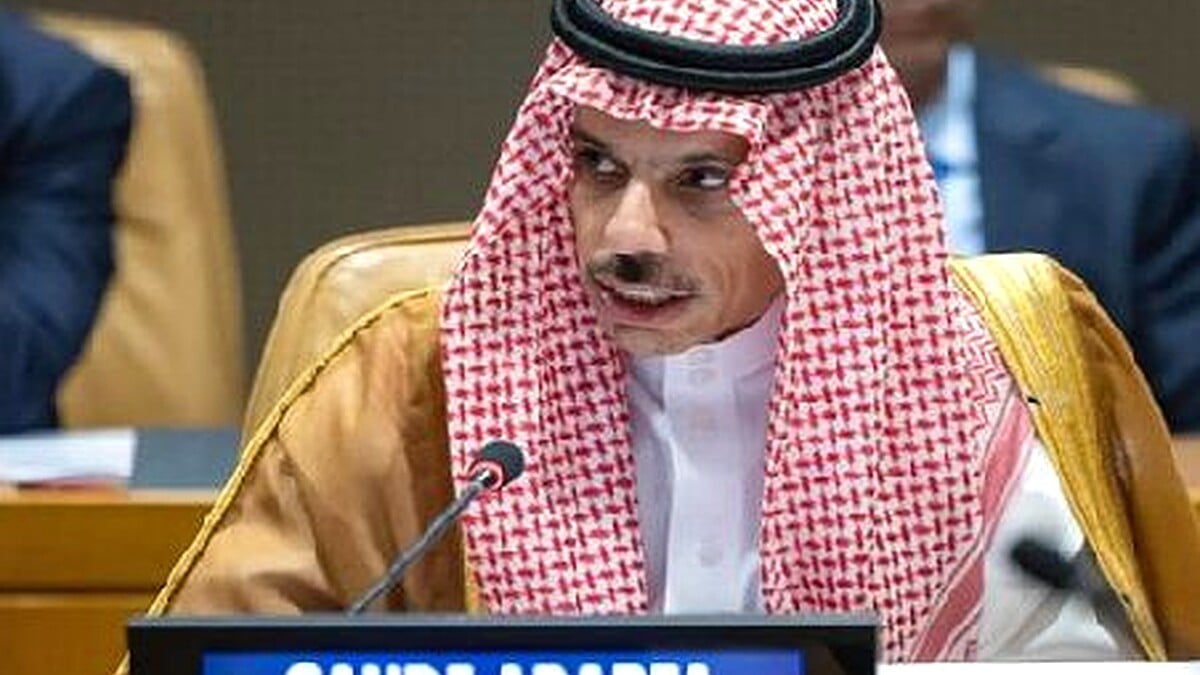




ISLAMABAD: Saudi Arabia has announced its readiness to deliver a full and decisive response to Iranian aggression, declaring that neither the Kingdom nor fellow Gulf states will accept any policy of blackmail or intimidation.
Prince Faisal bin Farhan, Saudi Foreign Minister, delivered the firm message after an emergency gathering of Arab and Islamic foreign ministers in Riyadh on Wednesday.
He warned that Iran must recognise the resolve of Saudi Arabia and its neighbours to counter any act of hostility without hesitation.
“Neither Saudi Arabia nor the Gulf states would accept blackmail, and escalation will be met with escalation,” the minister stated clearly.
He added that freedom of navigation in vital regional waters would be protected at all costs.
The remarks came hours after Iranian ballistic missiles targeted areas near Riyadh, including two refineries, during the very ministerial meeting.
Saudi officials described the timing as a calculated attempt to intimidate participants and exert pressure on Gulf capitals.
Interception systems destroyed most incoming projectiles, yet debris sparked limited fires at energy facilities.
Such incidents form part of a wider pattern of Iranian strikes on Gulf infrastructure that began after late February escalations.
Prince Faisal emphasised that these actions have completely shattered the limited trust that had existed with Tehran.
He noted that Iran appears to believe its neighbours lack the capacity or will to respond, calling this a dangerous miscalculation.
Gulf Cooperation Council members possess advanced military capabilities and stand united in defence of their sovereignty.
Recent GCC statements have repeatedly affirmed the right to self-defence under Article 51 of the United Nations Charter.
A United Nations Security Council resolution adopted earlier this month, co-sponsored by 136 countries, condemned Iranian attacks on GCC states and Jordan in the strongest terms.
The resolution demanded an immediate and unconditional cessation of all provocations, including proxy activities.
Despite diplomatic isolation, Tehran has continued targeting civilian and economic sites across the region.
Energy infrastructure has borne the brunt, with reported strikes on facilities in Saudi Arabia, the United Arab Emirates, Qatar and Bahrain.
Saudi Aramco, the world’s largest oil exporter, has described the ongoing disruptions to the Strait of Hormuz as the industry’s biggest crisis in decades.
Normally, around 20 million barrels of oil and petroleum products transit the strait daily, accounting for roughly 20 per cent of global seaborne oil trade.
Since late February, commercial tanker traffic has fallen to a mere trickle, with only a handful of vessels making the passage.
Iran itself has managed to sustain limited exports through the waterway, but Gulf producers have diverted volumes where possible.
Saudi Arabia has accelerated use of its East-West pipeline to the Red Sea port of Yanbu, offering customers alternative loading options.
The pipeline’s capacity reaches up to five million barrels per day, though actual throughput remains lower due to infrastructure limits.
The United Arab Emirates similarly utilises the Habshan-Fujairah pipeline to bypass the strait.
These contingency measures provide partial relief but cannot fully offset the scale of disruption.
Global oil inventories stand at multi-year lows, heightening risks of price volatility and supply shortages.
Analysts warn that prolonged closure of the strait could trigger significant economic repercussions across Asia and Europe.
Pakistan, as a major importer of Gulf crude, monitors these developments closely for their impact on energy costs and trade routes.
Prince Faisal stressed that Gulf states coordinate closely to confront the threat collectively.
He dismissed Iranian justifications linking attacks to external military presence, calling them unconvincing.
Instead, he portrayed the strikes as premeditated coercion aimed at achieving political objectives through intimidation.
The minister expressed hope that Tehran would heed the unified message from the Riyadh meeting and recalculate its approach swiftly.
Continued aggression, he cautioned, would only deepen Iran’s isolation and invite stronger countermeasures.
Bahrain has separately called for a firm international response to safeguard freedom of navigation in the Strait of Hormuz.
Such calls reflect broader concern that threats to this critical chokepoint endanger not only regional stability but global commerce.
Gulf leaders have repeatedly highlighted their preference for dialogue while making clear that restraint should not be mistaken for weakness.
Prince Faisal reiterated that political, economic and diplomatic levers would be employed first to halt attacks on Gulf territory.
At the same time, he left no doubt that military options remain available if necessary.
The Saudi position aligns with earlier GCC ministerial declarations condemning Iranian violations of sovereignty and good-neighbourly principles.
These statements have underscored the indivisibility of security among member states.
Any aggression against one is viewed as an attack on all, in line with the GCC Joint Defence Agreement.
Observers note that the current crisis marks a sharp reversal from the relative de-escalation that followed the 2023 China-brokered reconciliation between Saudi Arabia and Iran.
That agreement had raised hopes for reduced tensions and enhanced economic cooperation.
Recent events have erased those gains, with trust now described as “completely shattered”.
Regional analysts suggest the Gulf states’ unified stance could encourage greater international engagement to restore maritime security.
Several countries have already extended naval missions to protect shipping lanes in the Arabian Sea and approaches to the strait.
For Pakistan, the situation carries added significance given longstanding ties with both Saudi Arabia and Iran, as well as dependence on stable energy flows.
Diplomatic circles in Islamabad continue to advocate for restraint and dialogue to prevent further escalation.
Prince Faisal’s clear message, however, signals that patience with Iranian pressure tactics has limits.
Gulf states, he concluded, will defend their interests resolutely while upholding international law and the safety of global navigation routes.