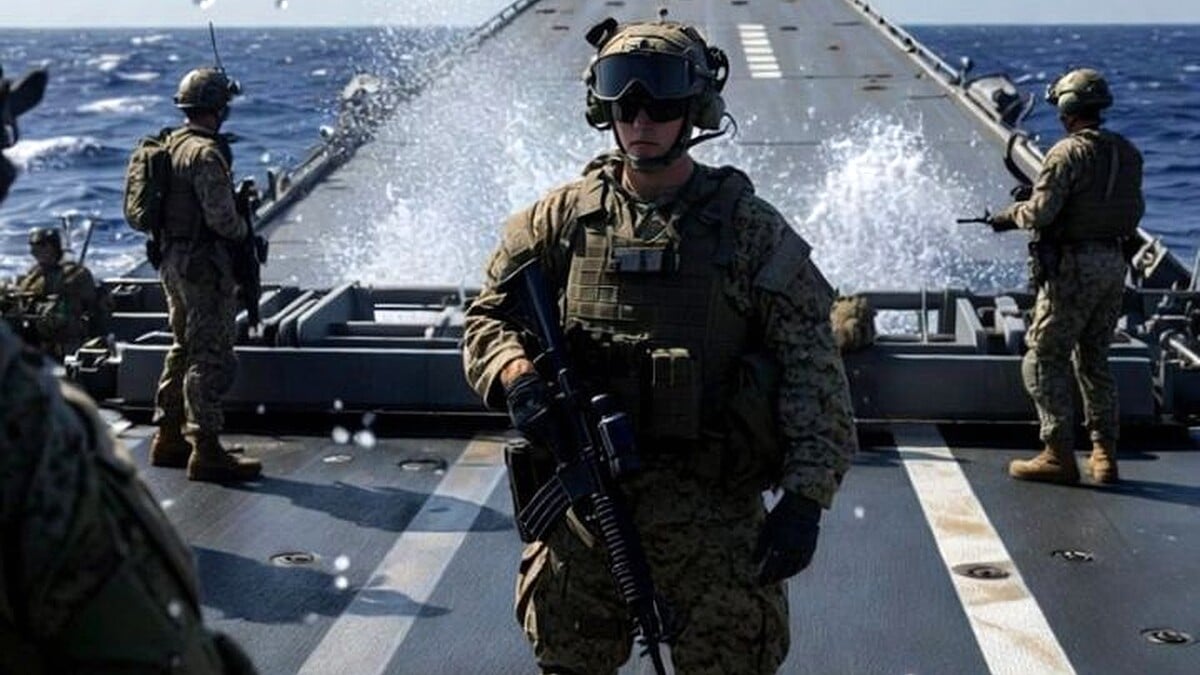




The United States has deployed approximately 2,500 Marines to the Middle East amid escalating tensions in the Strait of Hormuz, signaling a potential shift toward more direct military involvement in the ongoing conflict with Iran.
ISLAMABAD: The United States has ordered the deployment of a Marine Expeditionary Unit comprising around 2,500 combat-ready Marines to the Middle East, approved by Defense Secretary Pete Hegseth following a request from US Central Command.
This move comes as Iranian actions have effectively disrupted maritime traffic through the Strait of Hormuz since early March, a critical chokepoint for global energy supplies.
The strait, only 21 miles wide at its narrowest point, handles roughly 20 percent of the world’s daily oil consumption and a significant share of liquefied natural gas exports from the Persian Gulf.
Since the onset of heightened hostilities involving US and Israeli operations against Iran starting late February, tanker transits have plummeted dramatically, with many shipping companies halting passages due to the risk of attacks.
Reports indicate that oil tanker traffic has dropped by as much as 97 percent in recent days, stranding vessels and forcing rerouting that adds substantial time and cost to global supply chains.
Brent crude prices have surged past $100 per barrel in response, marking a sharp increase from levels around $65 earlier in the period and reflecting intense market fears over prolonged supply disruptions.
Analysts note that the price spike has erased recent gains from policy adjustments elsewhere and introduced a heavy geopolitical risk premium into energy markets.
The deployed Marine Expeditionary Unit, typically embarked on an Amphibious Ready Group including an assault ship such as the USS Tripoli, guided-missile cruisers, and destroyers, brings integrated air, ground, and amphibious capabilities.
This force includes F-35 fighter jets, MV-22 Osprey tilt-rotor aircraft, attack helicopters, light armored vehicles, and artillery units designed for rapid projection of power from the sea without relying on established runways or ports.
Such units are historically structured for seizing and holding coastal objectives, providing commanders with flexible options for land-based operations if required.
Military experts point out that Marine Expeditionary Units played a key role as initial ground forces in major operations, including the 2003 invasion of Iraq, where they secured key infrastructure swiftly.
The current deployment adds to existing US naval assets in the region and appears aimed at bolstering deterrence against further Iranian interference in the waterway.
Iran maintains a formidable array of coastal defenses along both sides of the strait, including thousands of naval mines—the largest such arsenal in the Middle East—and an extensive inventory of anti-ship missiles capable of targeting vessels from shore-based launchers.
These systems, some costing as little as $50,000 each, pose asymmetric threats to multi-billion-dollar warships and commercial tankers alike.
Despite repeated airstrikes by US and allied forces targeting Iranian naval assets, including minelaying vessels, the strait remains effectively paralyzed, with no immediate resumption of normal traffic in sight.
Defense officials have indicated that the US military is not yet fully prepared to escort tankers through the passage under current conditions, highlighting the complexity of the challenge.
The deployment underscores Washington’s determination to safeguard freedom of navigation in this vital artery, amid warnings that prolonged closure could lead to even steeper oil price increases and broader economic fallout.
Global energy markets remain on edge, with some forecasts suggesting Brent could climb toward $150 if disruptions extend further.
The presence of amphibious forces capable of direct action has fueled speculation about potential operations to neutralize Iranian positions on nearby islands or coastal areas controlling the strait.
However, Pentagon statements emphasize that the primary intent is to enhance regional security and support ongoing efforts rather than signal an imminent ground invasion.
The escalation coincides with broader conflict dynamics, including strikes on energy infrastructure and Iranian pledges to leverage the strait as strategic pressure against adversaries.
As the situation evolves, the arrival of these Marines represents a significant reinforcement of US posture in one of the world’s most volatile maritime domains.