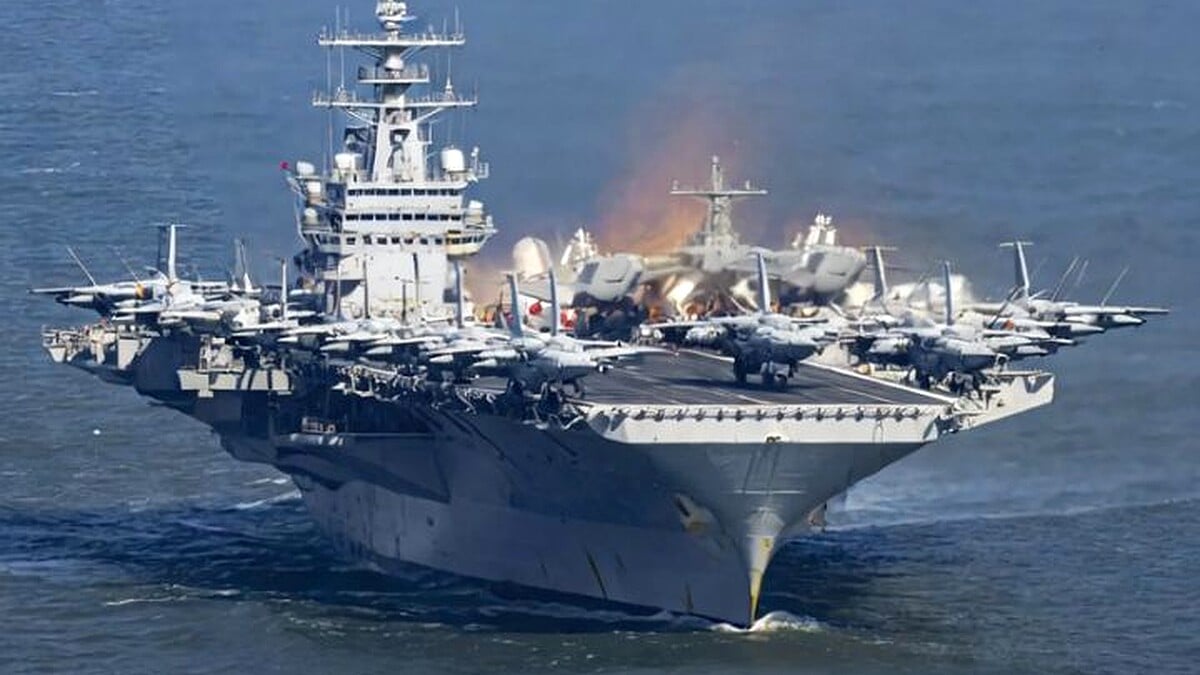




ISLAMABAD: Iran’s Islamic Revolutionary Guard Corps has released footage purporting to show the launch of anti-ship ballistic missiles directed toward the United States Navy’s USS Abraham Lincoln aircraft carrier, heightening tensions in the ongoing regional conflict.
The video, widely circulated on social media platforms and Iranian-affiliated channels on March 6, 2026, depicts multiple missile launches from coastal positions, claimed to be aimed at the Nimitz-class supercarrier operating in the Arabian Sea or nearby waters.
Iranian military spokespersons described the action as part of retaliatory operations following United States and Israeli strikes on Iranian territory, including facilities and leadership targets, which began in late February 2026.
The USS Abraham Lincoln, a nuclear-powered vessel carrying approximately 5,000 personnel and embarked Carrier Air Wing Nine, has been central to United States Central Command operations in the region since its deployment earlier in the year.
Reports indicate the carrier was positioned in the Arabian Sea, roughly 250 to 500 kilometres off Iran’s southern coast near areas such as Chabahar, placing it within theoretical range of Iran’s developing anti-ship ballistic missile arsenal.
Iran’s Revolutionary Guard asserted that four such missiles were involved in targeting the carrier, framing the move as a demonstration of capability against American naval presence in the Gulf of Oman and adjacent seas.
United States Central Command swiftly rejected these assertions, stating in official communications that no missiles approached the USS Abraham Lincoln and that the vessel sustained no damage.
Central Command emphasized that the carrier continued normal flight operations, launching fighter aircraft in support of ongoing missions against Iranian threats.
Independent analyses of circulating footage have raised questions about its authenticity, with some observers noting similarities to earlier propaganda videos or simulations released by Iranian entities.
Prior instances include AI-generated or simulated depictions of attacks on United States carriers, circulated by IRGC-linked channels as early as January and February 2026 to underscore deterrence messaging.
The current release aligns with Iran’s pattern of publicising missile capabilities amid the conflict, which has seen barrages of ballistic missiles, cruise missiles, and drones directed at United States-affiliated sites in Gulf states.
Regional air defence systems, including those operated by the United Arab Emirates and others, have intercepted a significant portion of incoming threats, though penetrations have caused limited damage in some locations.
The USS Abraham Lincoln forms the core of a carrier strike group, supported by guided-missile destroyers, cruisers, and submarines equipped with advanced defensive systems such as Aegis combat suites designed to counter ballistic and cruise missile threats.
Military experts note that successfully targeting a manoeuvring carrier at sea with ballistic missiles requires precise real-time tracking, terminal guidance, and overcoming layered defences, challenges that have limited historical successes.
No credible independent verification has confirmed impacts on the carrier, and United States officials have dismissed Iranian claims as unsubstantiated propaganda.
The incident underscores the broader naval dimension of the conflict, where Iran seeks to contest United States maritime dominance through asymmetric capabilities, including anti-ship missiles developed over recent years.
United States forces have responded with strikes on Iranian naval assets, including the reported sinking of vessels and attacks on drone carriers, as documented in Central Command releases.
Tensions persist as both sides exchange claims, with the potential for further escalation in the strategically vital Strait of Hormuz and surrounding waters.
Observers monitor developments closely, given the implications for global energy routes and alliance dynamics in the Middle East.
The release of such footage serves dual purposes for Iran: bolstering domestic morale and projecting power internationally amid sustained military pressure.
United States presence in the region, including the Abraham Lincoln and accompanying assets, remains robust, supporting defensive and offensive operations as directed by higher authorities.
The situation evolves rapidly, with diplomatic channels limited and military postures on high alert across the theatre.