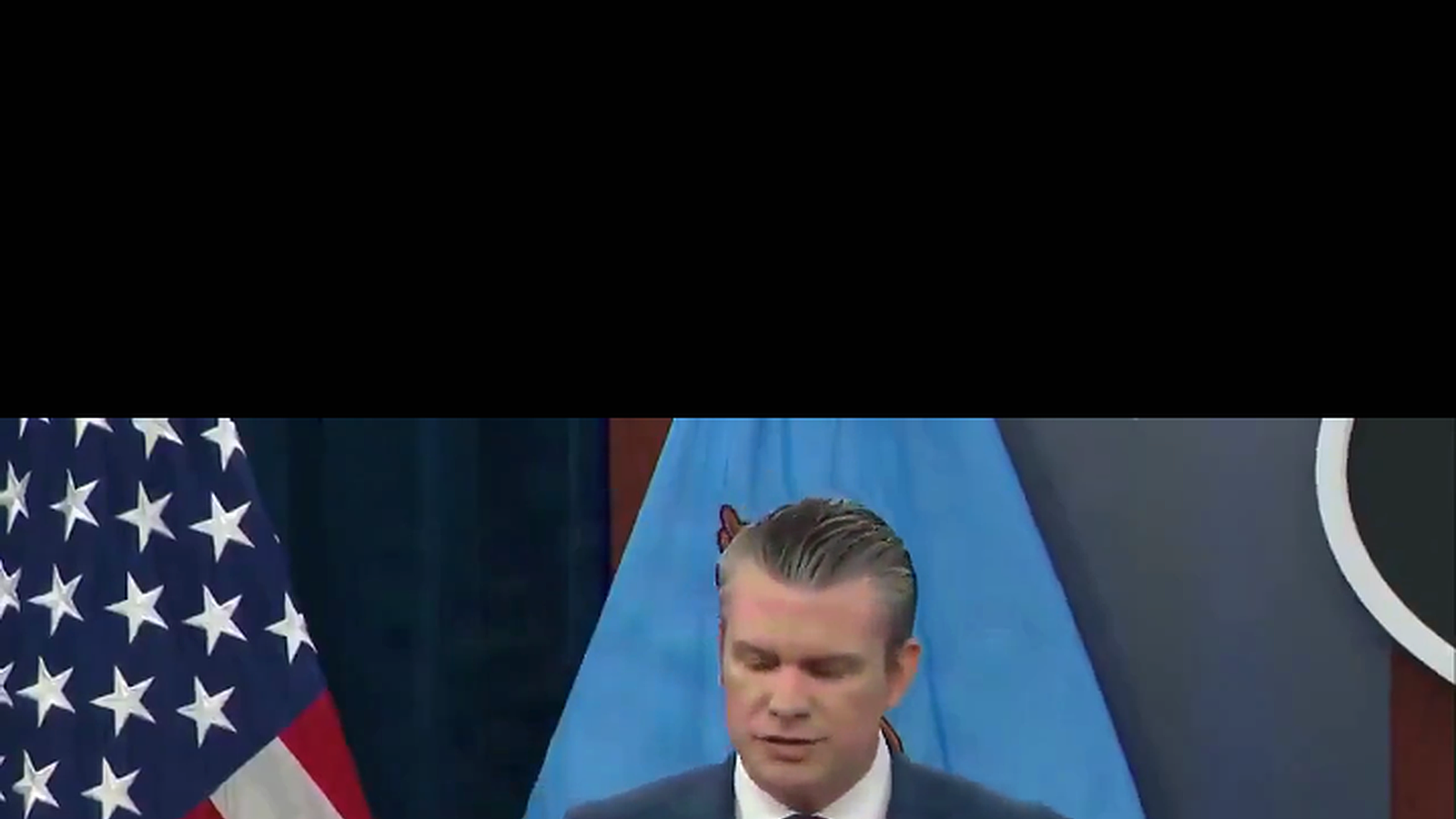




ISLAMABAD: In a statement, United States Secretary of Defense Pete Hegseth declared that regimes believing in what he termed “Islamic prophetic delusions” cannot possess nuclear weapons, directly linking the ongoing military assault on Iran to broader religious prejudices.
The remarks came during a Pentagon briefing on Monday, where Hegseth defended President Donald Trump’s authorization of Operation Epic Fury, a joint US-Israeli campaign that commenced on February 28, 2026, targeting Iran’s leadership, military infrastructure, and nuclear facilities. This operation has already resulted in the deaths of key Iranian figures, including Supreme Leader Ali Khamenei, and has escalated into a full-scale conflict with retaliatory strikes affecting US bases in the region.
Hegseth’s full quote emphasized, “Crazy regimes like Iran, hell-bent on prophetic Islamist delusions, cannot have nuclear weapons. It’s common sense.” He framed the strikes as a necessary response to Iran’s alleged threats, including attacks that killed four US service members prior to the operation. Critics argue that such language not only targets Iran’s government but also disparages core Islamic tenets, including prophetic traditions central to the faith.
The military campaign, described by US officials as the most precise aerial operation in history, began with a decapitation strike on a high-level meeting in Tehran, eliminating Khamenei, the defense minister, and other top commanders. By March 2, US Central Command reported striking over 1,250 targets, destroying 11 Iranian ships, and degrading air defense systems, missile sites, and drone facilities.
Casualties have mounted rapidly, with the US confirming six American deaths by March 3, while Iranian sources report hundreds of civilian and military losses, including damage to cultural sites like the UNESCO-listed Golestan Palace in Tehran. Power outages and explosions have plagued cities such as Urmia and Karaj, disrupting daily life and exacerbating humanitarian concerns.
President Trump, in interviews, projected the conflict could last four to five weeks but affirmed readiness to extend it indefinitely to neutralize Iran’s missile capabilities, navy, and nuclear program. He described the strikes as addressing a generational threat dating back to 1979, invoking self-defense under Article 51 of the UN Charter and accusing Iran of violating Security Council resolutions on its nuclear activities.
Iran’s nuclear program, under international scrutiny since the early 2000s, has been a flashpoint. The 2015 Joint Comprehensive Plan of Action, which limited Iran’s enrichment in exchange for sanctions relief, was abandoned by the US in 2018 under Trump’s first term. Recent intelligence suggests Iran has enriched uranium to near-weapons-grade levels, with the International Atomic Energy Agency reporting 5,525.5 kilograms of enriched uranium as of late 2025, far exceeding JCPOA limits.
Hegseth’s phrasing has drawn sharp rebukes for its perceived Islamophobia. Social media platforms in Pakistan and beyond erupted with accusations of religious bigotry, with users labeling the comments as offensive to over 1.8 billion Muslims worldwide. One prominent post from a Pakistani analyst questioned the silence of the Muslim ummah, garnering thousands of engagements.
In Pakistan, a nuclear-armed Islamic republic, the statement resonates deeply. Officials and experts view it as a veiled threat, given Islamabad’s own arsenal, developed in response to regional security dynamics, including India’s nuclear tests in 1998. Pakistan’s program, estimated at 170 warheads by the Stockholm International Peace Research Institute in 2025, is justified as a deterrent against existential threats.
Foreign policy analysts in Islamabad argue that Hegseth’s words undermine diplomatic efforts and fuel anti-Western sentiment. A senior diplomat, speaking anonymously, noted that such rhetoric could embolden extremists and complicate counterterrorism cooperation, which has seen Pakistan conduct over 50 operations against militant groups in 2025 alone.
Broader reactions from the Organization of Islamic Cooperation have condemned the strikes and the accompanying language, calling for an immediate ceasefire and UN intervention. Saudi Arabia reported a drone attack on its Ras Tanura refinery, halting operations temporarily, while oil prices surged 10 percent to over 82 dollars per barrel amid fears of disrupted supplies through the Strait of Hormuz.
The conflict has rippled across the Middle East, with Iranian proxies launching retaliatory missiles at US embassies and bases in Iraq, Syria, and Saudi Arabia. In Beirut, explosions linked to the strikes have heightened tensions, prompting evacuations.
Experts warn of a protracted war. The Institute for the Study of War reported on March 2 that US-Israeli forces have established local air superiority over western Iran, enabling further degradation of defenses. However, Iran’s top security official, Ali Larijani, vowed a long resistance, denying reports of negotiation attempts and labeling Trump’s aims as delusional.
Pakistan’s government has yet to issue an official response, but public discourse reflects growing unease. Mosques in Lahore and Karachi held prayers for peace, with imams decrying the vilification of Islamic beliefs. Civil society groups urged Islamabad to convene an emergency OIC session to address the crisis.
Historically, US policies on nuclear non-proliferation have been selective. While Iran faces sanctions, Israel’s undeclared arsenal, estimated at 90 warheads, receives tacit approval. This double standard, highlighted in a 2025 Carnegie Endowment report, erodes trust in international regimes like the Nuclear Non-Proliferation Treaty, which Pakistan has not signed.
The episode underscores deepening US-Iran hostilities. Since the 1979 revolution, tensions have simmered, escalating through proxy conflicts in Yemen, Syria, and Iraq. The current war marks the first direct US military engagement with Iran since the 1980s Tanker War.
As the conflict unfolds, global powers like China and Russia have called for restraint, with Beijing offering mediation. The UN Security Council convened an emergency meeting, but veto powers complicate resolutions.
In Islamabad, concerns mount over spillover effects, including refugee influxes and economic strain from rising energy costs. Pakistan’s economy, already grappling with inflation at 12 percent in early 2026, could face further pressure.
Hegseth’s comments, while aimed at Iran, risk alienating allies. A Pew Research survey from 2025 showed 65 percent of Pakistanis view the US unfavorably, a sentiment likely to worsen.
The path forward remains uncertain. Trump administration officials insist the operation is laser-focused on regime capabilities, not occupation. Yet, with no clear endgame, the strikes could reshape Middle Eastern geopolitics for decades.
Pakistan, balancing ties with Washington and Tehran, must navigate carefully. Enhanced border security measures have been implemented, with the military on alert for potential escalations.
Ultimately, Hegseth’s inflammatory rhetoric highlights the intersection of religion and geopolitics, prompting calls for dialogue over division in a volatile region.