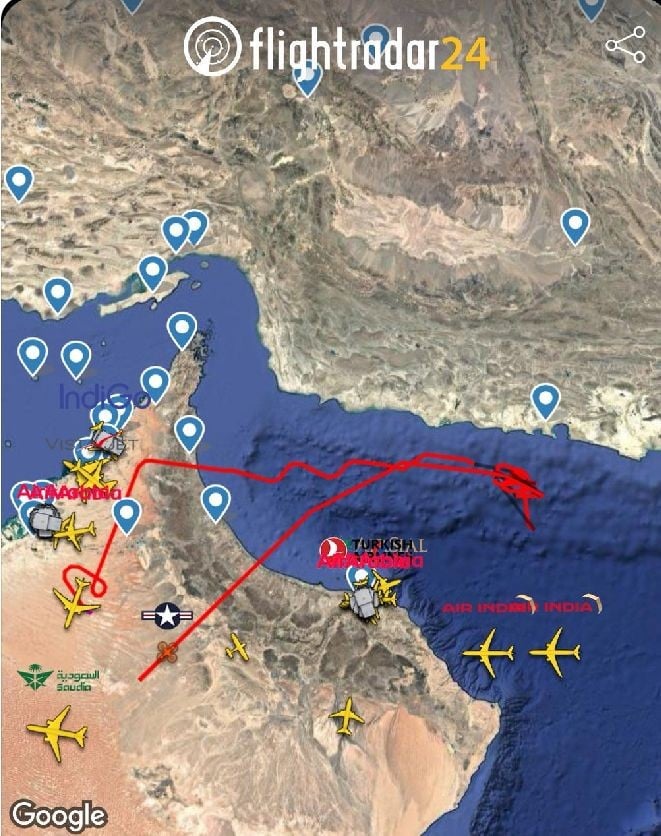




ISLAMABAD: Pakistan’s defence authorities have firmly dismissed circulating claims on social media that a United States Navy MQ-4C Triton drone, identified as VVPE661, violated or utilised Pakistani airspace on February 28, 2026, labelling such assertions as entirely baseless and misleading.
The allegations surfaced amid heightened regional tensions following reported military activities in the Middle East, including coordinated strikes on Iranian targets and persistent maritime surveillance operations near the Gulf.
Open-source flight tracking data, widely referenced by independent analysts and defence observers, unequivocally demonstrates that the drone remained confined to international airspace over the Gulf of Oman and the Arabian Sea throughout its mission.
The aircraft, bearing registration number 169661 and hex code AE7814, departed from Al Dhafra Air Base in the United Arab Emirates on the specified date.
It conducted routine intelligence, surveillance, and reconnaissance activities in the maritime domain far south of Pakistan’s borders.
No trajectory or positional data from platforms such as Flightradar24 or similar trackers indicated any proximity to Pakistani territory or entry into its sovereign airspace.
Pakistan’s defence officials issued clear confirmations that no foreign military aircraft, including unmanned aerial vehicles, breached national airspace on the day in question.
Such statements align with standard protocols for monitoring and safeguarding territorial integrity, particularly in an era of advanced aerial surveillance technologies.
The MQ-4C Triton, manufactured by Northrop Grumman, represents one of the most sophisticated high-altitude long-endurance unmanned systems in the US Navy inventory.
Designed specifically for broad-area maritime surveillance, the platform operates at altitudes exceeding 50,000 feet for extended durations, often surpassing 30 hours, while collecting real-time data on naval movements, shipping lanes, and potential threats.
Its deployment from Al Dhafra Air Base, a key US military facility in the UAE, supports ongoing strategic interests in the Persian Gulf region, including monitoring the Strait of Hormuz through which a substantial portion of global oil transits.
Recent operations involving similar Tritons have focused on international waters adjacent to Iran, reflecting efforts to maintain situational awareness amid escalating confrontations.
False narratives linking the drone’s flight to Pakistan appear to have originated from misinterpretations of regional flight patterns or deliberate misinformation campaigns.
Social media amplification of unverified claims has occasionally fuelled unnecessary speculation, particularly in South Asia where sensitivities around foreign military presence remain acute.
Defence experts emphasise the importance of relying on verifiable data from multiple sources rather than anecdotal reports or unconfirmed posts.
Pakistan maintains robust air defence networks and radar coverage capable of detecting intrusions, ensuring swift responses to any unauthorised activity.
The absence of any official alert or interception further corroborates the position that the Triton operated exclusively in distant maritime zones.
This incident underscores broader challenges in the digital age, where open-source intelligence can be both illuminating and prone to distortion.
Accurate dissemination of facts becomes essential to prevent escalation of tensions or erosion of public trust in official channels.
Regional stability depends on transparent communication and adherence to international norms governing airspace and surveillance activities.
As geopolitical dynamics evolve in the Middle East and beyond, incidents like these highlight the need for rigorous fact-checking and restraint in public discourse.
Pakistan continues to prioritise sovereignty while engaging constructively in regional security dialogues.
The dismissal of these claims reinforces the country’s commitment to factual accuracy in defence-related matters.