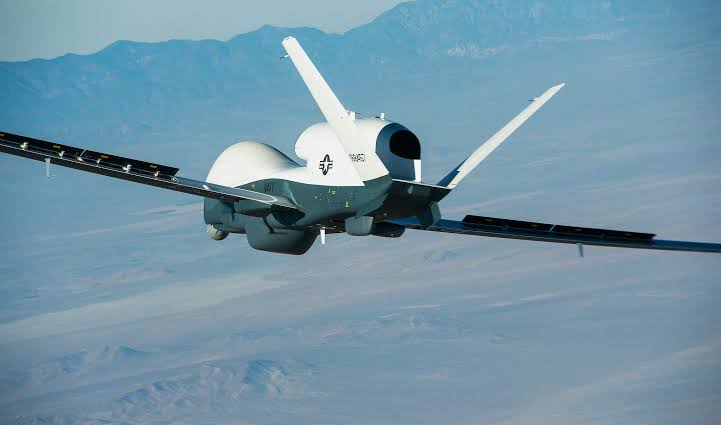




ISLAMABAD: A sophisticated US Navy MQ-4C Triton spy drone, valued at hundreds of millions of dollars, disappeared from radar over the Persian Gulf south of Iran following an emergency beacon transmission, fuelling speculation of electronic warfare interference or hostile action amid heightened regional tensions, uncorfirmed media reports have surfaced.
The incident unfolded on February 22, 2026, when the drone, bearing registration 169660 and callsign OVRLD1, departed from Al Dhafra Air Base in the United Arab Emirates for a routine high-altitude maritime intelligence, surveillance, and reconnaissance mission.
Operating at approximately 32,900 feet, the Triton was conducting long-range patterns over international waters in the Persian Gulf when it abruptly broadcast a distress signal.
Moments later, open-source flight tracking data and social media reports indicated the aircraft vanished from radar screens, with no further contact established.
The MQ-4C Triton represents a naval variant of the renowned RQ-4 Global Hawk, designed specifically for persistent maritime domain awareness.
Equipped with advanced electro-optical, infrared, and radar sensors, it can monitor vast ocean areas, track naval vessels, and detect missile activities from extreme altitudes exceeding 50,000 feet.
Its endurance allows flights lasting over 24 hours, making it invaluable for monitoring strategic chokepoints like the Strait of Hormuz.
Estimates place the unit cost of advanced MQ-4C configurations between $180 million and over $600 million when factoring in research, development, and specialised payloads, positioning it among the most expensive unmanned aerial systems in the US arsenal.
No official confirmation has emerged from the Pentagon regarding the loss, though defence analysts note the absence of statements often indicates sensitive ongoing assessments.
Open-source observers highlight the drone’s path remained in international airspace, consistent with US operations that skirt territorial boundaries to gather intelligence without direct overflight.
Speculation has centred on electronic warfare as a potential cause, with some reports suggesting Iranian capabilities in jamming or spoofing signals may have disrupted the Triton’s communications and navigation links.
Iran has demonstrated such techniques in the past, notably in the 2011 capture of an RQ-170 Sentinel through GPS spoofing and signal jamming, forcing the drone into autopilot and redirecting it to land intact.
More recently, experts have pointed to possible Russian or Chinese-origin electronic warfare systems aiding Iran in degrading high-altitude UAV operations.
These systems could overwhelm satellite and line-of-sight control links, compelling the drone to lose autonomy or trigger emergency protocols.
The sudden disappearance echoes the 2019 incident when Iran downed an RQ-4A Global Hawk variant using a surface-to-air missile over the Strait of Hormuz, claiming airspace violation while the US insisted the flight occurred in international airspace.
That event escalated tensions dramatically, nearly prompting US retaliatory strikes before de-escalation.
The current vanishing raises parallel concerns, particularly as US-Iran relations remain strained over sanctions, nuclear negotiations, and maritime security.
Recent weeks have seen reciprocal incidents, including US forces downing Iranian Shahed-series drones approaching naval assets like the USS Abraham Lincoln carrier group.
Such exchanges underscore the volatile environment in the Persian Gulf, where surveillance assets play a critical role in deterrence and monitoring potential threats to global energy routes.
Defence security analysts emphasise that the Triton’s loss, if confirmed as hostile, would represent a significant blow to US maritime intelligence gathering in the region.
The platform’s ability to provide real-time data on Iranian naval movements and missile launches makes it a cornerstone of CENTCOM operations.
Any compromise could force reliance on alternative assets, including manned aircraft or satellites, potentially at higher risk or cost.
While technical malfunction remains a possibility, the emergency signal followed by immediate radar loss has led many to question benign explanations.
Electronic warfare experts note that jamming could induce such a sequence by severing control links and degrading onboard systems.
Spoofing, if employed, might mislead navigation, though the Triton’s advanced safeguards make outright hijacking challenging.
The incident injects fresh uncertainty into an already combustible US-Iran standoff, centred on deterrence, sanctions enforcement, and freedom of navigation.
As investigations continue without official details, the disappearance highlights evolving threats to high-value unmanned platforms in contested domains.
Regional observers warn that further escalations could draw in broader international actors, given the strategic importance of the Persian Gulf to global trade and energy security.