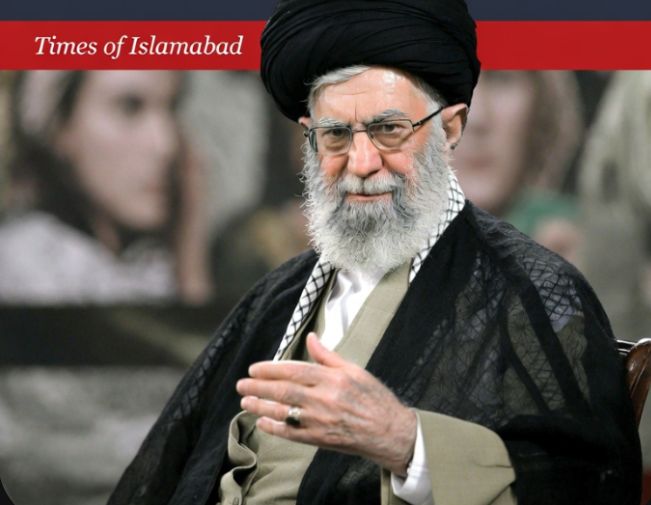




ISLAMABAD: Iran’s Supreme Leader Ayatollah Ali Khamenei has significantly empowered Ali Larijani, secretary of the Supreme National Security Council, granting him extensive authority over critical state functions including national security, crisis management and foreign negotiations.
This development, reported by The New York Times on February 22, 2026, comes amid heightened domestic unrest and external threats from the United States, effectively positioning Larijani as the de facto manager of day-to-day governance.
The shift has notably marginalized President Masoud Pezeshkian, who assumed office in 2025 but has faced challenges in asserting influence over major policy areas.
According to sources cited in the report, including senior Iranian officials and Revolutionary Guards members, Khamenei turned to Larijani in early January 2026 during widespread protests demanding reforms and amid fears of U.S. military action.
Larijani, aged 67, a former commander in the Islamic Revolutionary Guard Corps and a veteran politician, has since overseen the suppression of dissent, coordination with allies such as Russia, Qatar and Oman, and oversight of nuclear discussions with Washington.
His responsibilities have expanded to include contingency planning for potential full-scale conflict, as U.S. forces continue to build up in the region.
The New York Times detailed that Khamenei has established layered succession mechanisms across military and government roles under his direct appointment.
Senior officials have been instructed to designate up to four replacements for key positions to ensure continuity if leadership is disrupted by assassinations or attacks.
Khamenei has also delegated emergency authority to a small circle of trusted aides, including Larijani, to maintain state functions in scenarios where communications fail or top figures are targeted.
While Larijani plays a pivotal role in crisis management and is viewed as a potential interim leader in extreme circumstances, he is not positioned as a successor to the Supreme Leader position.
That role requires senior Shiite clerical credentials, which Larijani lacks.
Instead, Khamenei has reportedly named three senior clerics as potential successors, though their identities remain undisclosed.
This arrangement underscores a focus on regime survival rather than personal succession to the supreme leadership.
Larijani’s elevation reflects Khamenei’s trust in his political acumen, bureaucratic experience and loyalty.
Having previously served as secretary of the Supreme National Security Council from 2005 to 2007 and as parliament speaker, Larijani brings a track record of navigating complex domestic and international challenges.
His recent appointment to the council post in August 2025 by President Pezeshkian, with Khamenei’s approval, set the stage for his current prominence.
Observers note that Pezeshkian, a heart surgeon by training, has publicly downplayed his political ambitions, stating he is “a doctor, not a politician” and cannot resolve all of Iran’s issues.
This stance has aligned with the apparent deference to Larijani’s authority in security and strategic matters.
The moves occur against a backdrop of recent events, including a ceasefire following earlier escalations, nationwide protests met with forceful responses, and ongoing regional volatility.
Iran’s leadership appears to prioritize internal stability and preparedness for external aggression.
Larijani’s expanded portfolio includes devising wartime governance plans, potentially through a revived or new national defense structure.
Such preparations aim to safeguard the Islamic Republic’s endurance under severe pressure.
Analysts interpret these steps as pragmatic contingency planning in an era of uncertainty.
Khamenei’s directives emphasize redundancy in command chains to prevent paralysis if key figures are removed.
This approach draws from historical precedents in Iran’s post-revolutionary governance.
The report highlights Larijani’s role in liaising with international partners while managing internal crackdowns.
His involvement in nuclear negotiations signals centralized control over sensitive diplomacy.
As Iran navigates these challenges, the power dynamics within its leadership continue to evolve.
The empowerment of Larijani marks a significant realignment, concentrating authority in security institutions amid broader threats to the regime’s stability.