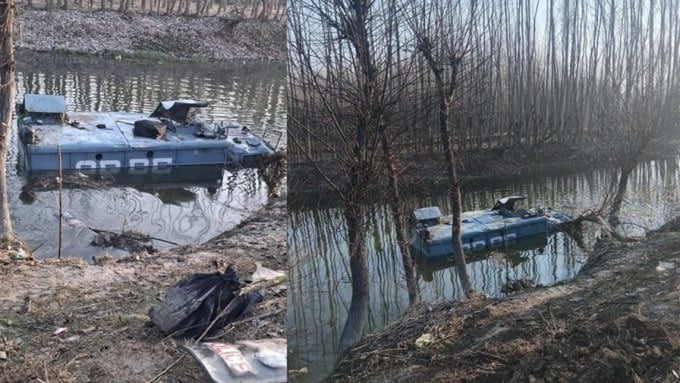




ISLAMABAD: Two personnel of India’s paramilitary force were reported to be killed and five others injured after their vehicle plunged off the Ahmed Nagar-Dagpor road in , in an incident that has triggered competing claims over whether the crash was accidental or the result of an armed ambush in the restive Himalayan region.
Officials confirmed that the deceased belonged to the (CRPF), one of the largest internal security forces deployed across conflict-prone zones of . Initial police statements described the episode as a road accident in a mountainous stretch known for sharp turns and steep gradients.
However, Kashmiri fighters’ group circulated a statement hours later asserting that it had ambushed the vehicle, forcing it off the road. The claim has not been independently verified, and security agencies have not publicly confirmed any exchange of fire at the site.
The incident occurred during routine movement of CRPF personnel along the Ahmed Nagar-Dagpor axis on the outskirts of the city. According to preliminary reports, the vehicle fell into a gorge, a common hazard in the hilly terrain that surrounds Srinagar.
Rescue teams comprising local police and fellow CRPF personnel rushed to the scene. The injured were shifted to a nearby hospital, where at least two were reported to be in critical condition. Authorities sealed off the area to conduct a forensic assessment amid heightened security.
The region, part of the disputed territory of , has witnessed intermittent violence for decades. While large-scale encounters have declined in recent years compared to the peak of militancy in the 1990s and early 2000s, sporadic attacks on security forces continue to occur, particularly in rural and semi-urban belts.
Security analysts note that road mobility remains a vulnerability for forces operating in mountainous conflict zones. Convoys navigating narrow roads are exposed not only to ambush risks but also to environmental hazards such as landslides, mechanical failure and reduced visibility during winter months.
Data compiled from official disclosures over the past five years show that road accidents account for a measurable proportion of non-combat fatalities among security personnel deployed in Jammu and Kashmir. Independent security trackers estimate that dozens of personnel have lost their lives in transport-related incidents since 2019, underscoring the challenging topography of the region.
At the same time, militant groups have previously targeted patrol vehicles using small arms fire or improvised explosive devices. In several past cases, initial confusion over the cause of crashes has complicated official narratives, with investigations later revealing ballistic or explosive traces.
Local residents in the Ahmed Nagar area described hearing a loud crash but did not report sustained gunfire. Some witnesses said they saw the vehicle veer sharply before tumbling down the slope. Others claimed security forces fired into the air shortly after the incident, possibly as a precautionary measure.
Senior police officials have stated that a detailed inquiry is under way to determine whether the crash resulted purely from road conditions or external interference. Forensic teams are expected to examine the wreckage for bullet marks, shrapnel or signs of sabotage.
The CRPF has played a central role in counterinsurgency operations in the Valley, often conducting joint patrols with local police and army units. Its deployment intensified after constitutional changes in August 2019, when New Delhi revoked the region’s semi-autonomous status and reorganised it into federally administered territories.
Since then, authorities have maintained that overall militant violence has declined, pointing to lower recruitment numbers and the neutralisation of several high-profile commanders. Yet targeted attacks, particularly against off-duty personnel and smaller patrol units, continue to challenge security planners.
The latest incident is likely to further tighten security measures in and around Srinagar, especially along vulnerable road corridors. Convoy movement protocols, including staggered travel and enhanced surveillance, may be reviewed in light of the crash.
Political reactions have also begun to surface. Leaders across the spectrum expressed condolences to the families of the deceased personnel and called for a transparent investigation. Some urged restraint in attributing responsibility until forensic findings are made public.
From , observers noted that such incidents, regardless of cause, risk exacerbating already fragile regional tensions. Cross-border rhetoric often intensifies following violence in Kashmir, even when investigations are still ongoing.
For now, the facts remain under scrutiny. Whether the tragedy on the Ahmed Nagar-Dagpor road was a fatal accident born of treacherous terrain or the result of a calculated ambush will depend on the findings of investigators in the coming days.
What is certain is that the loss of two CRPF personnel and the injury of five others has once again highlighted the volatility of a region where geography and geopolitics intersect with deadly consequences.