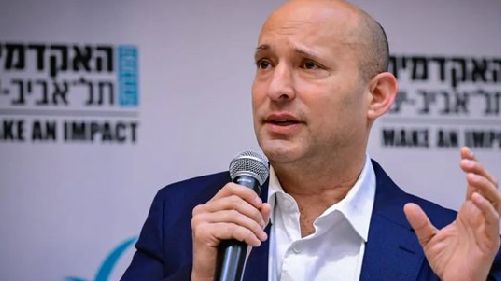




ISLAMABAD: Former Israeli Prime Minister Naftali Bennett has ignited fresh geopolitical tensions by labeling Turkey as the “new Iran,” accusing President Recep Tayyip Erdogan of encircling Israel and forging a hostile Sunni bloc that includes nuclear-armed Pakistan, according to reports from his February 17, 2026, address at the Conference of Presidents of Major American Jewish Organizations in Jerusalem.
Bennett’s remarks underscore Israel’s growing concerns over shifting alliances in the Middle East, where Turkey and Qatar are allegedly collaborating to sway Saudi Arabia against Israel and establish a Muslim Brotherhood-aligned axis reminiscent of Iran’s influence.
He explicitly mentioned Pakistan’s nuclear capabilities as a critical element in this potential bloc, warning that such a development could escalate threats to Israel’s security.
This statement marks a rare direct reference to Pakistan in Israeli discourse on regional threats, amplifying fears of broader nuclear proliferation risks.
Historical context reveals longstanding Israeli apprehensions toward Pakistan’s nuclear program, which began in the 1970s and culminated in successful tests in 1998.
In the 1980s, Israel reportedly prepared for preemptive strikes on Pakistan’s Kahuta nuclear facility, constructing mock-ups in the Negev desert and considering operations from Indian bases, as detailed in accounts from journalists Adrian Levy and Catherine Scott-Clark.
These plans, akin to Israel’s 1981 bombing of Iraq’s Osirak reactor, were ultimately abandoned due to logistical challenges and potential backlash from the United States, Pakistan’s ally during the Cold War.
Israeli Prime Minister Menachem Begin, in a 1979 letter to British leader Margaret Thatcher, expressed alarm over Pakistan’s pursuit of nuclear weapons, describing it as a “mortal danger” to Israel amid fears of collaboration with Libya under Muammar Gaddafi.
More recently, Benjamin Netanyahu has publicly identified Pakistan as a secondary threat after Iran, stating in interviews that militant Islamic regimes like those in Iran and Pakistan could disregard international norms if armed with nuclear weapons.
Netanyahu’s comments, echoed in a 2011 interview, highlight Israel’s view of Pakistan’s arsenal as a potential enabler for radical actors, despite Pakistan’s assurances of non-proliferation.
Pakistan’s nuclear doctrine emphasizes deterrence against India, with red lines including territorial loss or economic strangulation, as articulated by former Strategic Plans Division head Khalid Kidwai in 2001.
Yet Israeli officials perceive this arsenal, estimated at 170 warheads in 2025 by the Bulletin of the Atomic Scientists, as a broader liability due to Pakistan’s political instability and history of non-state actor involvement.
The Stockholm International Peace Research Institute notes Pakistan’s ongoing production of fissile material, potentially allowing for 14 to 27 new warheads annually, with yields ranging from 5 to 12 kilotons based on 1998 tests.
Israel’s concerns are compounded by reports of Pakistan’s missile advancements, including the Shaheen-III with a 2,750-kilometer range capable of reaching beyond South Asia.
U.S. Deputy National Security Advisor Jon Finer, in a December 2025 forum, highlighted Pakistan’s pursuit of sophisticated missile technology, possibly extending to over 3,000 kilometers with assistance from Belarus and China.
Such developments fuel Israeli fears that Pakistan could target distant adversaries or share technology with anti-Israel entities.
Recent events, including Iran’s June 2025 conflict with Israel, have intensified speculation about Pakistan’s role.
An Iranian general’s claim that Pakistan pledged nuclear support against Israel if Iran were attacked—swiftly denied by Islamabad—sparked debates on potential alliances.
Pakistan’s Foreign Minister Ishaq Dar condemned the allegations as fabricated, reaffirming the arsenal’s defensive posture focused on India.
Analysts suggest that if Israel neutralizes Iran’s nuclear program, as in the June 2025 strikes on Natanz and Arak sites, Pakistan could emerge as the next focus under Israel’s Begin Doctrine of preemptive action against proliferating states.
Hebrew University geopolitics director Meir Masri has identified Pakistan as a future target, arguing that its plutonium-based warheads pose risks amid regional instability.
Pakistan’s tactical nuclear weapons, designed for battlefield use against Indian forces, are seen by Israel as lowering the threshold for nuclear escalation.
The Arms Control Association estimates Pakistan’s stockpile could reach 200 warheads by the late 2020s, heightening global concerns.
Israeli media outlets, such as The Media Line, have reported on Pakistan’s denials of nuclear strike rumors, but underscore historical tensions, including a 2016 incident where fake news prompted Pakistan’s defense minister to issue a nuclear warning to Israel.
Pakistan maintains it poses no threat to Israel, with no diplomatic recognition and a policy of supporting Palestinian causes.
However, shared borders with Iran and economic ties, including the stalled Iran-Pakistan gas pipeline, could draw Pakistan into wider conflicts.
Experts warn that any Israeli action against Pakistan would risk U.S. backlash, given Pakistan’s major non-NATO ally status since 2004.
Pakistan’s military spokesperson, Lt. Gen. Ahmed Sharif Chaudhry, dismissed fears of Iran-style strikes in July 2025, asserting no concerns over becoming the next target.
Yet Bennett’s speech reflects Israel’s strategic calculus, viewing Pakistan’s nuclear program through the lens of existential threats.
As regional dynamics evolve, with Turkey’s influence in Syria and Gaza, Israel’s rhetoric may signal preparations for broader countermeasures.
Pakistan’s expansion of uranium enrichment and plutonium reactors at Khushab underscores its commitment to nuclear parity with India, estimated at 164 warheads.
This buildup, independent of civil nuclear efforts like the 8,000-megawatt goal by 2030, complicates disarmament talks.
The Federation of American Scientists projects Pakistan’s arsenal could surpass Britain’s by 2030 if trends continue.
In this context, Bennett’s inclusion of Pakistan in a hostile axis amplifies calls for international oversight.
While Pakistan rejects NSG membership barriers, its refusal to separate military and civilian programs sustains suspicions.
Ultimately, Bennett’s warning highlights the precarious balance of power, where nuclear capabilities intersect with ideological alliances, potentially reshaping Middle Eastern security.
Israel, Pakistan, Nuclear Weapons, Naftali