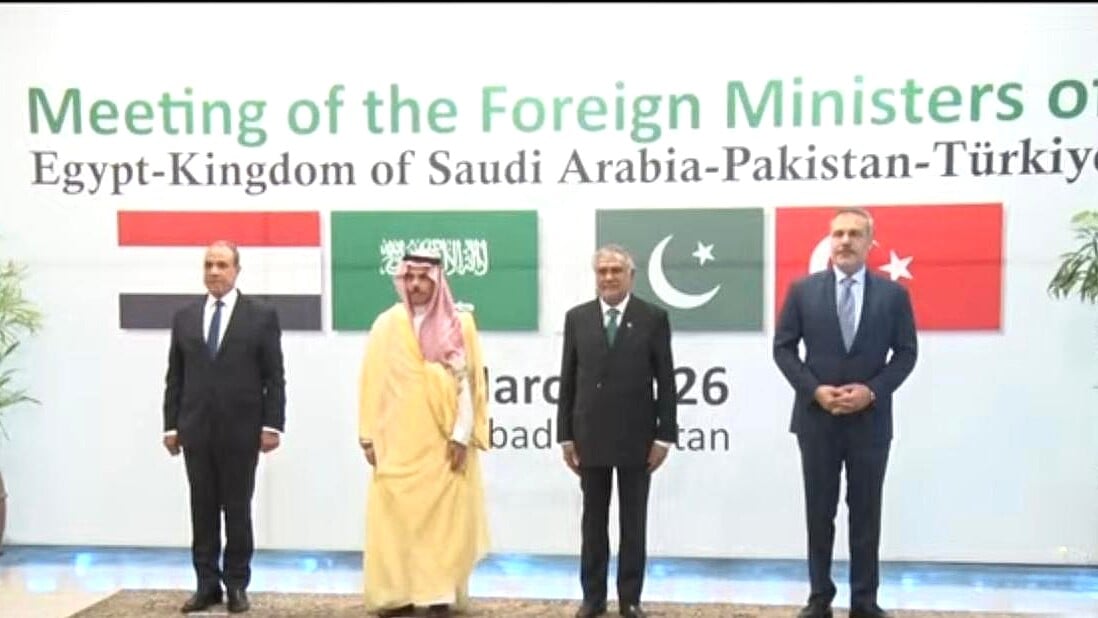




ISLAMABAD: A powerful new Middle East alignment led by Turkey, Egypt and Pakistan is rapidly emerging, delivering a major shock to Israel as it reshapes the region’s power balance and forces Washington to rethink its Iran strategy, Jerusalem Post Reported.
Foreign ministers from Turkey, Egypt, Pakistan and Saudi Arabia held urgent talks in Riyadh just days ago, according to Middle East Eye and Arab News reports, laying groundwork for deeper defence cooperation that analysts now call an “Islamic NATO” in the making.
Pakistan’s Foreign Ministry confirmed the four nations will hold in-depth discussions in Islamabad this week on de-escalating the US-Israel-Iran conflict, positioning the bloc as a decisive mediator.
The combined population of these four states exceeds 435 million, creating a demographic and economic giant that dwarfs Israel’s influence in any post-war order.
Turkey, with NATO’s second-largest army, signed a landmark military pact with Egypt in February 2026 covering air defences and joint drone production, as reported by The National.
Pakistan brings its nuclear deterrent and battle-hardened forces, while Saudi Arabia adds vast financial resources and oil leverage, forming a formidable counterweight to traditional US-Israeli partnerships.
Jerusalem Post analysis on March 27 highlighted how Turkey and Pakistan have emerged as key mediators, with back-channel messages passed between US envoy Steve Witkoff and Iranian Foreign Minister Abbas Araghchi.
Sources close to the talks told Reuters that the United States shared a 15-point plan with Iran through Pakistani channels, which the new alignment is now refining to ensure regional stability on Muslim-majority terms.
This diplomatic surge comes as global oil prices surge amid Strait of Hormuz threats, directly impacting energy security for the bloc’s members who control critical shipping lanes.
Egypt’s Foreign Minister Badr Abdelatty coordinated calls involving Turkish and Pakistani counterparts, confirming the trio’s central role in indirect US-Iran negotiations, per Daily Sabah and Wall Street Journal reports.
Analysts warn Israel faces isolation as these powers prioritise ending the month-old war launched on February 28, potentially curtailing Israeli military gains and forcing concessions on nuclear and territorial issues.
Pakistan’s Prime Minister held a detailed phone call with Iran’s president on Saturday, underscoring Islamabad’s unique bridge-building capacity between Tehran and Washington.
The alignment’s push for internal regional solutions marks a clear departure from decades of reliance on external powers, with Turkish officials explicitly seeking a formal security pact that could include joint exercises and intelligence sharing.
Combined military spending of the four nations already rivals major Western blocs, with Pakistan’s defence budget alone supporting advanced missile systems and Turkey’s growing indigenous arms industry.
Jerusalem Post articles from the past week describe the development as a “reshaping of the Middle East order,” noting how the bloc’s mediation efforts sideline Israeli hardline positions on Iran.
Regional media in Pakistan and Turkey amplify the narrative of Muslim unity, with Dawn sources confirming “strategic synergy” between Ankara, Cairo and Islamabad as the most effective path to peace.
As the Islamabad quadrilateral meeting unfolds, observers predict concrete proposals on reopening Hormuz shipping and a phased ceasefire framework that could bind all parties, including indirect guarantees for Israeli security only within negotiated limits.
This unexpected convergence of Sunni powerhouses and key Muslim states has stunned Tel Aviv, where officials now scramble to assess long-term implications for US support and regional deterrence.
The bloc’s success could permanently alter US-Iran ties, embedding mediation by Turkey, Egypt and Pakistan as the new norm and reducing Israel’s ability to shape outcomes unilaterally.
With talks continuing into the coming days, the emerging alignment signals a historic pivot, one that places Muslim-led diplomacy at the centre of Middle East stability and leaves Israel confronting a fundamentally altered strategic landscape.