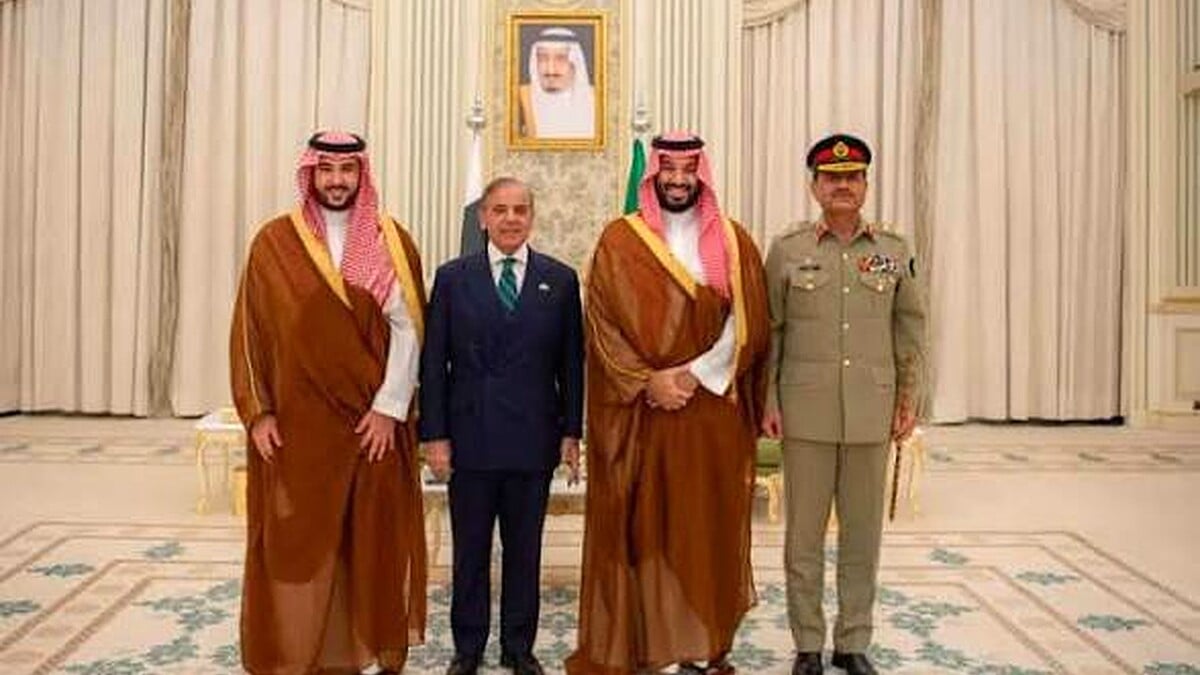




ISLAMABAD: A senior Pakistani source has said that the Strategic Mutual Defence Agreement signed with Saudi Arabia last September is fast becoming a strategic headache for Islamabad, Financial Times has claimed.
However, No serving Pakistani official has publicly endorsed this view, and it appears to reflect analytical or insider commentary rather than an on-record government position.
The pact, inked on September 17, 2025, by Prime Minister Shehbaz Sharif and Saudi Crown Prince Mohammed bin Salman, declares that any aggression against one country shall be considered aggression against both.
It was envisioned as a classic exchange of cash for deterrence.
Pakistan would extend its military reach and nuclear shadow over the kingdom while Riyadh would deliver substantial economic lifelines to cash-strapped Islamabad.
Yet six months on, the expected flood of Saudi investments has failed to materialise, leaving Pakistani officials privately frustrated.
The agreement formalised decades of close military ties.
Pakistan has historically stationed thousands of troops in Saudi Arabia, with reports suggesting plans for up to 25,000 personnel under the new framework, including armoured, artillery and air force units.
In return, expectations ran high for billions in fresh capital.
Earlier signals included a potential $11 billion lifeline discussed in 2023 and MoUs worth $2.8 billion alongside a $3 billion loan in late 2024.
Saudi Arabia had also indicated interest in Pakistan’s Reko Diq mining project, acquiring a 15 percent stake for $540 million in one reported deal, and upgrading a $6 billion oil refinery.
However, concrete new inflows tied directly to the defence pact remain conspicuously absent as of early 2026.
Defence Minister Khawaja Mohammad Asif initially hinted that Pakistan’s nuclear capability could be made available to Riyadh if needed, though he later walked back the statement.
A Saudi official told Reuters the pact encompassed “all military means.”
International analysts described it as potentially extending a Pakistani nuclear umbrella into the Middle East, a move that raised eyebrows in Washington and New Delhi.
The pact emerged against a backdrop of Saudi unease over US security guarantees and rising regional threats, including Israeli strikes and tensions involving Iran and the Houthis.
Pakistani officials have publicly invoked the agreement to deter potential Iranian actions.
Foreign Minister Ishaq Dar stated in March 2026 that Pakistan warned Tehran to keep the mutual defence commitment in mind amid escalating Middle East hostilities.
Yet privately, concerns are mounting that the deterrence element has underperformed while the economic payoff has stalled.
The FT source, described as having insight into senior military thinking, captured the sentiment bluntly: the pact was supposed to be cash for deterrence, but new Saudi investments have not arrived and deterrence has failed to deliver expected results.
Pakistan continues to seek conversion of existing $5 billion Saudi deposits at the State Bank into a 10-year long-term facility.
It has also requested expansion of the $1.2 billion deferred oil payment facility to $5 billion with extended repayment terms.
Talks on joint ventures in mining, energy, information technology and defence production persist under the broader economic cooperation framework launched after the pact.
Saudi Arabia’s Vision 2030 emphasises diversification, creating potential synergies with Pakistan’s resources in copper, gold and emerging lithium deposits.
Yet analysts note that major Gulf investments often hinge on visible reforms in Pakistan’s energy market, contract enforcement and bureaucratic efficiency.
The pact has reshaped regional perceptions.
It signals Gulf states exploring alternatives to exclusive US reliance for security.
For Pakistan, it reinforces its role as a key Muslim-world security provider while offering prestige and potential long-term economic upside.
However, the absence of immediate cash inflows has exposed vulnerabilities.
Pakistan’s economy remains under pressure, with remittances from over 2.5 million Pakistanis in Saudi Arabia providing vital support alongside past Saudi financial packages exceeding $30 billion since the 1980s.
Regional media in Pakistan and the Gulf have reported the pact as a historic milestone strengthening joint deterrence and bilateral defence industrial cooperation.
International outlets such as Reuters, Al Jazeera and the Bulletin of the Atomic Scientists have highlighted its nuclear ambiguity and geopolitical ripple effects on India, Iran and the broader Middle East balance.
As tensions simmer, including recent US-Israeli actions against Iran, the pact faces its first real-world tests.
Pakistan has hosted regional foreign ministers in Islamabad to discuss de-escalation, underscoring its delicate balancing act.
Defence cooperation continues through high-level military meetings reviewing projects and exploring technology transfers aligned with Saudi Vision 2030.
Yet the core bargain of substantial new investments for enhanced security commitments remains unfulfilled, breeding quiet disillusionment in parts of Islamabad’s security establishment.
The coming months will prove critical.
Whether Riyadh unlocks fresh capital flows or the pact remains more symbolic than transformative could define the future trajectory of one of the Islamic world’s most enduring partnerships.