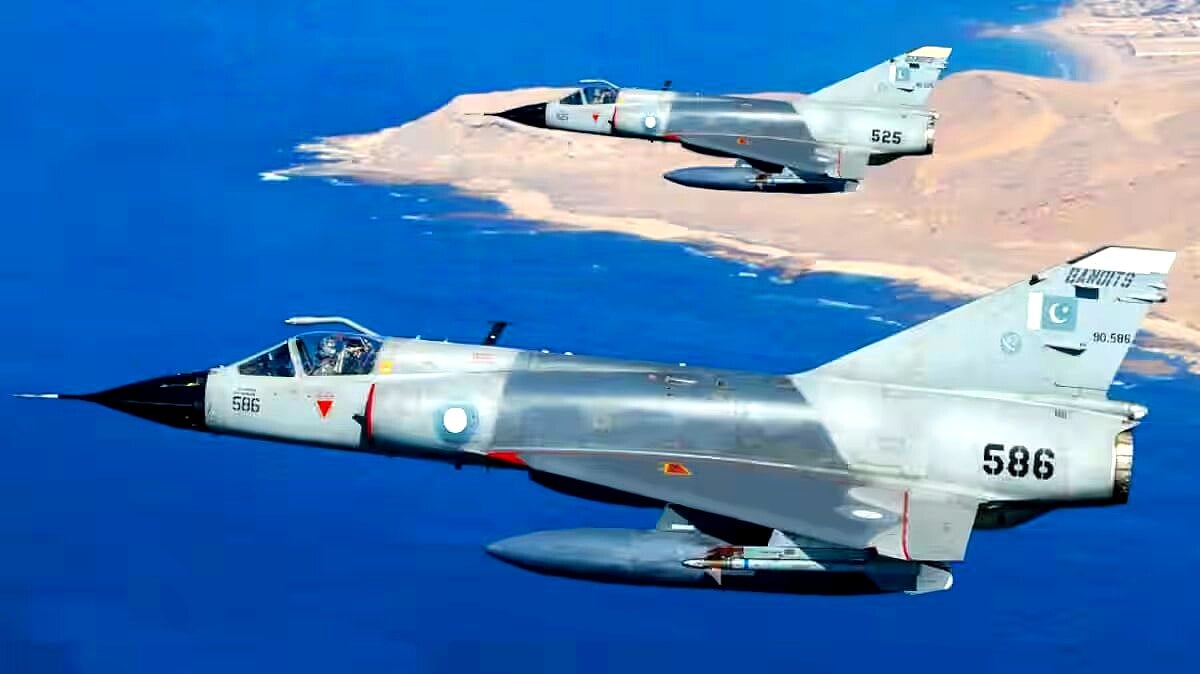




ISLAMABAD: A recent comparison of air-to-ground weapons between the Indian Air Force’s Mirage 2000 and the Pakistan Air Force’s Mirage III and 5 reveals notable differences.
The weapons equipped on these aircraft show a distinct strategic approach from each country.
The Indian Air Force’s Mirage 2000 employs a diverse range of munitions.
Key among them are the SPICE-2000 bombs, with a range of 60 to 100 kilometers, providing precision engagement capabilities.
In addition, the Crystal Maze missile offers an approximate range of 80 kilometers for tactical strikes.
Another significant addition is the HAMMER/AASM system, which boasts a flexible strike range between 15 to 70 kilometers.
Unguided bombs (UGBs) also remain part of the Mirage 2000’s arsenal.
Pakistan’s Mirage III and 5 platforms, on the other hand, rely on a formidable arsenal of cruise missiles.
So far, confirmed assets include the Ra’ad air-launched cruise missile (ALCM) with a range nearing 350 kilometers.
The advanced Ra’ad-II extends this reach further, capable of covering 550 to 600 kilometers.
Additionally, the Taimoor ALCM offers expanded strategic reach at around 600 kilometers.
The H-2 and H-4 stand-off weapons (SOW) provide versatility, with ranges spanning from 60 to 120 kilometers.
Experts cite these weapons’ ranges as a crucial factor in their operational impact.
The longer ranges of Pakistan’s cruise missiles indicate a strategic focus on extended deterrence.
In comparison, India’s weaponry leans towards precision and tactical flexibility.
This difference highlights the varied strategic objectives pursued by both nations’ air forces.
Military analysts point out the implications of these differences in the broader regional security context.
Enhanced range in Pakistani missiles could shift strategic calculations in South Asia.
Conversely, India’s precision weapons underline its focus on targeted missions.
As these technologies continue to evolve, observers anticipate further developments and upgrades.
The comparison underscores how technology influences military posturing and decision-making.
Both countries are expected to continue refining their arsenals in response to shifting regional dynamics.
This is a developing story, marking an ongoing debate around air power in the subcontinent.