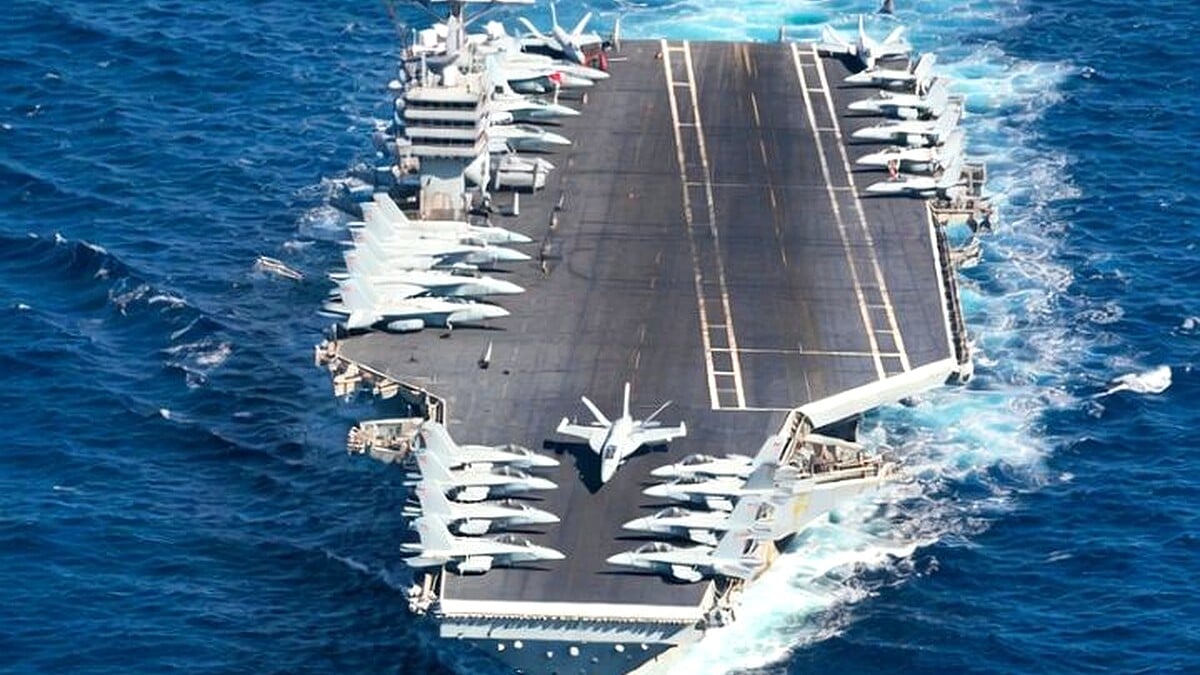
ISLAMABAD: In a dramatic assertion that has sent ripples across global defence circles, Iran’s Army announced it fired coastal cruise missiles directly targeting the United States Navy’s formidable aircraft carrier USS Abraham Lincoln.
The announcement, carried by state media including Mehr News Agency and Press TV, described the launch as a precise operation from Iranian coastal positions, claiming the missiles struck the carrier operating some 250 to 340 kilometres offshore near the Gulf of Oman.
Military analysts note this marks one of the most direct challenges to American naval power in recent years, occurring amid heightened tensions following reported US strikes on Iranian positions and the earlier sinking of the Iranian frigate Dena.
The USS Abraham Lincoln, a Nimitz-class nuclear-powered supercarrier designated CVN-72, displaces over 100,000 tons and stretches 333 metres in length, capable of carrying up to 90 aircraft including advanced F-35C stealth fighters and F/A-18 Super Hornets.
Its propulsion system allows speeds exceeding 30 knots, supporting a crew of more than 5,000 personnel and enabling sustained operations across vast ocean expanses while projecting air power deep into contested zones.
Iranian officials stated the coastal cruise missiles, believed to include advanced variants such as the Noor and Ghadir systems, were deployed as part of a retaliatory measure linked to the honouring of martyrs from the destroyer Dena incident.
These shore-to-sea missiles form a core element of Iran’s mosaic defence strategy along its 2,400-kilometre coastline, with reported ranges exceeding 200 kilometres and sophisticated guidance systems designed to evade modern naval countermeasures.
According to Iranian military statements, the operation successfully compelled the Abraham Lincoln to alter course and withdraw toward the southeastern Indian Ocean, though no visual evidence of impact has been independently verified.
United States Central Command swiftly rejected the claims, releasing imagery of the carrier continuing routine flight operations and asserting that none of the launched missiles approached the vessel.
CENTCOM described the Iranian assertion as unfounded, emphasising the carrier strike group’s ongoing role in supporting regional missions without interruption or damage.
The episode unfolds against a backdrop of escalating US-Iran confrontations, including recent American Tomahawk cruise missile strikes on Iranian naval facilities and reported losses on both sides.
Iran maintains one of the region’s largest missile arsenals, estimated at several thousand ballistic and cruise systems, many optimised for anti-ship roles in confined waters like the Strait of Hormuz.
That narrow chokepoint handles nearly 20 per cent of global seaborne oil trade, valued at roughly $1 trillion annually, making any naval incident there a potential trigger for worldwide energy market volatility.
Pakistani security experts monitoring the Gulf have highlighted the proximity of the event to vital shipping lanes that supply 60 per cent of China’s oil imports and significant volumes to South Asia.
Defence observers point out that the Abraham Lincoln forms part of a dual-carrier presence in the area, alongside the USS Gerald R Ford, representing an unprecedented concentration of US naval assets since the onset of broader regional hostilities.
The Iranian Army’s public relations office framed the missile firing as a measured response to what it termed malicious US actions, coinciding with ceremonies commemorating naval personnel lost in prior clashes.
Footage released by Iranian outlets purportedly showing missile launches streaking toward the horizon has circulated widely, though international fact-checkers have questioned its authenticity and timing.
Regional media outlets in Tehran and beyond have amplified the narrative, portraying the action as a demonstration of Iran’s defensive sovereignty over its maritime approaches.
Global oil prices reacted with an initial spike of nearly three per cent on futures markets following the announcement, underscoring the sensitivity of energy supplies to even unverified naval provocations.
Naval strategists underscore that modern aircraft carriers like the Lincoln are protected by layered defences, including escort destroyers equipped with Aegis combat systems and advanced radar capable of tracking multiple threats simultaneously.
Yet the very claim of a successful coastal strike highlights vulnerabilities in blue-water operations when facing determined land-based missile batteries, a lesson drawn from evolving asymmetric warfare doctrines.
As tensions persist, the incident underscores the fragile balance in the Gulf, where routine patrols by the world’s most powerful navy now intersect with increasingly assertive coastal defence postures.
Further developments remain under close watch by international stakeholders, with potential implications for stability across the broader Middle East and beyond.