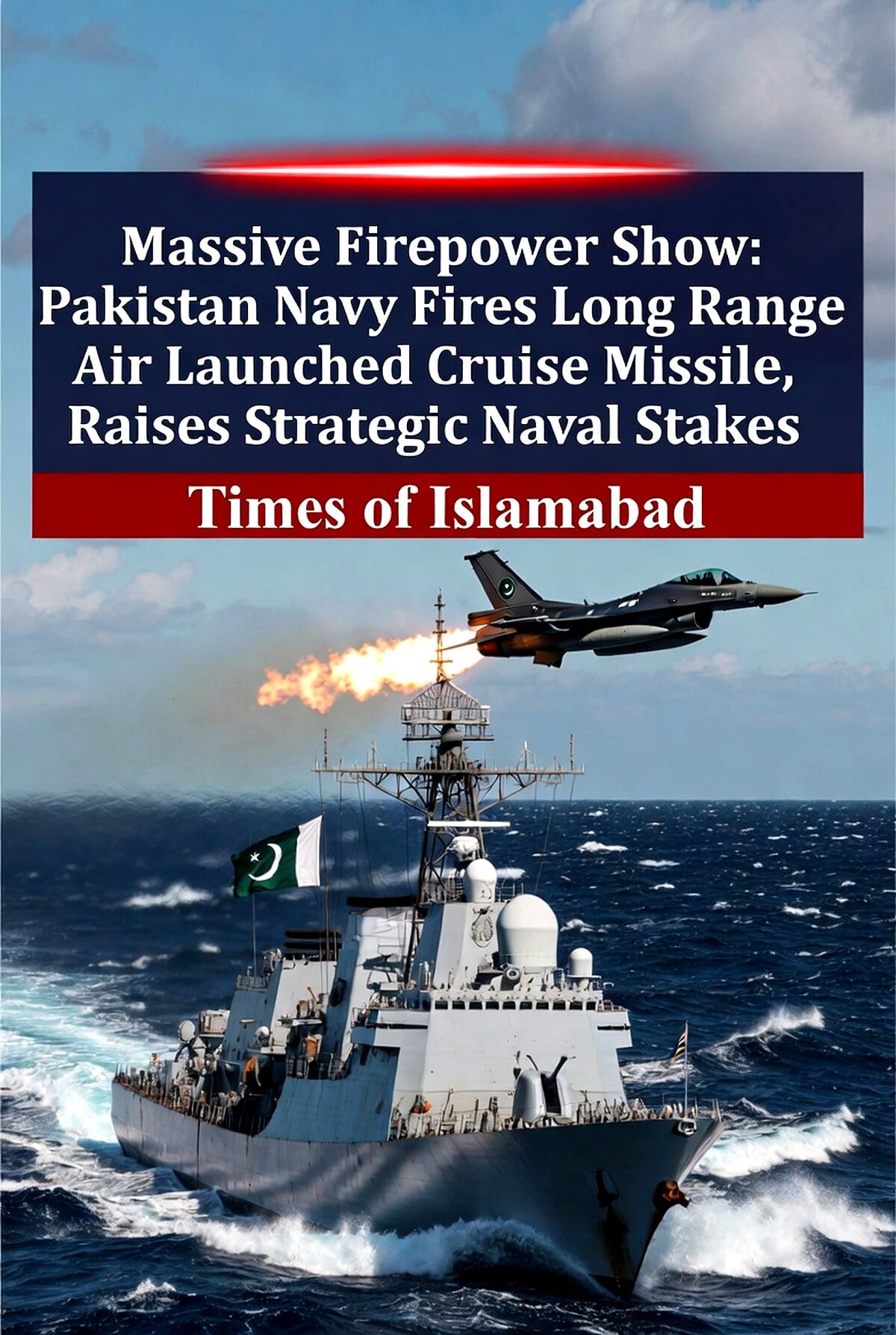




Title: Pakistan Navy Fires Indigenous Long Range Cruise Missile Test Raises Strategic Naval Stakes
Excerpt: Pakistan tests Taimur cruise missile, boosting naval strike precision significantly
Categories: Pakistan, Defence
ISLAMABAD: A sudden breakthrough in Pakistan’s naval strike capability is turning heads across the region, but the full implications of this latest missile test are only beginning to unfold.
Pakistan has successfully tested the indigenously developed Taimur Air-Launched Cruise Missile (ALCM), a move that signals a major leap in precision warfare and maritime dominance.
But that’s not the full story…
A Precision Strike Capability That Changes the Game
According to the (ISPR), the Taimur missile demonstrated exceptional accuracy during its test, striking its designated target with high precision.
The system is designed as an anti-ship weapon, capable of being launched from airborne platforms, giving Pakistan a flexible and fast-response strike option.
What makes this development particularly significant is the shift from traditional sea-based deterrence to multi-domain strike capability.
And this raises an important question…
How Powerful Is the Taimur Missile?
While official specifications remain classified, defense analysts estimate that the Taimur ALCM could have a range exceeding 350–500 kilometers, placing it firmly in the category of long-range precision strike weapons.
This allows aircraft to launch the missile well outside enemy radar coverage, increasing survivability and mission success rates.
What’s more concerning is its likely terrain-hugging flight profile, making it difficult for enemy radar systems to detect and intercept.
Combined with advanced guidance systems, possibly including inertial navigation and satellite updates, the missile can maintain accuracy even in contested environments.
But the real impact goes beyond just range…
A Major Boost for Pakistan Navy’s Firepower
The integration of air-launched cruise missiles into the arsenal dramatically enhances its offensive reach.
Previously, anti-ship operations relied heavily on surface vessels and submarines, but this new capability introduces a powerful aerial dimension.
Now, enemy naval assets can be targeted from multiple directions, complicating defense planning and increasing the effectiveness of coordinated strikes.
This is where things get interesting…
Strategic Implications for Regional Balance
The successful test of Taimur sends a strong signal across the Arabian Sea, particularly to the .
With India heavily investing in aircraft carriers and advanced naval platforms, Pakistan’s ability to strike these high-value assets from standoff distances introduces a new layer of deterrence.
However, a deeper issue is emerging…
Modern naval warfare is increasingly shifting toward long-range precision engagements, where speed, stealth, and accuracy outweigh sheer numbers.
And Pakistan appears to be adapting rapidly to this evolving doctrine.
Indigenous Development: A Strategic Milestone
Perhaps the most important aspect of the Taimur missile is that it is indigenously developed.
This reduces reliance on foreign suppliers and ensures operational independence in critical defense technologies.
It also reflects the growing capabilities of Pakistan’s defense industry in producing advanced guided weapon systems.
But that’s not the full story…
The Twist: Future Upgrades Could Be Even More Lethal
Defense experts believe that the current version of the Taimur missile is just the beginning.
Future upgrades could include extended range variants, potentially crossing 700 kilometers, as well as enhanced stealth features to evade next-generation air defense systems.
There is also speculation about integration with multiple aircraft platforms, including long-range maritime patrol aircraft and possibly unmanned combat aerial vehicles (UCAVs).
And this raises an important question…
Could Pakistan eventually deploy a network-centric strike system where multiple platforms coordinate missile attacks in real-time?
A New Era of Maritime Deterrence
The introduction of Taimur ALCM marks a shift toward layered and flexible deterrence for Pakistan.
Instead of relying on a single mode of attack, the country is building a diversified strike capability that can operate across air, sea, and potentially unmanned domains.
What’s more concerning for adversaries is the unpredictability this creates.
A naval task force operating in the region must now account for threats not just from the sea, but also from the sky, with little warning.
And that changes everything…