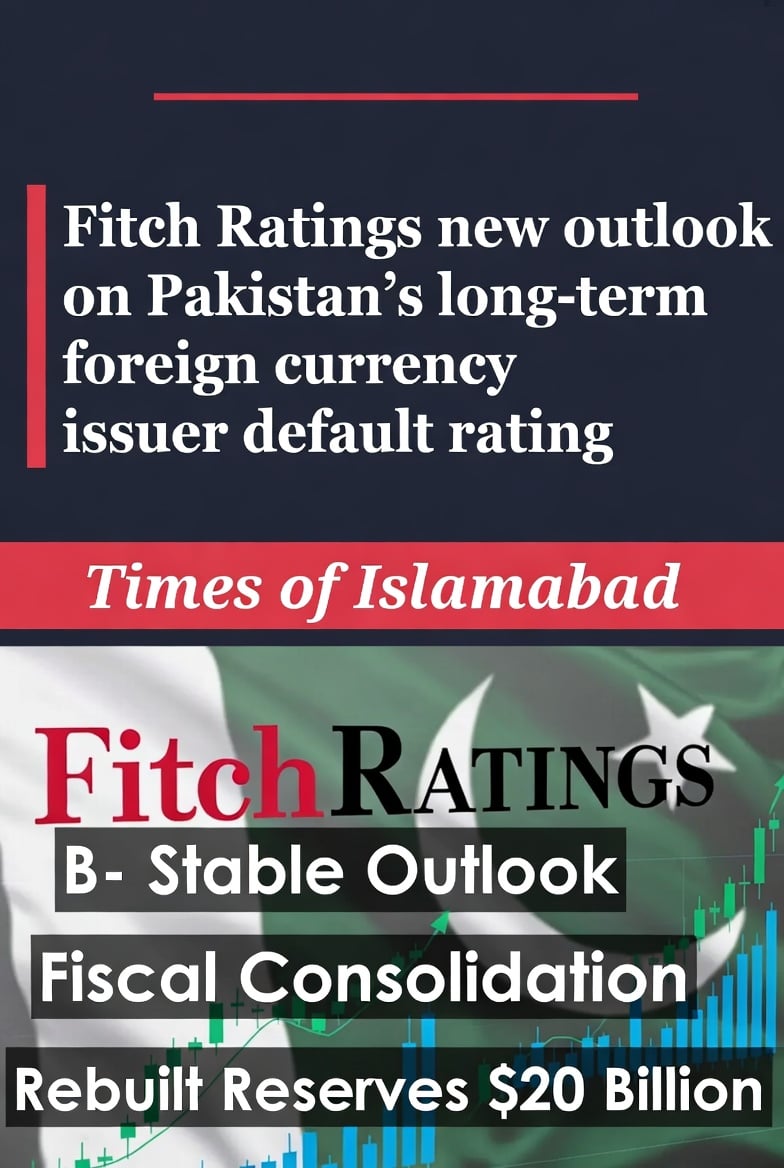




ISLAMABAD: Fitch Ratings one of the world’s top three credit agencies has affirmed Pakistan’s long-term foreign currency issuer default rating at ‘B-’ with a stable outlook.
The landmark decision announced on Monday signals growing global confidence in the country’s economic trajectory.
Fitch highlighted Pakistan’s steady progress on fiscal consolidation and macro stability measures that remain broadly aligned with its International Monetary Fund programme.
These efforts have strengthened the nation’s funding capacity and external position significantly.
Foreign exchange buffers rebuilt over the past year now stand at nearly 20 billion US dollars providing a vital cushion.
This reserve build-up from crisis lows of under seven billion dollars in late 2022 offers protection against external shocks including the ongoing war in the Middle East.
Pakistan’s proactive role as a ceasefire broker in the region is expected to yield tangible diplomatic and economic dividends.
The country’s mediation between Iran and the United States has already secured a fragile truce and positioned Islamabad as a key peace facilitator.
Fitch noted that such diplomatic achievements may partly offset external pressures and enhance investor sentiment.
The affirmation follows an earlier upgrade to ‘B-’ from ‘CCC+’ in April 2025 reflecting sustained improvements in public finances.
Under the IMF’s 37-month Extended Fund Facility approved in September 2024 Pakistan has implemented tough reforms with notable success.
The third review of the programme concluded positively in March 2026 confirming broad alignment with fiscal and monetary targets.
Tax revenues have risen by nearly three percentage points of GDP over the past year through enhanced mobilisation efforts.
The general government fiscal deficit has narrowed from 7.9 per cent of GDP in fiscal year 2022 to a projected 5.1 per cent in fiscal year 2026.
Inflation has plummeted from a peak of 29 per cent in fiscal year 2023 to an average of just 4.5 per cent in fiscal year 2024.
This sharp decline has enabled the State Bank of Pakistan to ease monetary policy gradually while maintaining price stability.
Remittances surged to a record 39 billion US dollars in fiscal year 2025 equivalent to 9.5 per cent of GDP.
The inflows helped deliver Pakistan’s first current account surplus in 14 years bolstering external liquidity.
Fitch emphasised that these buffers shield the economy from regional volatility while supporting debt servicing.
Pakistan’s external principal and interest obligations for fiscal year 2026 are comfortably covered by current reserve levels.
The stable outlook reflects expectations of continued adherence to IMF-supported policies and multilateral support.
Regional media including Dawn and The Express Tribune have echoed Fitch’s positive assessment highlighting the rating’s role in restoring market access.
Analysts project that the affirmation could lower borrowing costs for Pakistan in international capital markets.
Improved ratings also facilitate greater foreign direct investment inflows into key sectors such as energy and infrastructure.
Pakistan’s government has welcomed the decision as validation of its reform agenda under Prime Minister Shehbaz Sharif.
The country continues to prioritise structural changes in energy viability public spending efficiency and revenue collection.
Diplomatic gains from ceasefire mediation are seen as complementary to economic stabilisation enhancing Pakistan’s global standing.
This dual progress in finance and foreign policy underscores the resilience of the Pakistani economy amid global uncertainties.
Fitch’s endorsement is expected to encourage further bilateral partnerships and investment from friendly nations.
As Pakistan navigates external challenges its rebuilt buffers and diplomatic leverage provide a strong foundation for sustained growth.
The rating affirmation reinforces the narrative of a stabilising economy on a clear path to higher creditworthiness.
Observers anticipate similar positive signals from other major agencies in the coming months.
Pakistan’s story of recovery serves as a model for emerging markets balancing fiscal discipline with strategic diplomacy.