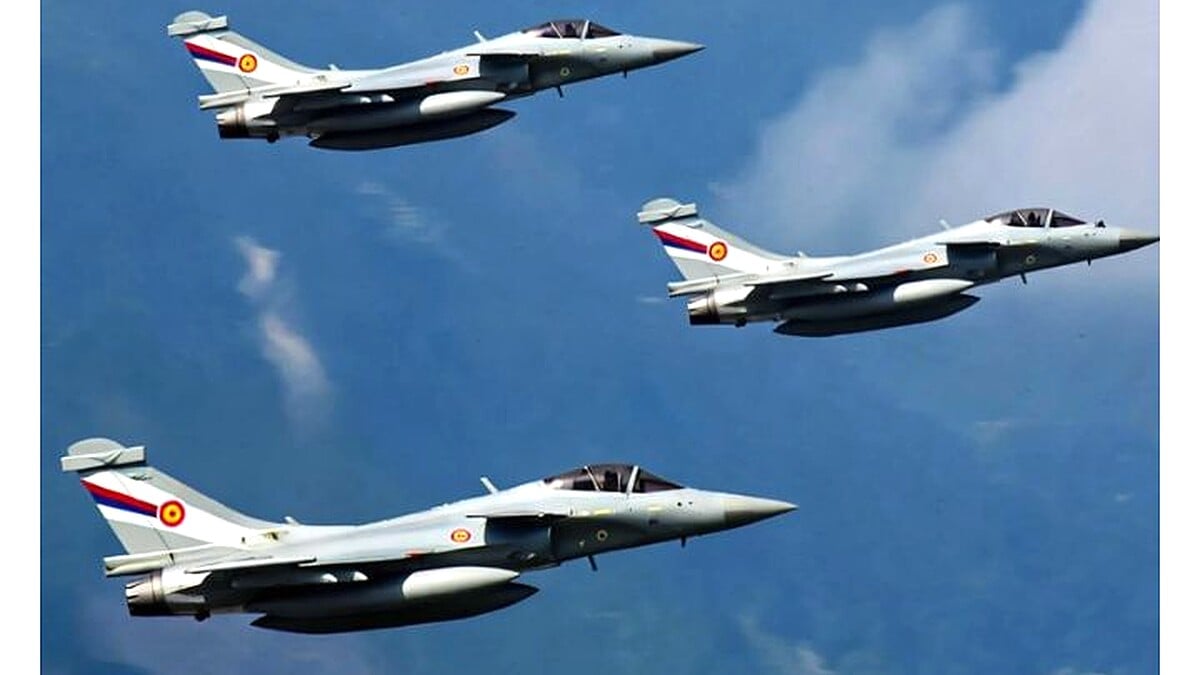




ISLAMABAD: Media reports have surfaced detailing a close approach by an Indian Air Force aircraft to Pakistan’s international border.
The aircraft reportedly flew dangerously near Pakistani airspace before executing a sharp turn.
Regional sources confirm the jet returned abruptly towards Indian territory without crossing the boundary.
Defence analysts believe the manoeuvre was a deliberate probe to test Pakistan’s air defence alertness levels.
Pakistan Air Defence Controllers issued immediate warnings about the severe consequences of airspace violation.
Combat Air Patrol aircraft from the Pakistan Air Force were swiftly diverted to monitor the situation.
These CAP missions positioned for rapid interception if the threat escalated further.
The incident underscores the high state of operational readiness maintained along Pakistan’s western frontier.
Pakistan operates one of South Asia’s most integrated air defence networks equipped with advanced Chinese systems.
The HQ-9BE surface-to-air missiles provide engagement ranges up to 260 kilometres against high-altitude targets.
Complementing them are LY-80 and HQ-16FE batteries offering layered protection up to 160 kilometres.
Sophisticated early-warning radars cover the entire border zone with detection capabilities exceeding 500 kilometres.
The Pakistan Air Force fields over 450 combat aircraft including more than 150 JF-17 Thunder fighters.
Additional squadrons of J-10C and upgraded F-16 variants enhance interception and beyond-visual-range strike potential.
This latest probe occurs amid lingering tensions from the May 2025 India-Pakistan aerial clashes.
During Operation Sindoor more than 114 aircraft from both sides engaged in the largest beyond-visual-range battle since World War II.
Pakistan claimed downing multiple Indian jets including three Rafale fighters and one Su-30MKI.
Independent assessments confirmed at least four Indian aircraft losses in that five-day confrontation.
India conducted large-scale exercises like Vayu Shakti 2026 near the Rajasthan border to demonstrate firepower.
Pakistan meanwhile strengthened its air defences and electronic warfare capabilities following those events.
Historical patterns reveal hundreds of annual ceasefire violations along the Line of Control before the 2003 agreement.
Even minor aerial probes carry risks of miscalculation between two nuclear-armed neighbours.
Experts warn such tests gauge reaction times and expose potential gaps in radar coverage or response protocols.
The swift Pakistani response in this case reaffirms the effectiveness of its integrated command-and-control systems.
Pakistan Air Force personnel number over 70,000 highly trained officers and technicians.
Modernisation programmes continue with indigenous production of JF-17 Block III variants and advanced munitions.
Analysts note the incident highlights fragile peace despite diplomatic efforts to reduce border tensions.
Regional media outlets have authenticated the reports through multiple defence sources.
International coverage remains limited yet similar past events drew global attention to escalation risks.
Pakistan has repeatedly emphasised its commitment to defending sovereign airspace through proportionate responses.
Civil aviation authorities maintain strict protocols amid ongoing military vigilance in the region.
Defence observers recommend sustained hotlines between directorates general of military operations to prevent unintended escalation.
This close approach serves as a stark reminder of persistent strategic competition along the shared border.
Pakistan’s air defence posture continues to evolve in response to emerging aerial threats and hybrid warfare tactics.
The professional handling of the situation by Pakistani controllers prevented any breach or confrontation.
Future stability in South Asia depends on mutual restraint and transparent communication between the two militaries.
Such incidents reinforce the need for confidence-building measures in one of the world’s most volatile regions.