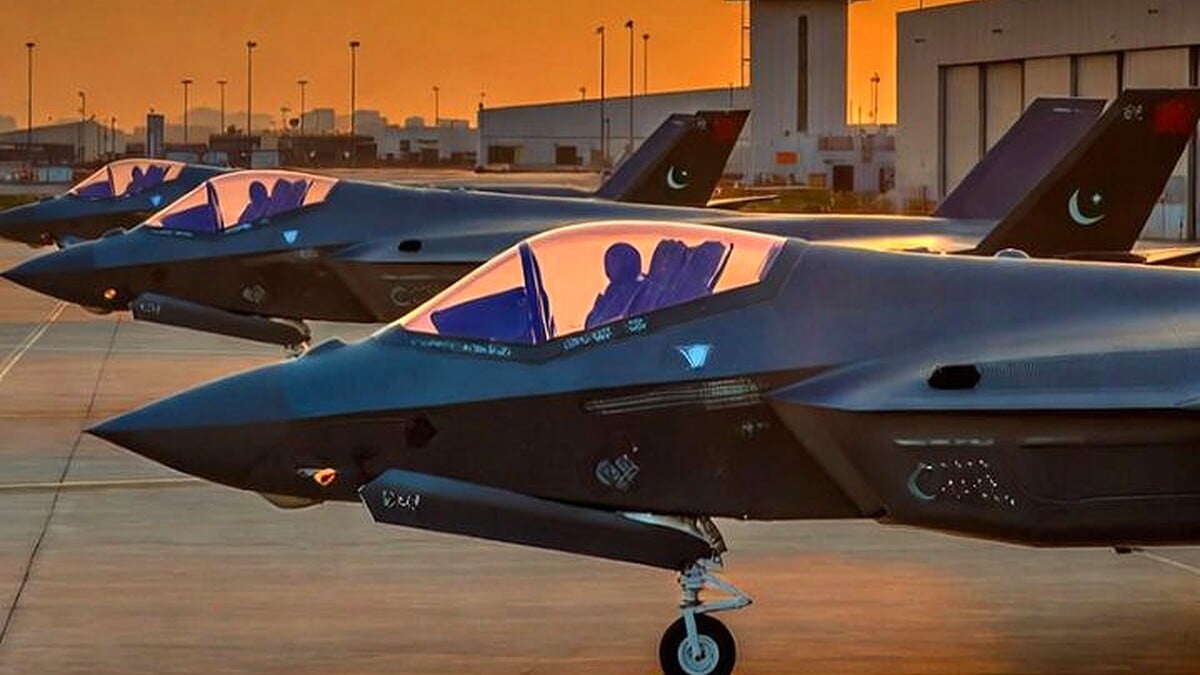




ISLAMABAD: Viral claims sweeping social media platforms that the Pakistan Air Force has taken delivery of its first batch of six J-35 stealth fighter jets have been categorically rejected by defence sources.
No official announcement, aircraft photographs or airfield activity supports the circulating videos and posts that surfaced in late March 2026.
Regional media outlets initially amplified unverified reports of an early induction but later clarified the absence of any confirmation from PAF headquarters or the Ministry of Defence.
Pakistan’s Defence Minister Khawaja Asif had earlier dismissed similar speculation in mid-2025 as “only in the media” during an interview with Arab News.
Senior officials familiar with the programme told local defence correspondents that the earliest possible delivery window remains 2027 at best.
The J-35 programme itself only entered limited series production for the Chinese People’s Liberation Army Air Force and Navy in late 2025.
Pakistan signed a framework agreement in principle for up to 40 J-35A export variants following high-level talks in Beijing in June 2025.
That potential order would make Islamabad the first export customer of the twin-engine fifth-generation platform developed by Shenyang Aircraft Corporation.
Current PAF fleet strength stands at approximately 450 combat aircraft including 76 F-16s across multiple variants and more than 180 JF-17 Thunder multirole fighters co-produced with China.
The service also operates Mirage III and V aircraft nearing the end of their structural lives plus a growing fleet of J-10CE fighters inducted since 2022.
Acquisition of the J-35 would represent Pakistan’s first true stealth capability designed to penetrate advanced air-defence networks.
Analysts note that the aircraft’s reported internal weapons bays could carry up to four PL-15 long-range air-to-air missiles and precision strike munitions.
Such a platform would significantly alter the regional air-power equation where India fields 36 Rafale jets with Meteor missiles and S-400 systems.
Defence Security Asia reported in January 2026 that an initial Pakistani batch of four to twelve J-35E aircraft could arrive between early 2026 and early 2027 under accelerated timelines.
However subsequent statements from Pakistani officials have pushed realistic delivery beyond that optimistic forecast.
Pilot conversion training for selected PAF officers is understood to have begun in China but remains at simulator and ground school stage.
No aircraft have yet been ferried or accepted into Pakistani service according to aviation tracking data and satellite imagery of relevant airbases.
Social media frenzy peaked with edited videos showing generic F-35 footage overlaid with Pakistani markings alongside authentic J-35 images from Chinese airshows.
These posts garnered hundreds of thousands of views within hours yet contained zero verifiable evidence from PAF or Chinese sources.
International outlets including Jane’s and Breaking Defense have tracked the negotiations but reported no actual handover events in 2026.
The programme forms part of broader China-Pakistan defence cooperation valued at billions of dollars encompassing JF-17 Block III production expansion and KJ-500 airborne early warning aircraft.
PAF Chief of Air Staff has publicly emphasised the need for fifth-generation platforms to maintain qualitative parity amid evolving threats.
Yet procurement timelines remain governed by production capacity at Shenyang facilities currently prioritising domestic PLA requirements.
Financial arrangements including possible 50 percent discounts reported in some outlets have not been officially detailed by either government.
Regional observers highlight that premature claims could stem from heightened tensions following the May 2025 India-Pakistan skirmishes.
Such rumours nevertheless underscore the strategic importance attached to stealth technology within Pakistan’s long-term air force modernisation roadmap.
Official silence from both Islamabad and Beijing on the specific six-jet claim reinforces the position that deliveries have not commenced.
Defence analysts project that once inducted the J-35 fleet could eventually equip two dedicated squadrons operating from hardened bases in Punjab and Sindh.
Until then PAF continues to rely on its proven mix of fourth-generation assets while monitoring production milestones in China.
The episode serves as a reminder of the rapid spread of unverified defence information in the digital age.
Credible updates will only emerge through formal statements from the Pakistan Air Force or the Ministry of Defence Production.