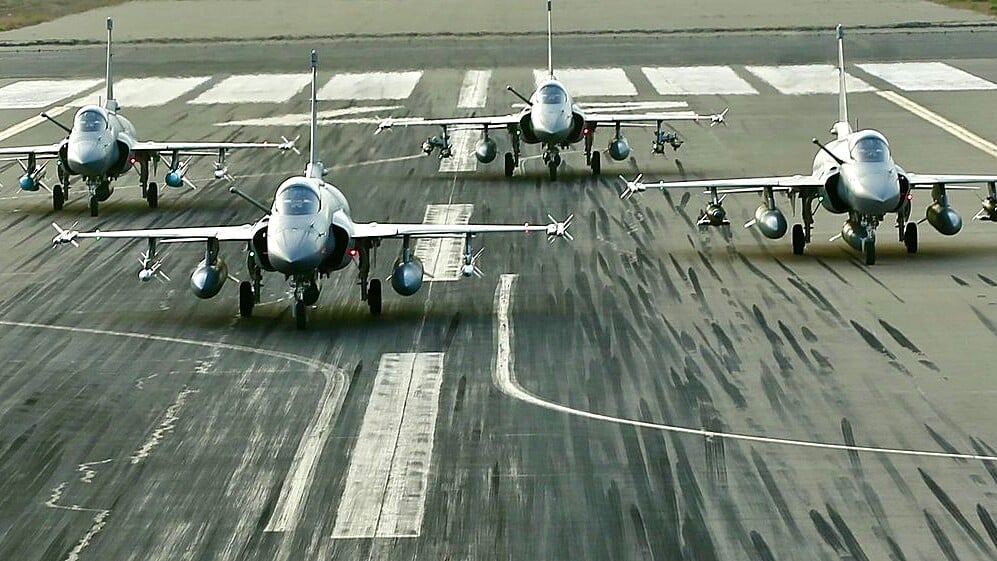
ISLAMABAD: Pakistan’s JF-17 Thunder multirole fighter jet continues to redefine the country’s defence export landscape, drawing international attention with its affordability, combat-proven record, and strategic partnerships that promise substantial economic benefits.
The platform, co-developed by Pakistan Aeronautical Complex and China’s Chengdu Aircraft Corporation, maintains a unit cost estimated at $30 million to $40 million for the advanced Block III variant. This pricing undercuts many Western equivalents, which frequently surpass $90 million, offering air forces in developing nations a viable path to modernisation.
Lower lifecycle costs, including approximately $5,000 per flight hour, further enhance its appeal by allowing sustained operations without excessive budgetary strain. The jet’s modular architecture supports integration of cutting-edge systems such as active electronically scanned array radar and precision munitions, enabling versatile air-to-air and air-to-ground missions.
Recent developments highlight accelerating export momentum. A Deutsche Welle (DW) documentary aired in early March 2026 titled “Pakistan bets on fighter jet exports to boost its economy” examines how the once-overlooked JF-17 now commands billion-dollar interest globally. The report questions whether these sales can meaningfully alleviate Pakistan’s debt burden while spotlighting the aircraft’s role in shifting the nation toward high-value industrial exports.
Myanmar pioneered JF-17 acquisitions with Block II deliveries beginning in 2015, followed by Nigeria’s integration of the type in 2021 for counter-insurgency and air defence duties. Azerbaijan secured the most significant contract to date, with a reported $4.6 billion agreement for up to 40 Block III jets, including comprehensive training and armament packages. Initial deliveries occurred in late 2024, and units participated in Azerbaijan’s 2025 Victory Day celebrations.
The IDEAS 2024 exhibition in Karachi generated widespread interest, yielding 82 memorandums of understanding valued at roughly $30 billion across defence sectors. While conversion rates vary, the event underscored the JF-17’s growing credibility among prospective buyers in Asia, Africa, and the Middle East.
Negotiations persist with additional nations, driven by the jet’s demonstrated reliability in Pakistan Air Force service. Combat experience bolsters its market position, distinguishing it from untested platforms and appealing to operators seeking proven capability at accessible prices.
Production capacity poses the primary hurdle to sustained growth. Current annual output hovers between 16 and 18 aircraft, requiring targeted investments to prevent delivery bottlenecks as orders accumulate.
The DW analysis emphasises this challenge, noting that while export revenues inject foreign exchange and support domestic manufacturing, scaling infrastructure remains essential for long-term viability. The documentary frames the JF-17 as central to Pakistan’s ambition to evolve from traditional sectors toward advanced defence production.
Strategic collaboration with China provides technological depth and supply chain advantages, fostering self-reliance in key subsystems. This partnership enhances the platform’s export potential by aligning with non-Western procurement preferences amid shifting global arms dynamics.
As demand rises for cost-effective, reliable fighters, the JF-17 positions Pakistan as an influential supplier in emerging markets. Success hinges on maintaining quality, timely deliveries, and robust after-sales support to convert interest into enduring partnerships.
The aircraft’s trajectory offers economic promise, generating high-value jobs and industrial spillover effects. For Pakistan, the JF-17 represents more than a military asset—it embodies a strategic lever for diversification and resilience in a competitive global marketplace.